
Manimahesh Kailash Peak
Manimahesh Kailash Peak, also known as Chamba Kailash, is a significant mountain in the Himalayas revered as the abode of Lord Shiva. It is one of the Panch Kailash mountains and holds immense religious importance, particularly for the Gaddi tribe. The peak overlooks the sacred Manimahesh Lake and remains an unconquered "virgin peak" due to its divine status.
Key Facts
- ›It is considered the fifth most important peak among the Panch Kailash mountains.
- ›Manimahesh Kailash is believed to be the abode of Lord Shiva.
- ›The peak has never been successfully summitted by mountaineers and is considered a "virgin peak".
- ›It is a major pilgrimage site and a popular trekking destination in Himachal Pradesh, India.
- ›The Manimahesh Lake is situated at the base of the peak and is also held in deep veneration.
- ›A significant fair is held annually by Manimahesh Lake during the Bhadon month.

Shiva, Parvati
Religious Pilgrimage Site, Abode of Lord Shiva, One of the Panch Kailash Mountains, Popular Trekking Destination
Manimahesh Fair
Snow, Rock
Rock Formation In the Form of A Shivling
Manimahesh Lake, Budhil River, Manimahesh Ganga River
About Manimahesh Kailash Peak
Manimahesh Kailash Peak, also known as Chamba Kailash, is a sacred mountain in the Himalayas of India, revered as the primary abode of the Hindu deity Lord Shiva. It holds significant religious importance as one of the "Panch Kailash" (Five Kailashas), a group of five distinct holy mountains across the Himalayas, with Manimahesh Kailash being the fifth in order of importance.
Religious Significance and Legends
The peak stands majestically over the Manimahesh Lake, which is itself a site of deep veneration, especially for the Gaddi tribe of the region. Local myths and legends strongly associate the mountain with Lord Shiva, believing he resides there and occasionally visits. A notable rock formation on the mountain is considered a divine manifestation of Shiva in the form of a Shivling. The area is also steeped in legends, including one about a Gaddi shepherd and his sheep being turned to stone for attempting to climb the peak, which explains the surrounding smaller peaks.
Pilgrimage and Trekking
Manimahesh Kailash is a major pilgrimage destination. A significant annual fair is held by Manimahesh Lake on the eighth day of the new moon period in the month of Bhadon, drawing thousands of devotees. The region is also a popular trekking destination, with two primary routes leading to the Manimahesh Lake: one from Hadsar village and another from village Holi.
An Unconquered Summit
Remarkably, Manimahesh Kailash Peak has never been successfully summitted by mountaineers, earning it the distinction of a "virgin peak." This is attributed by devotees to the divine power of the mountain, believed to be protected by Lord Shiva. An attempt by an Indo-Japanese team in 1968 was aborted, further reinforcing its sacred and unconquered status. The mountain's geographical location places it in the watershed of the Budhil valley, forming part of the mid-Himalayan range, and it is the source of several streams that contribute to the Budhil River.
Source: Wikipedia ↗
Frequently Asked Questions
What is Manimahesh Kailash Peak?
Manimahesh Kailash Peak, also referred to as Chamba Kailash, is a prominent mountain in the Himalayas. It is highly revered in Hinduism as the dwelling place of Lord Shiva and is one of the five sacred Panch Kailash mountains.
Where is Manimahesh Kailash Peak located?
The peak is situated in the Bharmour subdivision of the Chamba district in the Indian state of Himachal Pradesh. It is located in the mid-Himalayan range, in the watershed of the Budhil valley.
Why is Manimahesh Kailash Peak considered sacred?
It is believed to be the abode of Lord Shiva, who is said to reside there. Legends also suggest that Shiva's disciple Mani lives there, and Shiva himself visits the mountain. A rock formation resembling a Shivling on the mountain is considered a manifestation of Lord Shiva.
Has Manimahesh Kailash Peak ever been climbed?
No, Manimahesh Kailash Peak remains an unconquered 'virgin peak'. An attempt in 1968 by an Indo-Japanese team was aborted, and local legends attribute its invincibility to the divine prowess of Lord Shiva.
What is the significance of Manimahesh Lake?
Manimahesh Lake lies at the base of the Kailash peak and is deeply venerated, particularly by the Gaddi tribe. An annual fair is held here during the Bhadon month, attracting thousands of pilgrims.
What are the trekking routes to Manimahesh Lake?
There are two main trekking routes to the lake: one from Hadsar village, which is frequently used by pilgrims and trekkers, and another from village Holi, which involves a climb and then a descent to the lake.
Related Temples (Hindu)

Taraknath Temple
The Taraknath Temple, located in Tarakeswar, West Bengal, India, is a significant Hindu pilgrimage site dedicated to Lord Shiva, worshiped here as Tarakanatha. Constructed in 1729, it features a distinct Bengal architectural style with an 'atchala' structure and an adjacent 'natmandir'. The temple is renowned for its belief that a dip in the nearby Dudhpukur tank fulfills prayers and is considered one of the 64 Jyotirlingas.

Tanot Mata Temple
The Tanot Mata Temple is a significant Hindu shrine located in the Jaisalmer district of Rajasthan, India, near the Pakistan border. Revered as a form of Goddess Hinglaj Mata, the temple is famously associated with the Indian victories in the Indo-Pakistani Wars of 1965 and 1971, with local folklore attributing the successful outcomes to divine intervention. The Border Security Force of India now manages the temple complex, which also includes a victory tower and a war museum.
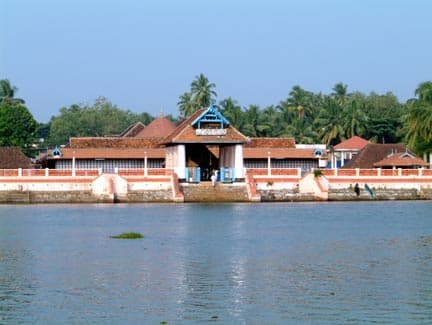
Thriprayar Temple
The Thriprayar Temple, also known as the Shree Ramaswami Temple, is a significant Hindu temple located in Triprayar, Thrissur district, Kerala, India. It is dedicated to Lord Rama, the seventh incarnation of Vishnu, who is depicted with four arms holding a conch, discus, bow, and garland. The temple's origin story involves the idol being worshipped by Krishna in Dwarka, later immersed in the sea, and eventually found by fishermen.