
Mamleshwar Mahadev
The Mamleshwar Mahadev temple is a significant Hindu shrine dedicated to Lord Shiva, located in Karsog town within the Mandi district of Himachal Pradesh. According to local folklore, the temple's origins are tied to Sage Bhrigu and a Kinnar girl named Mamlesha, from whom the deity derives its name. The temple is also associated with the Pandavas from the Mahabharata epic, who are credited with constructing parts of the temple and maintaining an eternal sacred fire.
Key Facts
- ›Dedicated to Lord Shiva, known as Mamleshwar.
- ›Believed to be established by Sage Bhrigu and named after a Kinnar girl, Mamlesha.
- ›Associated with the Pandavas, who are said to have built the outer structure and lit an eternal fire.
- ›Houses a 5000-year-old wheat grain weighing 250 grams, believed to be from the Pandavas' time.
- ›Features 'Bhima's drum,' a large drum attributed to the Pandava Bhima.
- ›Located in the picturesque Karsog valley, surrounded by high hills.

Shiva
Religious Pilgrimage Site, Associated With Sage Bhrigu and the Pandavas, Folklore and Local Legends
Sage Bhrigu, Mamlesha, Pandavas
About Mamleshwar Mahadev
Mamleshwar Mahadev Temple
The Mamleshwar Mahadev temple is a significant Hindu shrine located in Karsog town, within the Mandi district of Himachal Pradesh, India. Nestled in the picturesque Karsog valley and surrounded by high hills, it is approximately 100 kilometers from Shimla and is accessible throughout the year.
History and Folklore
According to local folklore, the temple's origins are deeply intertwined with the sage Maharishi Bhrigu, who is believed to have meditated here. The narrative recounts that a modest Kinnar girl named Mamlesha served him, and Sage Bhrigu eventually married her. To sanctify the union, the sage worshipped Mahakala Shiva, leading to Shiva's installation at this site. The deity subsequently became known as Mamleshwar, deriving its name from Mamlesha, and the village gained fame as Mamel.
The temple is also strongly associated with the Pandavas, the five brothers from the epic Mahabharata. Folk belief suggests that the Pandavas constructed the outer portion of the temple structure. Furthermore, they are credited with establishing an 'akhand dhuna' (eternal fire) within the temple premises, which is said to have been burning for centuries. Legends also speak of the Pandavas slaying a demon who was terrorizing the local villagers, with Bhima reportedly killing the demon in a place called "lyad."
Key Attractions and Beliefs
A notable feature of the Mamleshwar Mahadev temple is the 'Agni Kund' (sacred fire), which is believed to have been lit by the Pandavas approximately 50 centuries ago and continues to burn eternally. Locals associate its lighting with the month of Sravana.
Another intriguing artifact found within the temple complex is a 5000-year-old wheat grain that weighs 250 grams. This is believed to be a remnant from the time of the Pandavas, who are said to have grown it for consumption during their period of incognito exile (agyatvas).
Additionally, the temple houses what is known as 'Bhima's drum.' Local belief attributes its creation to the Pandava Bhima, who supposedly played it in his free time. An alternative legend suggests the drum was fashioned from a massive bekhal tree that once housed a demon slain by the gods.
The Mamleshwar Mahadev temple is considered a sacred place that has witnessed the passage of multiple epochs, from Satya Yuga through Kali Yuga, and remains an active site of worship and a significant pilgrimage destination.
Source: Wikipedia ↗
Frequently Asked Questions
What is the origin story of the Mamleshwar Mahadev temple?
According to folk belief, Sage Bhrigu meditated here and married a Kinnar girl named Mamlesha. To avoid any perceived defect in the marriage, the sage worshipped Mahakala Shiva, who was then established here. Shiva came to be known as Mamleshwar from the girl's name, and the village became Mamel.
What is the significance of the 'Agni Kund' at the temple?
The 'Agni Kund,' or sacred fire pit, is believed to have been lit by the Pandavas around 50 centuries ago and has been burning continuously since. Locals believe the Pandavas lit this fire in the month of Sravana.
What is the 5000-year-old wheat grain found at the temple?
Within the temple premises, there is a remarkably preserved wheat grain that is believed to be 5000 years old and weighs 250 grams. It is thought that the Pandavas cultivated this grain for sustenance during their period of exile (agyatvas).
What is the legend behind 'Bhima's drum'?
Locals claim that a large drum, known as 'Bhima's drum,' was built by the Pandava Bhima for his leisure. Another belief suggests it was made from a giant bekhal tree that once housed a demon, which was slain by the gods.
What is the temple's connection to the Pandavas?
Folk belief attributes the construction of the outer part of the temple to the Pandavas during their exile. They are also credited with lighting the eternal 'Agni Kund' and reportedly slaying a local demon.
Related Temples (Hindu)

Taraknath Temple
The Taraknath Temple, located in Tarakeswar, West Bengal, India, is a significant Hindu pilgrimage site dedicated to Lord Shiva, worshiped here as Tarakanatha. Constructed in 1729, it features a distinct Bengal architectural style with an 'atchala' structure and an adjacent 'natmandir'. The temple is renowned for its belief that a dip in the nearby Dudhpukur tank fulfills prayers and is considered one of the 64 Jyotirlingas.

Tanot Mata Temple
The Tanot Mata Temple is a significant Hindu shrine located in the Jaisalmer district of Rajasthan, India, near the Pakistan border. Revered as a form of Goddess Hinglaj Mata, the temple is famously associated with the Indian victories in the Indo-Pakistani Wars of 1965 and 1971, with local folklore attributing the successful outcomes to divine intervention. The Border Security Force of India now manages the temple complex, which also includes a victory tower and a war museum.
Thriprayar Temple
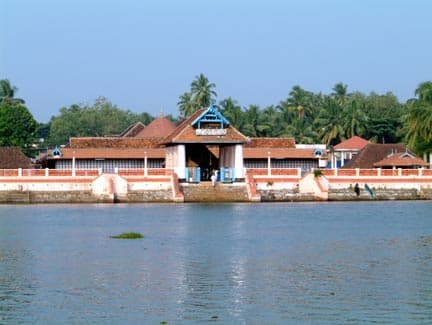
The Thriprayar Temple, also known as the Shree Ramaswami Temple, is a significant Hindu temple located in Triprayar, Thrissur district, Kerala, India. It is dedicated to Lord Rama, the seventh incarnation of Vishnu, who is depicted with four arms holding a conch, discus, bow, and garland. The temple's origin story involves the idol being worshipped by Krishna in Dwarka, later immersed in the sea, and eventually found by fishermen.