
Maluti temples
Cara-cala·17th-19th·India
The Maluti temples are a significant cluster of 72 terracotta temples located in Jharkhand, India, built between the 17th and 19th centuries by the Baj Basanta dynasty. Originally numbering 108, these temples were inspired by the family deity Mowlakshi and dedicated to various Hindu deities including Shiva, Durga, Kali, and Vishnu. Declared one of the world's most endangered cultural heritage sites by the Global Heritage Fund, the site is undergoing conservation efforts to preserve its unique architectural style and cultural significance.
Key Facts
- ›Consists of 72 extant terracotta temples, with an original count of 108.
- ›Built between the 17th and 19th centuries by the kings of the Baj Basanta dynasty.
- ›Temples are dedicated to various deities, including Mowlakshi (family deity), Shiva, Durga, Kali, and Vishnu.
- ›Architectural style is predominantly the Cara-cala design, popular in Bengal, featuring hut-shaped roofs.
- ›Decorated with sculptures depicting episodes from the Mahabharata and Ramayana, and scenes of village life.
- ›Declared one of the world's 12 most endangered cultural heritage sites by the Global Heritage Fund.

Mowlakshi, Shiva, Durga, Kali, Vishnu, Manasa Devi, Bamakhyapa
- Significant Cluster of Terracotta Temples
- Representative of Cara-Cala Architectural Style
- Historical Capital of the Baj Basanta Dynasty
- Considered One of the World's Most Endangered Cultural Heritage Sites
Baj Basanta Dynasty
Terracotta
Basanta, Raja Baj Basanta
Episodes From the Mahabharata, Episodes From the Ramayana, Fight Between Durga and Mahishasura, Scenes of Village Life
Chila River, Dwarka River
About Maluti temples
The Maluti temples represent a significant collection of 72 extant terracotta temples, originally numbering 108, located in the village of Maluti in Jharkhand, India. These temples were constructed between the 17th and 19th centuries by the kings of the Baj Basanta dynasty, who established Maluti as their capital. The construction was largely inspired by the family deity, goddess Mowlakshi, and the temples are dedicated to a variety of Hindu deities, including Shiva, Durga, Kali, and Vishnu.
Historical Context and Patronage
The history of Maluti is tied to a grant of a tax-free kingdom, known as "Nankar Raj," bestowed upon a Brahmin named Basanta by Alauddin Husain Shah of Gaura between 1495 and 1525. Basanta, who was later titled Raja Baj Basanta, chose to build temples rather than palaces. His descendants continued this tradition, with his family clans building the temples in clusters. The name Maluti is believed to be derived from Mallahati, referencing the Malla Kings of Bankura.
Architectural Features and Decorations
The Maluti temples are primarily built in the Cara-cala design, a style popular in Bengal that features a square chamber with a hut-shaped roof created by corbelled cornices. This architectural style differs from the Nagara, Vesara, or Dravida styles. The temples are adorned with intricate sculptures depicting scenes from epic narratives like the Mahabharata and Ramayana, as well as the mythological battle between Durga and Mahishasura. Carvings of rural village life are also found on some structures. Inscriptions in early Bengali script, combining Sanskrit, Prakrit, and Bengali, are present on some temples and offer historical and socio-political details.
Conservation and Significance
Despite their historical and architectural importance, the Maluti temples are in a semi-dilapidated state. Initiated by the NGO "Save Heritage and Environment (SHE)" and supported by the Global Heritage Fund (GHF) and the Indian Trust for Rural and Heritage Development, conservation efforts are underway. The GHF has designated Maluti as one of the world's twelve most endangered cultural heritage sites, making it the sole Indian representative on this list. The site's cultural heritage is at risk, highlighting the urgency of preservation and the integration of local communities in conservation processes.
Source: Wikipedia ↗
Frequently Asked Questions
Where are the Maluti temples located?
The Maluti temples are situated in Maluti village, near Shikaripara in the Dumka district of Jharkhand, India. They are located on the eastern part of the Chota Nagpur Plateau, close to the border of West Bengal.
When were the Maluti temples built?
According to the Indian Trust for Rural Heritage and Development (ITRHD), the Maluti temples were constructed between the 17th and 19th centuries. This period saw the continuous patronage of the Baj Basanta dynasty.
Who built the Maluti temples?
The temples were built by the kings of the Baj Basanta dynasty, who made Maluti their capital. The dynasty was inspired by their family deity, goddess Mowlakshi, to construct these numerous temples.
What deities are worshipped at the Maluti temples?
The temples are dedicated to various Hindu deities. The primary tutelary deity is Mowlakshi, the family deity of the Baj Basanta dynasty. Other deities include Shiva, Durga, Kali, and Vishnu.
What is the architectural style of the Maluti temples?
The Maluti temples are not built in the traditional Nagara, Vesara, or Dravida styles. They predominantly feature the Cara-cala design, which is characteristic of Bengal, with square chambers topped by dome-like structures and corbelled cornices that resemble hut-shaped roofs.
Are the Maluti temples well-preserved?
Out of the original 108 temples, only 72 remain extant. These surviving temples are in a semi-dilapidated condition and are considered endangered cultural heritage sites by the Global Heritage Fund.
Related Temples (Hindu)

Taraknath Temple
The Taraknath Temple, located in Tarakeswar, West Bengal, India, is a significant Hindu pilgrimage site dedicated to Lord Shiva, worshiped here as Tarakanatha. Constructed in 1729, it features a distinct Bengal architectural style with an 'atchala' structure and an adjacent 'natmandir'. The temple is renowned for its belief that a dip in the nearby Dudhpukur tank fulfills prayers and is considered one of the 64 Jyotirlingas.

Tanot Mata Temple
The Tanot Mata Temple is a significant Hindu shrine located in the Jaisalmer district of Rajasthan, India, near the Pakistan border. Revered as a form of Goddess Hinglaj Mata, the temple is famously associated with the Indian victories in the Indo-Pakistani Wars of 1965 and 1971, with local folklore attributing the successful outcomes to divine intervention. The Border Security Force of India now manages the temple complex, which also includes a victory tower and a war museum.
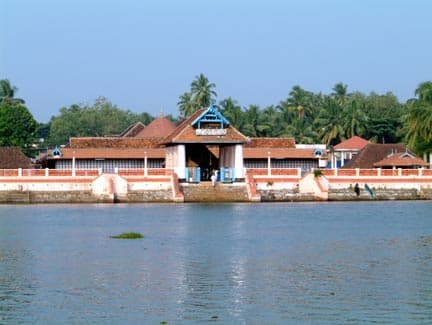
Thriprayar Temple
The Thriprayar Temple, also known as the Shree Ramaswami Temple, is a significant Hindu temple located in Triprayar, Thrissur district, Kerala, India. It is dedicated to Lord Rama, the seventh incarnation of Vishnu, who is depicted with four arms holding a conch, discus, bow, and garland. The temple's origin story involves the idol being worshipped by Krishna in Dwarka, later immersed in the sea, and eventually found by fishermen.