
Mahendragiri, Orissa
Mahendragiri is a significant mountain peak located in the Eastern Ghats of Odisha, India, renowned for its religious associations and biodiversity. It is revered as the eternal abode of Lord Parashurama and holds importance in Hindu epics like the Ramayana and Mahabharata. The mountain is also recognized as a biodiversity hotspot with a rich variety of flora and fauna.
Key Facts
- ›Mahendragiri is the 8th highest peak in Odisha, reaching an elevation of 1,501 meters.
- ›It is considered a 'Kula Parvata' (chief mountain) in ancient Hindu scriptures.
- ›The mountain is associated with Lord Parashurama, who is believed to reside there and perform penance.
- ›Mahendragiri is recognized as a biodiversity hotspot due to its numerous medicinal plants and diverse species.
- ›Archaeological remains are present on and around the hill.
- ›The main festival celebrated at Mahendragiri is Shivaratri.

Parashurama, Shiva
Religious Pilgrimage Site, Biodiversity Hotspot, Mythological Importance
Shivaratri
Pandavas
About Mahendragiri, Orissa
Mahendragiri, Odisha
Mahendragiri is a prominent mountain peak situated in the Eastern Ghats of Odisha, India, within the Gajapati district. Standing at an elevation of 1,501 meters, it is recognized as the second-highest motorable mountain and the eighth-highest peak in Odisha. The mountain is a significant site in Hindu tradition, deeply interwoven with epic narratives and revered for its spiritual and ecological importance.
Religious and Mythological Significance
Mahendragiri holds a revered place in Hindu mythology, particularly in connection with the sage and warrior Parashurama, an avatar of Lord Vishnu. Ancient scriptures, including the Puranas, Ramayana, and Mahabharata, identify Mahendragiri as 'Mahendra Parvata' and describe it as the eternal abode where Parashurama resides and performs penance. It is believed that Parashurama was meditating on this mountain when Lord Rama broke the sacred bow of Shiva. The texts also mention that Lord Balarama visited Mahendragiri to meet Parashurama. Furthermore, the mountain is listed as one of the seven chief mountains, or 'Kula Parvatas,' in Hindu cosmology. Legends also attribute the construction of temples on the mountain to the Pandavas.
Biodiversity and Conservation
Beyond its religious significance, Mahendragiri is recognized as a vital biodiversity hotspot. The hill and its surrounding areas are home to a rich variety of flora and fauna, including over 600 species of flowering plants, many of which possess medicinal properties. The region's faunal diversity is also substantial, particularly noted for being a haven for herpetofauna. In recognition of its ecological importance, proposals have been made to declare Mahendragiri hill as a Biosphere Reserve, with extensive plans for core, buffer, and transitional zones.
Historical and Archaeological Context
Interesting archaeological remains have been discovered on Mahendragiri, hinting at its long history of human inhabitation and religious activity. The mountain's association with epic figures and its inclusion in ancient geographical texts underscore its historical and cultural importance within the region.
Festivals and Worship
The primary festival observed at Mahendragiri is Shivaratri, drawing devotees and pilgrims. The site continues to be an active place of worship and a destination for those seeking spiritual solace and connection with ancient traditions.
Source: Wikipedia ↗
Frequently Asked Questions
What is the religious significance of Mahendragiri?
Mahendragiri is deeply significant in Hinduism as the mountain where Lord Parashurama, an avatar of Vishnu and one of the Chiranjeevis, is believed to eternally reside and perform penance. It is mentioned in ancient texts like the Puranas, Ramayana, and Mahabharata as a sacred site.
What are the mythological connections of Mahendragiri?
According to mythology, Lord Parashurama meditated on Mahendragiri when Lord Rama broke Shiva's bow. Lord Balarama is also said to have visited Mahendragiri to meet Lord Parashurama. The mountain is considered one of the seven chief mountains, or 'Kula Parvatas', in Hindu cosmology.
Why is Mahendragiri considered a biodiversity hotspot?
Mahendragiri and its surroundings are recognized as a biodiversity hotspot due to the presence of over 600 flowering plants, many of which are medicinal. The region also boasts significant faunal diversity, particularly known for its herpetofauna.
Are there any proposed conservation efforts for Mahendragiri?
Yes, the Ministry of Environment and Forests proposed declaring Mahendragiri hill as a Biodiversity Hotspot area in 1986. More recently, in 2014, an expert committee recommended its declaration as a Biosphere Reserve, with a proposed total area of 4715.32 km².
What are the archaeological findings at Mahendragiri?
Interesting archaeological remains have been found on and around Mahendragiri hill. Legends also suggest that temples present on the mountain were built by the Pandavas.
Related Temples (Hindu)

Taraknath Temple
The Taraknath Temple, located in Tarakeswar, West Bengal, India, is a significant Hindu pilgrimage site dedicated to Lord Shiva, worshiped here as Tarakanatha. Constructed in 1729, it features a distinct Bengal architectural style with an 'atchala' structure and an adjacent 'natmandir'. The temple is renowned for its belief that a dip in the nearby Dudhpukur tank fulfills prayers and is considered one of the 64 Jyotirlingas.

Tanot Mata Temple
The Tanot Mata Temple is a significant Hindu shrine located in the Jaisalmer district of Rajasthan, India, near the Pakistan border. Revered as a form of Goddess Hinglaj Mata, the temple is famously associated with the Indian victories in the Indo-Pakistani Wars of 1965 and 1971, with local folklore attributing the successful outcomes to divine intervention. The Border Security Force of India now manages the temple complex, which also includes a victory tower and a war museum.
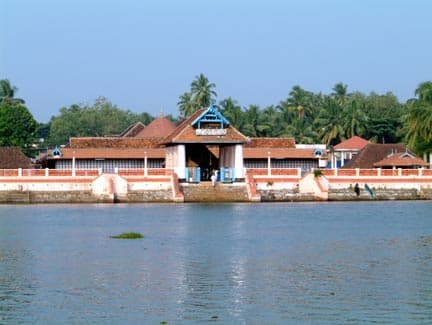
Thriprayar Temple
The Thriprayar Temple, also known as the Shree Ramaswami Temple, is a significant Hindu temple located in Triprayar, Thrissur district, Kerala, India. It is dedicated to Lord Rama, the seventh incarnation of Vishnu, who is depicted with four arms holding a conch, discus, bow, and garland. The temple's origin story involves the idol being worshipped by Krishna in Dwarka, later immersed in the sea, and eventually found by fishermen.