
Maharani sthan
Indian Subcontinent
Maharani Sthan, also known as Bhagawati Sthan, refers to common Hindu temples dedicated to Goddess Bhagawati, a folk deity revered as an incarnation of Parvati or Kali, symbolizing female power in the Mithila region. These temples typically house seven forms of the Goddess, representing her divine sisters, and are considered places of faith and village guardianship.
Key Facts
- ›Maharani Sthan temples are dedicated to Goddess Bhagawati, a folk deity embodying female power.
- ›Goddess Bhagawati is considered an incarnation of Goddess Parvati or Kali.
- ›These temples are common in the Mithila region of the Indian subcontinent.
- ›Typically, seven forms of Goddess Bhagawati are established within a Maharani Sthan.
- ›The seven forms often include Brahmini, Maheshwari, Kaumari, Baisnavi, Barahin, Narasimha, and Chamunda.
- ›The name 'Maharani Sthan' literally translates to 'place for worship of the Goddess Bhagawati'.

Goddess Bhagawati
- Symbol of Women Power In Hinduism
- Presiding Female Deity of Villages In the Mithila Region
- Major Shakti Peeth
- Royal Kuldevi of King Janaka
- Believed Location of Lord Rama's First Meeting With Goddess Sita
About Maharani sthan
Maharani Sthan, also commonly known as Bhagawati Sthan, refers to a class of Hindu temples prevalent in the Mithila region of the Indian subcontinent that are dedicated to Goddess Bhagawati. Goddess Bhagawati is honored as a powerful folk deity, revered as an incarnation of Goddess Parvati or Kali, and is widely considered a symbol of feminine strength within Hinduism. These temples often serve as the presiding female deity's place of worship for the villages in the region, embodying faith and protection.
The name 'Maharani Sthan' is composed of two Indic terms. 'Maharani' is an honorific title for Goddess Bhagawati, translating to 'chief queen,' while 'Sthan' means 'place.' Thus, the combined term signifies a 'place for worship of the Goddess Bhagawati.'
Within the typical Maharani Sthan temple, seven distinct forms of Goddess Bhagawati are established. This practice is rooted in the legend that the Goddess possesses seven sisters, and therefore, seven 'Pinds' or manifestations are present. These seven forms commonly include Brahmini, Maheshwari, Kaumari, Baisnavi, Barahin, Narasimha, and Chamunda. In certain temples, three additional forms may be consecrated: Rajdevi, Phulmati, and Daya.
Several notable Maharani Sthan temples are recognized for their religious and historical significance. The Rajdevi Mandir in Janakpur is an important Bhagwati Sthan, believed to be the royal tutelary deity (kuldevi) of King Janaka. The Girija Devi Mandir near Janakpur is another significant site, reputed to be where Lord Rama first encountered Goddess Sita in Mithila. Uchchaith Bhagawati Mandir is regarded as a major Shakti Peeth in the region, and Maharani Sthan Mandir at Jhizhat is a well-known pilgrimage site. Additionally, Ugratara Sthan in Mahishi village and Purandevi Mandir in Purnia are important centers of worship.
Source: Wikipedia ↗
Frequently Asked Questions
What is Maharani Sthan?
Maharani Sthan, also referred to as Bhagawati Sthan, is a common type of Hindu temple found in the Mithila region dedicated to Goddess Bhagawati. It serves as a place of worship for this folk deity.
Who is Goddess Bhagawati?
Goddess Bhagawati is a prominent folk deity in the Mithila region, believed to be an incarnation of Goddess Parvati or Kali. She is revered as a symbol of women's power in Hinduism and as the presiding female deity of the villages.
What does the name 'Maharani Sthan' mean?
The name 'Maharani Sthan' is derived from Indic terms. 'Maharani' is an honorific word for Goddess Bhagawati, meaning 'chief queen,' and 'Sthan' means 'place,' thus translating to 'place for worship of the Goddess Bhagawati'.
How many forms of Goddess Bhagawati are typically found in these temples?
According to legend, Goddess Bhagawati has seven sisters, and in a Maharani Sthan temple, seven 'Pinds' or forms of the Goddess are established. These often include Brahmini, Maheshwari, Kaumari, Baisnavi, Barahin, Narasimha, and Chamunda.
Are there other forms of Goddess Bhagawati found in some Maharani Sthan temples?
Yes, in some Maharani Sthan temples, three additional forms of Goddess Bhagawati are established. These are Rajdevi, Phulmati, and Daya.
Are there specific famous Maharani Sthan temples?
Yes, several notable Maharani Sthan temples exist, including Rajdevi Mandir in Janakpur, Girija Devi Mandir in Phulhar, Uchchaith Bhagawati Mandir (considered a major Shakti Peeth), Maharani Sthan Mandir at Jhizhat, Ugratara Sthan at Mahishi, Purandevi Mandir in Purnia, and Raj Rajeshwari Mandir at Dokhar.
Related Temples (Hindu)

Taraknath Temple
The Taraknath Temple, located in Tarakeswar, West Bengal, India, is a significant Hindu pilgrimage site dedicated to Lord Shiva, worshiped here as Tarakanatha. Constructed in 1729, it features a distinct Bengal architectural style with an 'atchala' structure and an adjacent 'natmandir'. The temple is renowned for its belief that a dip in the nearby Dudhpukur tank fulfills prayers and is considered one of the 64 Jyotirlingas.

Tanot Mata Temple
The Tanot Mata Temple is a significant Hindu shrine located in the Jaisalmer district of Rajasthan, India, near the Pakistan border. Revered as a form of Goddess Hinglaj Mata, the temple is famously associated with the Indian victories in the Indo-Pakistani Wars of 1965 and 1971, with local folklore attributing the successful outcomes to divine intervention. The Border Security Force of India now manages the temple complex, which also includes a victory tower and a war museum.
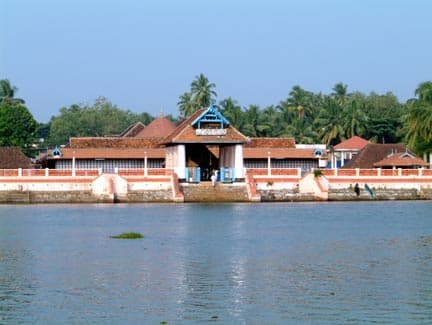
Thriprayar Temple
The Thriprayar Temple, also known as the Shree Ramaswami Temple, is a significant Hindu temple located in Triprayar, Thrissur district, Kerala, India. It is dedicated to Lord Rama, the seventh incarnation of Vishnu, who is depicted with four arms holding a conch, discus, bow, and garland. The temple's origin story involves the idol being worshipped by Krishna in Dwarka, later immersed in the sea, and eventually found by fishermen.