
Mahakaleshwar Jyotirlinga Ujjain
The Mahakaleshwar Jyotirlinga in Ujjain, Madhya Pradesh, is a highly revered Hindu temple dedicated to Lord Shiva, recognized as one of the twelve most sacred Jyotirlingas. Situated on the banks of the holy river Shipra, the temple is unique for its south-facing idol of Shiva and its multi-level structure, including an underground sanctum. It holds significant religious importance as a Shakta Pitha and is deeply intertwined with the history and spiritual life of Ujjain.
Key Facts
- ›It is one of the twelve Jyotirlingas, considered the most sacred abodes of Shiva.
- ›The presiding deity, Shiva, is in the lingam form and is believed to be Swayambhu (self-manifested).
- ›The temple's idol of Mahakaleshwar is Dakshinamurti, meaning it faces south, a unique feature among the Jyotirlingas.
- ›The temple complex has five levels, with one being underground, accessed by brass lamps.
- ›It is revered as one of the 18 Maha Shakta Pithas, where the Upper Lip of Sati Devi is believed to have fallen.
- ›The temple was destroyed by Iltutmish in 1234–35 and later reconstructed during the Maratha rule in the 18th century.

Shiva
One of the Twelve Jyotirlingas, Revered As A Maha Shakta Pitha, Unique Dakshinamurti Idol, Integral To the Spiritual Life of Ujjain
Maratha
Maha Shivaratri, Nag Panchami, Shravan, Bhadrapada
Ramachandra Sukthankar
Shipra River
About Mahakaleshwar Jyotirlinga Ujjain
Mahakaleshwar Jyotirlinga, Ujjain
The Mahakaleshwar Jyotirlinga, located in the ancient city of Ujjain, Madhya Pradesh, is one of the most sacred Hindu temples dedicated to Lord Shiva. It is recognized as one of the twelve Jyotirlingas, sites believed to be the most potent abodes of Shiva, where the deity is worshipped in the lingam form. The temple is situated on the banks of the holy river Shipra, a location that adds to its spiritual significance.
Unique Features and Significance
A distinguishing characteristic of the Mahakaleshwar Jyotirlinga is its presiding idol, which faces south. This orientation, known as Dakshinamurti, is a unique feature among the twelve Jyotirlingas and is attributed to the tantric Shivnetra tradition. The lingam itself is believed to be Swayambhu, meaning it is self-manifested and derives its power from within. The temple complex is multi-level, with one of its five stories located underground, accessible via passages lit by brass lamps. Beyond its status as a Jyotirlinga, the shrine is also revered as one of the 18 Maha Shakta Pithas, believed to mark the spot where a part of Goddess Sati's body fell.
Historical and Mythological Context
Historical accounts and Puranic legends highlight the temple's enduring importance. The city of Ujjain, known in ancient times as Avantika, has long been a center for learning and devotion. Legends recount how Lord Shiva appeared in his Mahakala form to protect King Chandrasena and his devotees from invading forces. Following this divine intervention, Shiva agreed to reside in Ujjain as Mahakala, ensuring the city's protection and offering devotees freedom from the fear of death and diseases. The temple has faced periods of destruction, notably by Iltutmish in the 13th century, but was later reconstructed and revived by Maratha rulers in the 18th century.
Religious Practices and Festivals
The Mahakaleshwar temple is a vibrant center of worship, with rituals and festivals drawing large crowds. The idol of Nagchandreshwar, located on the third storey, is open for darshan only on the day of Nag Panchami. A significant annual event is the grand religious procession known as Mahakal Ki Sawari, held during the Hindu months of Shravan and Bhadrapada, where the deity's idol is carried through the city. On the day of Maha Shivaratri, a large fair is held near the temple, with worship continuing throughout the night, underscoring the temple's pivotal role in the spiritual life of its devotees and the region.
Source: Wikipedia ↗
Frequently Asked Questions
What makes the Mahakaleshwar Jyotirlinga unique among the twelve Jyotirlingas?
The Mahakaleshwar Jyotirlinga is unique because its presiding deity, Shiva, faces south, a feature known as Dakshinamurti. This orientation is upheld by the tantric Shivnetra tradition and is found only at this shrine among the twelve Jyotirlingas.
What is the significance of the Mahakaleshwar temple as a Shakta Pitha?
The shrine is revered as one of the 18 Maha Shakta Pithas, believed to enshrine the presence of Shakti due to the falling body parts of Sati Devi. The Upper Lip of Sati Devi is said to have fallen here, with the Shakti revered as Mahakali.
What is the historical background of the Mahakaleshwar temple?
The temple has a long history, with references in ancient scriptures. It was destroyed by Iltutmish in the 13th century and later attacked by Khalji rulers, but was reconstructed and revived during the Maratha rule in the 18th century.
What are some notable features of the temple's architecture?
The temple has a distinctive multi-level structure, with one level situated underground. The sanctum sanctorum houses the idol of Mahakaleshwar, with other deities like Ganesha, Parvati, Kartikeya, and Nandi installed in surrounding areas. The shikhar (spire) is adorned with sculptural finery.
What legends are associated with the origin of the Mahakaleshwar Jyotirlinga?
According to the Puranas, Lord Shiva appeared in his Mahakala form to protect King Chandrasena and his devotees from enemies. Upon the devotees' pleas, Shiva agreed to reside in Ujjain as Mahakala in a self-manifested lingam, promising protection and freedom from the fear of death and diseases.
When is Maha Shivaratri celebrated at the temple, and what is special about it?
Maha Shivaratri is a significant event at the Mahakaleshwar temple, with a large fair held nearby and worship continuing through the night. This festival is dedicated to Lord Shiva and is a major occasion for devotees to visit and offer prayers.
Related Temples (Hindu)

Taraknath Temple
The Taraknath Temple, located in Tarakeswar, West Bengal, India, is a significant Hindu pilgrimage site dedicated to Lord Shiva, worshiped here as Tarakanatha. Constructed in 1729, it features a distinct Bengal architectural style with an 'atchala' structure and an adjacent 'natmandir'. The temple is renowned for its belief that a dip in the nearby Dudhpukur tank fulfills prayers and is considered one of the 64 Jyotirlingas.

Tanot Mata Temple
The Tanot Mata Temple is a significant Hindu shrine located in the Jaisalmer district of Rajasthan, India, near the Pakistan border. Revered as a form of Goddess Hinglaj Mata, the temple is famously associated with the Indian victories in the Indo-Pakistani Wars of 1965 and 1971, with local folklore attributing the successful outcomes to divine intervention. The Border Security Force of India now manages the temple complex, which also includes a victory tower and a war museum.
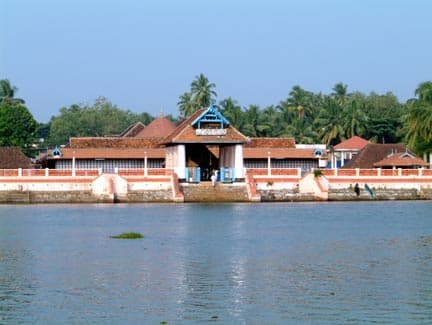
Thriprayar Temple
The Thriprayar Temple, also known as the Shree Ramaswami Temple, is a significant Hindu temple located in Triprayar, Thrissur district, Kerala, India. It is dedicated to Lord Rama, the seventh incarnation of Vishnu, who is depicted with four arms holding a conch, discus, bow, and garland. The temple's origin story involves the idol being worshipped by Krishna in Dwarka, later immersed in the sea, and eventually found by fishermen.