
Lakshmi Narasimha Temple, Mangalagiri
The Lakshmi Narasimha Temple in Mangalagiri, Andhra Pradesh, is a significant Vaishnavite temple dedicated to Lord Vishnu. It is renowned for its exceptionally tall gopuram, one of the highest in South India, and holds a place among the eight sacred sites for Lord Vishnu and eight mahakshetras Narasimha.
Key Facts
- ›It is a Vaishnavite temple dedicated to Lord Vishnu.
- ›The temple features one of the tallest gopurams in South India, standing 153 feet high.
- ›Historically patronized by the Vijayanagara rulers, including Krishnadevaraya.
- ›The eleven-story gali gopuram was constructed by Rajah Vasireddy Venkatadri Nayudu.
- ›It is located at the foot of the Auspicious Hill in Mangalagiri, near Vijayawada.
- ›The temple's history is mentioned in the Brahma Vaivarta Purana.

Vishnu, Narasimha
- Vaishnavite Pilgrimage Site
- One of Eight Sacred Places of Lord Vishnu
- One of Eight Mahakshetras Narasimha
- Architectural Significance Due To Its Tall Gopuram
Vijayanagara Empire
Yudhishthira, Vijayanagara Rulers, Krishnadevaraya, Rajah Vasireddy Venkatadri Nayudu
About Lakshmi Narasimha Temple, Mangalagiri
The Lakshmi Narasimha Temple, situated in Mangalagiri, Andhra Pradesh, is a prominent Vaishnavite temple dedicated to Lord Vishnu. It is recognized as one of the eight sacred places for Lord Vishnu in India and is also counted among the eight mahakshetras dedicated to Narasimha, a fierce avatar of Vishnu.
History and Patronage
The temple's origins are popularly attributed to Yudhishthira, the eldest of the Pandava brothers, with its history purportedly recorded in the ancient Hindu scripture, the Brahma Vaivarta Purana. Historically, the temple received significant patronage from the Vijayanagara rulers. An inscription at the site attests to a visit by the renowned ruler Krishnadevaraya. The temple's striking eleven-story gali gopuram, which stands as one of the tallest in South India, was a later construction commissioned by Rajah Vasireddy Venkatadri Nayudu, the Rajah of Amaravathi and a devoted follower of Narasimha.
Architectural Features
A defining characteristic of the Lakshmi Narasimha Temple is its exceptionally tall gopuram, measuring 153 feet (47 meters) in height and 49 feet (15 meters) in width. This eleven-story structure is unique in its architectural style for this region of India and contributes significantly to the temple's prominence.
Location and Significance
The temple is located at the base of the auspicious hill in Mangalagiri, a site that is part of the broader Vijayawada area within the Guntur district. It forms part of a trinity of Narasimha temples in the vicinity, with the Panakala Narasimha Temple located on the hill and the Gandalaya Narasimha Temple at its summit. Its status as a major pilgrimage destination underscores its religious and cultural importance.
Source: Wikipedia ↗
Frequently Asked Questions
What is the significance of the Lakshmi Narasimha Temple in Mangalagiri?
The Lakshmi Narasimha Temple is considered one of the eight sacred places of Lord Vishnu in India and one of the eight mahakshetras Narasimha. It is a prominent pilgrimage site for devotees of Vishnu.
What is notable about the gopuram of the Lakshmi Narasimha Temple?
The temple boasts one of the highest gopurams in South India, standing at an impressive 153 feet tall with eleven stories. It is also unique in its kind in this region of India.
Who patronized the construction and development of the Lakshmi Narasimha Temple?
The temple received patronage from the Vijayanagara rulers, with an inscription indicating a visit by Krishnadevaraya. The grand eleven-story gali gopuram was specifically built by Rajah Vasireddy Venkatadri Nayudu.
Where is the Lakshmi Narasimha Temple located?
The temple is situated at the foot of the Auspicious Hill in Mangalagiri, which is part of the Vijayawada region in the Guntur district of Andhra Pradesh, India.
What is the historical or scriptural basis for the Lakshmi Narasimha Temple?
Popular belief suggests the temple was discovered by Yudhishthira, the eldest Pandava brother. Its history is said to be documented in the Brahma Vaivarta Purana, an ancient Hindu scripture.
Related Temples (Hindu)

Taraknath Temple
The Taraknath Temple, located in Tarakeswar, West Bengal, India, is a significant Hindu pilgrimage site dedicated to Lord Shiva, worshiped here as Tarakanatha. Constructed in 1729, it features a distinct Bengal architectural style with an 'atchala' structure and an adjacent 'natmandir'. The temple is renowned for its belief that a dip in the nearby Dudhpukur tank fulfills prayers and is considered one of the 64 Jyotirlingas.

Tanot Mata Temple
The Tanot Mata Temple is a significant Hindu shrine located in the Jaisalmer district of Rajasthan, India, near the Pakistan border. Revered as a form of Goddess Hinglaj Mata, the temple is famously associated with the Indian victories in the Indo-Pakistani Wars of 1965 and 1971, with local folklore attributing the successful outcomes to divine intervention. The Border Security Force of India now manages the temple complex, which also includes a victory tower and a war museum.
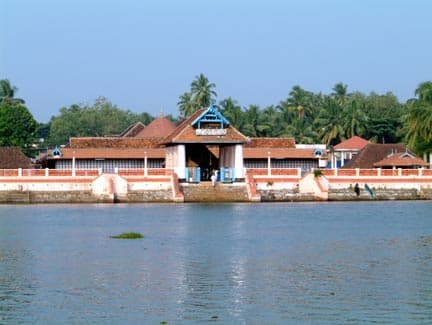
Thriprayar Temple
The Thriprayar Temple, also known as the Shree Ramaswami Temple, is a significant Hindu temple located in Triprayar, Thrissur district, Kerala, India. It is dedicated to Lord Rama, the seventh incarnation of Vishnu, who is depicted with four arms holding a conch, discus, bow, and garland. The temple's origin story involves the idol being worshipped by Krishna in Dwarka, later immersed in the sea, and eventually found by fishermen.