
Krishna Janmasthan Temple Complex
6th century BC·India
The Krishna Janmasthan Temple Complex in Mathura, Uttar Pradesh, India, is a significant Hindu pilgrimage site believed to be the birthplace of Lord Krishna. The complex houses several temples, including the Keshavdev temple and the Bhagavata Bhavan, and is notable for its historical layers, having been destroyed and rebuilt multiple times throughout centuries. It remains an active center of worship and a focal point for major Hindu festivals.
Key Facts
- ›The complex is believed to be the exact birthplace of Lord Krishna.
- ›It has a history of destruction and rebuilding, with the current complex largely constructed in the 20th century.
- ›The site contains the Keshavdev temple, the Garbh Griha shrine (believed to be the prison cell of Krishna's birth), and the Bhagavata Bhavan.
- ›Archaeological findings at the site date back to the 6th century BCE.
- ›Major festivals like Krishna Janmashtami and Diwali are celebrated here.
- ›The complex is situated adjacent to the Shahi Eidgah mosque.

Krishna, Radha Krishna
- Birthplace of Lord Krishna
- Major Hindu Pilgrimage Site
- Historical Religious Significance Dating Back To 6th Century Bce
Gupta Empire, Rashtrakutas, Gahadavala, Mughal Empire, Jat Rebellion
Krishna Janmashtami, Radhashtami, Diwali, Holi
Red Sandstone
Vajranabh, Chandragupta Ii, Jajja, Raja Veer Singh Deva Bundela, Dara Shikoh, Raja Patnimal, Rai Krishna Das, Madan Mohan Malaviya, Jugal Kishore Birla, Ramkrishna Dalmia, Mahadji Scindia
- Frescoes Depicting Life Events of Krishna and His Associates In Bhagavata Bhavan
Potra Kund
About Krishna Janmasthan Temple Complex
The Krishna Janmasthan Temple Complex, located in Mathura, Uttar Pradesh, India, is a paramount Hindu pilgrimage site revered as the birthplace of Lord Krishna. Historical and religious traditions assert that Krishna was born in a prison cell here to Devaki and Vasudeva. Archaeological excavations at the site have unearthed artifacts dating back to the 6th century BCE, indicating a long-standing religious significance.
History and Construction
The history of the temple complex is marked by periods of destruction and reconstruction. According to tradition, a temple was first built at the birthplace by Krishna's great-grandson, Vajranabh. The site, formerly known as Katra Keshavdeva, saw a magnificent temple rebuilt by the Gupta Emperor Chandragupta II around 400 CE. Inscriptions also mention donations from the Rashtrakutas in the late 8th century. During the medieval period, the temple faced destruction and rebuilding, with a Vishnu temple noted in 1150 CE. The Mughal era brought further turmoil; Sultan Sikandar Lodi prohibited Hindu rituals in Mathura in the 16th century. In the 17th century, Raja Veer Singh Deva Bundela built a temple, later described by travelers Tavernier and Manucci, and patronized by Prince Dara Shikoh. However, Mughal emperor Aurangzeb ordered the destruction of the Keshavdeva temple in 1670 and the construction of the Shahi Eidgah mosque in its place.
The modern temple complex began to take shape in the 20th century. After the East India Company auctioned the land in 1804, it was purchased by Raja Patnimal. His descendants retained ownership, and legal battles in the 1930s affirmed their rights. In 1944, Madan Mohan Malaviya acquired the land, and following his death, Jugal Kishore Birla established the Shri Krishna Janmasthan Seva Sansthan. Construction of the new complex commenced in 1953 and was completed in 1982, funded by various industrialists and business families.
Temples and Features
The Krishna Janmasthan Temple Complex comprises several key structures:
- Keshavdeva Temple: Built in memory of Jadiadevi Dalmia, its construction began in 1957 and was inaugurated in 1958. It is situated south of the Shahi Eidgah.
- Garbha Griha Shrine: Believed to be the original sanctum sanctorum, this area is thought to be the site of the prison cell where Krishna was born. It features a marble pavilion and an underground cell, with an adjacent shrine to Goddess Yogmaya.
- Bhagavata Bhavan: Dedicated to Shrimad Bhagavata, its construction started in 1965, with the installation of deities in 1982. This temple houses shrines for Radha Krishna, Balarama, Subhadra, Jagannatha, Rama, Lakshmana, and Sita. Its hall is adorned with frescoes depicting Krishna's life, and the walls of the parikrama are inscribed with the Bhagavad Gita on copper plates.
- Potra Kund: A large, deep stepped water tank located southeast of the Janmasthan temple, it is said to have been used for the ritual bathing of infant Krishna. The steps were originally built by Mahadji Scindia in 1782.
Culture and Significance
The complex is one of the most visited temples in India, attracting devotees for its religious sanctity and historical depth. Major festivals like Krishna Janmashtami, Radhashtami, Diwali, and Holi are celebrated with great fervor, drawing large crowds. The site's proximity to the Shahi Eidgah mosque also makes it a location of historical and cultural contention.
Source: Wikipedia ↗
Frequently Asked Questions
What is the significance of the Krishna Janmasthan Temple Complex?
The Krishna Janmasthan Temple Complex is considered highly significant as it is believed to be the actual birthplace of Lord Krishna, one of the most revered deities in Hinduism. This makes it a crucial pilgrimage destination for devotees.
What are the main temples within the Krishna Janmasthan complex?
The complex features three main temples: the Keshavdev temple, dedicated to Krishna; the Garbh Griha shrine, believed to be the spot of Krishna's birth in a prison cell; and the Bhagavata Bhavan, which houses deities like Radha Krishna, Balarama, Subhadra, and Jagannatha.
What is the historical background of the Krishna Janmasthan Temple Complex?
The site has religious importance dating back to at least the 6th century BCE, with evidence from archaeological findings. The temples have been destroyed and rebuilt numerous times, notably by Mughal emperor Aurangzeb in 1670, before the current complex was erected in the 20th century.
What major festivals are celebrated at the Krishna Janmasthan Temple Complex?
Key festivals celebrated enthusiastically at the complex include Krishna Janmashtami, which marks Krishna's birth, Radhashtami, Diwali, and Holi. These celebrations are integral to the cultural and religious life of Mathura.
What is the relationship between the temple complex and the Shahi Eidgah mosque?
The Shahi Eidgah mosque stands adjacent to the Krishna Janmasthan Temple Complex. Historical accounts indicate the mosque was built by Mughal emperor Aurangzeb on the ruins of a Hindu temple, leading to ongoing historical and legal discussions regarding the site.
Related Temples (Hindu)

Taraknath Temple
The Taraknath Temple, located in Tarakeswar, West Bengal, India, is a significant Hindu pilgrimage site dedicated to Lord Shiva, worshiped here as Tarakanatha. Constructed in 1729, it features a distinct Bengal architectural style with an 'atchala' structure and an adjacent 'natmandir'. The temple is renowned for its belief that a dip in the nearby Dudhpukur tank fulfills prayers and is considered one of the 64 Jyotirlingas.

Tanot Mata Temple
The Tanot Mata Temple is a significant Hindu shrine located in the Jaisalmer district of Rajasthan, India, near the Pakistan border. Revered as a form of Goddess Hinglaj Mata, the temple is famously associated with the Indian victories in the Indo-Pakistani Wars of 1965 and 1971, with local folklore attributing the successful outcomes to divine intervention. The Border Security Force of India now manages the temple complex, which also includes a victory tower and a war museum.
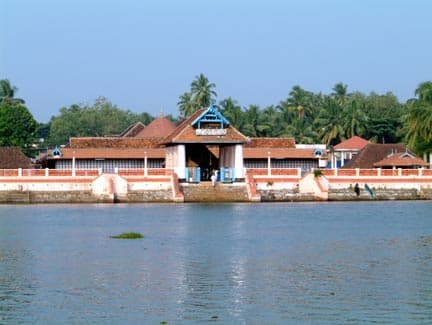
Thriprayar Temple
The Thriprayar Temple, also known as the Shree Ramaswami Temple, is a significant Hindu temple located in Triprayar, Thrissur district, Kerala, India. It is dedicated to Lord Rama, the seventh incarnation of Vishnu, who is depicted with four arms holding a conch, discus, bow, and garland. The temple's origin story involves the idol being worshipped by Krishna in Dwarka, later immersed in the sea, and eventually found by fishermen.