
Kopineshwar Mandir, Thane
Kopineshwar Mandir is a significant Hindu temple in Thane, Maharashtra, dedicated to Lord Shiva, who is considered the patron deity of the city. The temple is renowned for housing one of the largest Shivalingas in Maharashtra and has undergone several renovations throughout its history.
Key Facts
- ›Dedicated to Lord Shiva, the patron god of Thane.
- ›Features one of the largest Shivalingas in Maharashtra, measuring 12 feet in diameter and 4'-3" in height.
- ›Originally built by the Shilahara dynasty.
- ›Underwent major renovations in 1760, 1879, and 1996.
- ›Located in the market area of Thane, with entrances facing Masunda Lake and Jambhli Naka market.
- ›The temple complex includes shrines dedicated to various deities such as Brahma, Rama, Hanuman, and Kali.

Shiva
- Patron Deity of Thane
- Houses One of the Largest Shivalingas In Maharashtra
Shilahara Dynasty
Shilahara Dynasty
Masunda Lake
About Kopineshwar Mandir, Thane
Kopineshwar Mandir, also known as Kaupīnēśvar Mandir, is a prominent Hindu temple located in Thane, Maharashtra, India. It is dedicated to Lord Shiva, who holds the esteemed position of the patron god of Thane. The temple is particularly renowned for housing a Shivalinga that is recognized as one of the largest in the entire state of Maharashtra.
History and Construction
The origins of Kopineshwar Mandir are attributed to the Shilahara dynasty, who were responsible for its initial construction. Over centuries, the temple has undergone significant renovations and rebuilding. Notable reconstruction efforts took place in 1760, followed by the rebuilding of the hall in front of the garbha griha (sanctum sanctorum) in 1879, which was funded by public donations. Further renovations were carried out in 1996, ensuring the temple's preservation and continued sanctity. Historically, the temple was situated on the banks of Masunda Lake, known locally as Talao Pali, though it is now separated by the Shivaji Road leading to the Thane railway station.
Temple Complex and Architecture
Strategically located within the bustling market area of Thane, Kopineshwar Mandir features two main entrances. One entrance faces the picturesque Masunda Lake, while the other is situated within the Jambhli Naka market. Upon entering through the gates, visitors are greeted by the Nandi, the sacred bull that serves as Lord Shiva's vahana (mount). The principal deity, Lord Shiva, is enshrined in the form of a colossal Shivalinga, measuring an impressive 12 feet in diameter and standing 4 feet 3 inches tall. Beyond the main shrine, the temple complex is expansive and includes separate shrines dedicated to a pantheon of deities, such as Brahma, Rama, Hanuman, Shitala Devi (also known as Thatakai), Uttareshwar (Kashi Viswalingeswar), Dattatreya, Garuda, and Kali, reflecting a diverse tradition of worship within the complex.
Source: Wikipedia ↗
Frequently Asked Questions
Who is the primary deity worshipped at Kopineshwar Mandir?
The primary deity worshipped at Kopineshwar Mandir is Lord Shiva. He is also considered the patron god of Thane city.
What is notable about the Shivalinga at Kopineshwar Mandir?
The Shivalinga inside Kopineshwar Mandir is considered one of the largest in Maharashtra. It measures 12 feet in diameter and stands 4 feet 3 inches tall.
What is the history of Kopineshwar Mandir's construction and renovations?
The temple was initially built by the Shilahara dynasty. It has since been renovated and rebuilt multiple times, with significant reconstructions occurring in 1760 and 1879, and further renovations in 1996.
Where is Kopineshwar Mandir located?
Kopineshwar Mandir is situated in the market area of Thane, Maharashtra. It has two entrances, one opposite Masunda Lake and another within the Jambhli Naka market.
Are there other deities worshipped at Kopineshwar Mandir besides Shiva?
Yes, the temple complex houses several other shrines dedicated to various deities. These include Brahma, Rama, Hanuman, Shitala Devi (Thatakai), Uttareshwar (Kashi Viswalingeswar), Dattatreya, Garuda, and Kali.
Related Temples (Hindu)

Taraknath Temple
The Taraknath Temple, located in Tarakeswar, West Bengal, India, is a significant Hindu pilgrimage site dedicated to Lord Shiva, worshiped here as Tarakanatha. Constructed in 1729, it features a distinct Bengal architectural style with an 'atchala' structure and an adjacent 'natmandir'. The temple is renowned for its belief that a dip in the nearby Dudhpukur tank fulfills prayers and is considered one of the 64 Jyotirlingas.

Tanot Mata Temple
The Tanot Mata Temple is a significant Hindu shrine located in the Jaisalmer district of Rajasthan, India, near the Pakistan border. Revered as a form of Goddess Hinglaj Mata, the temple is famously associated with the Indian victories in the Indo-Pakistani Wars of 1965 and 1971, with local folklore attributing the successful outcomes to divine intervention. The Border Security Force of India now manages the temple complex, which also includes a victory tower and a war museum.
Thriprayar Temple
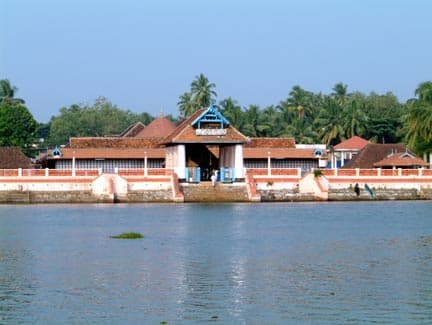
The Thriprayar Temple, also known as the Shree Ramaswami Temple, is a significant Hindu temple located in Triprayar, Thrissur district, Kerala, India. It is dedicated to Lord Rama, the seventh incarnation of Vishnu, who is depicted with four arms holding a conch, discus, bow, and garland. The temple's origin story involves the idol being worshipped by Krishna in Dwarka, later immersed in the sea, and eventually found by fishermen.