
Kodungallur Bhagavathy Temple
The Sree Kurumba Bhagavati Temple, located in Kodungallur, Kerala, is a significant Hindu temple dedicated to Bhadrakali, a fierce form of the goddess Mahakali. Revered as Kodungallur Amma, the deity is believed to represent Parashakti herself and is depicted with eight hands, holding various attributes including the head of the demon king Daruka. This ancient temple is recognized as the head of 64 Bhadrakali shrines in Malabar and is considered one of the oldest functioning temples in India.
Key Facts
- ›Dedicated to Goddess Bhadrakali, a fierce form of Mahakali.
- ›Believed to be the head of 64 Bhadrakali shrines in Malabar.
- ›One of the oldest functioning temples in India.
- ›Associated with legends of Parasurama, Lord Shiva, and the demon Daruka.
- ›Celebrates major festivals like Bharani and Thalappoli.
- ›Historically managed by the Kodungallur Kovilakam and now by the Cochin Devaswom Board.

Bhadrakali, Mahakali, Parashakti
- One of the Oldest Functioning Temples In India
- Head of 64 Bhadrakali Kavus In Malabar
- Associated With Legends of Parasurama and Kannaki
Chera Dynasty, Kulasekhara Dynasty
Bharani Festival, Thalappoli Festival
Parasurama, Senguttuvan, Adi Sankaracarya
About Kodungallur Bhagavathy Temple
Sree Kurumba Bhagavati Temple
The Sree Kurumba Bhagavati Temple, also known as Sree Kurumba Bhagavathy Temple, is a prominent Hindu temple situated in Kodungallur, Thrissur District, Kerala, India. It holds deep religious significance as a shrine dedicated to Goddess Bhadrakali, a formidable manifestation of Mahakali, who is widely revered in Kerala as "Sri Kurumba" and Kodungallur Amma.
Historical and Mythological Context
The temple is recognized as the principal shrine among 64 Bhadrakali temples in the Malabar region and is esteemed as one of the oldest continuously functioning temples in India. According to legend, sage Parasurama established the temple and installed the goddess to aid Lord Shiva in defeating the demon Darikan. Another significant tradition attributes the temple's origin to the Sangam period, with Chera king Senguttuvan reportedly building a shrine for Kannaki, who is believed to have sought salvation and divine union with the enshrined goddess.
Religious Practices and Festivals
The deity is worshipped in her fierce ('ugra') form, facing North, and is depicted with eight arms bearing various symbolic objects, including the severed head of the demon king Daruka. The temple's consecration is historically linked to Shakta worship, which involved rituals such as the offering of toddy and the sacrifice of chickens, though animal sacrifice has been banned since 1978. Two major festivals draw devotees and pilgrims: the Bharani festival, characterized by rituals like Kozhikkallu Modal and Kavu Theendal, and the Thalappoli festival, celebrated in the month of Makaram with processions and special observances.
Administration and Legacy
Historically managed by the royal Kodungallur Kovilakam family, the temple's administration was transferred to the Cochin Devaswom Board in 1950. The temple's enduring prominence underscores its vital role in the spiritual and cultural landscape of Kerala, attracting devotees from across the region and beyond.
Source: Wikipedia ↗
Frequently Asked Questions
Who is the primary deity worshipped at Kodungallur Bhagavathy Temple?
The primary deity worshipped at the Kodungallur Bhagavathy Temple is Goddess Bhadrakali, a powerful and fierce form of Mahakali. She is also known by the names "Sri Kurumba" and Kodungallur Amma, signifying her role as the Mother of Kodungallur.
What is the historical significance of the Kodungallur Bhagavathy Temple?
The temple is considered one of the oldest functioning Hindu temples in India. Legends trace its origin to sage Parasurama, who is said to have established it to help Lord Shiva defeat the demon Darikan. Another legend links its establishment to the Sangam period deity Kannaki, with Chera king Senguttuvan believed to have built a shrine for her.
What are the main festivals celebrated at the temple?
The temple celebrates two major festivals: the Bharani festival and the Thalappoli festival. The Bharani festival involves rituals like Kozhikkallu Modal and Kavu Theendal, where oracles run around the temple and attendants throw objects. The Thalappoli festival, celebrated in Makaram, includes religious rituals, elephant processions, and special offerings by various communities.
What is the architectural style or unique features of the temple?
The goddess is depicted in her fierce ('ugra') form, facing North, with eight hands holding various attributes, including the head of the demon king Daruka. The temple's installation is also noted for the presence of Lord Shiva facing south, Parashakti facing north, and Bhadrakali facing west.
What is the current administrative body of the temple?
The temple was historically managed by the Kodungallur Kovilakam, the royal family. Since 1950, the administration of the Kodungallur Bhagavathy Temple has been taken over by the Cochin Devaswom Board.
Related Temples (Hindu)

Taraknath Temple
The Taraknath Temple, located in Tarakeswar, West Bengal, India, is a significant Hindu pilgrimage site dedicated to Lord Shiva, worshiped here as Tarakanatha. Constructed in 1729, it features a distinct Bengal architectural style with an 'atchala' structure and an adjacent 'natmandir'. The temple is renowned for its belief that a dip in the nearby Dudhpukur tank fulfills prayers and is considered one of the 64 Jyotirlingas.

Tanot Mata Temple
The Tanot Mata Temple is a significant Hindu shrine located in the Jaisalmer district of Rajasthan, India, near the Pakistan border. Revered as a form of Goddess Hinglaj Mata, the temple is famously associated with the Indian victories in the Indo-Pakistani Wars of 1965 and 1971, with local folklore attributing the successful outcomes to divine intervention. The Border Security Force of India now manages the temple complex, which also includes a victory tower and a war museum.
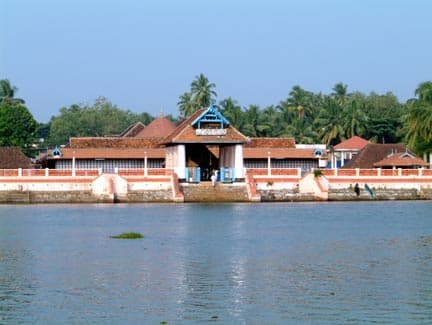
Thriprayar Temple
The Thriprayar Temple, also known as the Shree Ramaswami Temple, is a significant Hindu temple located in Triprayar, Thrissur district, Kerala, India. It is dedicated to Lord Rama, the seventh incarnation of Vishnu, who is depicted with four arms holding a conch, discus, bow, and garland. The temple's origin story involves the idol being worshipped by Krishna in Dwarka, later immersed in the sea, and eventually found by fishermen.