
Ketakeshwar Dewal
Ketakeshwar Dewal is a significant Hindu shrine located in the Ketakibari area of Tezpur, Assam, India. It is renowned for housing one of the largest Shivalingas in the world, a sacred icon of Lord Shiva. The shrine complex includes two distinct areas, one for the Shivalinga and another for its original base, with local legend attributing their separation to a past earthquake.
Key Facts
- ›Houses one of the largest Shivalingas globally.
- ›Consists of two main parts: the Shivalinga and its original base.
- ›Legend attributes the displacement of the Shivalinga to a historical earthquake.
- ›Located in the Ketakibari area of Tezpur, Assam, India.
- ›Managed and developed by a local committee.
- ›Recently received a protective shelter for the holy area and devotees.

Shiva
- Religious Pilgrimage
- Housing One of the World's Largest Shivalingas
About Ketakeshwar Dewal
Ketakeshwar Dewal is a revered Hindu shrine situated in the Ketakibari area of Tezpur, Assam, India. It holds significant religious importance, primarily due to its possession of what is reputed to be one of the largest Shivalingas in the world, an icon representing Lord Shiva.
Site Description and Legend
The shrine complex is distinctively divided into two main sections. One part houses the imposing Shivalinga, while a few meters away lies its original base. According to local legend, a powerful earthquake in the past caused the Shivalinga to become dislodged from its foundation and relocate to its current position. This geological event, intertwined with religious belief, adds a layer of mystique to the site.
Site Management and Development
Ketakeshwar Dewal is open to visitors and is managed by a dedicated local committee responsible for the development of the surrounding area. Initially, the shrine was nestled amidst bamboo groves, accessible via a small foot pathway. In recent times, significant improvements have been made, including the construction of a full shelter.
This protective structure serves a dual purpose: safeguarding the holy area from adverse weather conditions and providing a comfortable assembly point for devotees to offer their prayers and engage in worship.
Source: Wikipedia ↗
Frequently Asked Questions
Where is Ketakeshwar Dewal located?
Ketakeshwar Dewal is situated in the Ketakibari area of Tezpur, within the state of Assam, India. It is considered a holy site in the region.
What is special about the Shivalinga at Ketakeshwar Dewal?
The Shivalinga at Ketakeshwar Dewal is reputed to be one of the largest in the world. Its presence makes the shrine a significant religious landmark.
Why are there two separate parts to the shrine?
The shrine site is divided into two sections: one where the Shivalinga is currently located and another a few meters away where its original base rests. Local legend states that a severe earthquake caused the Shivalinga to be uprooted and moved to its present position.
Who is responsible for the upkeep of Ketakeshwar Dewal?
A local committee is actively involved in overseeing the development and maintenance of the area around Ketakeshwar Dewal. They ensure the site is preserved and accessible to visitors and devotees.
What recent developments have been made at the shrine?
Recently, a full shelter has been constructed at the site. This structure serves to protect the sacred area from natural elements and provides a space for devotees to gather and offer their prayers.
Related Temples (Hindu)

Taraknath Temple
The Taraknath Temple, located in Tarakeswar, West Bengal, India, is a significant Hindu pilgrimage site dedicated to Lord Shiva, worshiped here as Tarakanatha. Constructed in 1729, it features a distinct Bengal architectural style with an 'atchala' structure and an adjacent 'natmandir'. The temple is renowned for its belief that a dip in the nearby Dudhpukur tank fulfills prayers and is considered one of the 64 Jyotirlingas.

Tanot Mata Temple
The Tanot Mata Temple is a significant Hindu shrine located in the Jaisalmer district of Rajasthan, India, near the Pakistan border. Revered as a form of Goddess Hinglaj Mata, the temple is famously associated with the Indian victories in the Indo-Pakistani Wars of 1965 and 1971, with local folklore attributing the successful outcomes to divine intervention. The Border Security Force of India now manages the temple complex, which also includes a victory tower and a war museum.
Thriprayar Temple
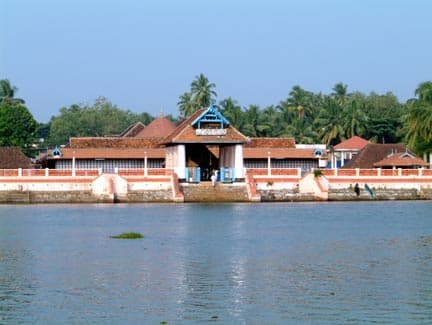
The Thriprayar Temple, also known as the Shree Ramaswami Temple, is a significant Hindu temple located in Triprayar, Thrissur district, Kerala, India. It is dedicated to Lord Rama, the seventh incarnation of Vishnu, who is depicted with four arms holding a conch, discus, bow, and garland. The temple's origin story involves the idol being worshipped by Krishna in Dwarka, later immersed in the sea, and eventually found by fishermen.