
Kandariya Mahadeva Temple
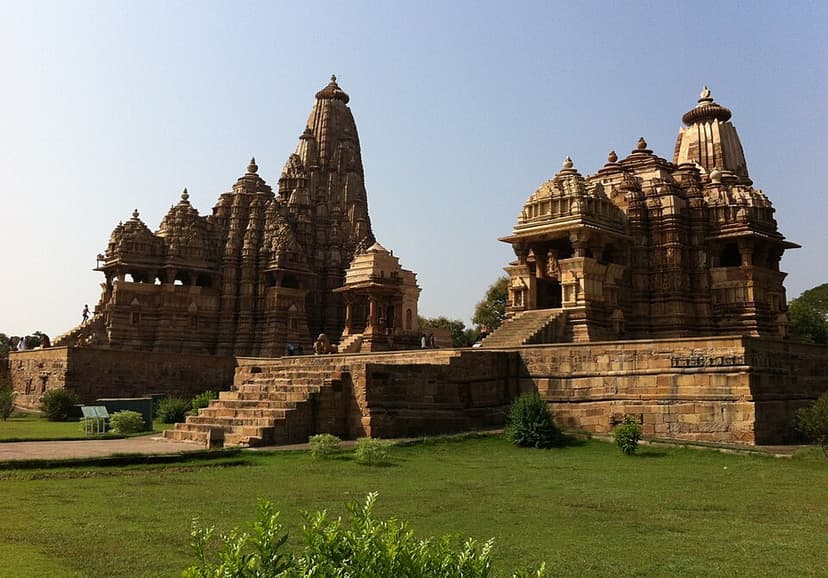
The Kandariya Mahadeva Temple, meaning "the Great God of the Cave," is the largest and most ornate Hindu temple in the medieval Khajuraho group in Madhya Pradesh, India. Dedicated to Shiva, it is renowned for its intricate architecture and sculptures, earning it a UNESCO World Heritage designation for its preservation and testimony to Chandela culture.
Key Facts
- ›The temple is the largest and most ornate in the medieval Khajuraho group.
- ›It is dedicated to Shiva, the chief deity, enshrined in the sanctum sanctorum.
- ›Construction of the temple is dated between 1025 and 1050 CE, during the reign of Vidyadhara.
- ›The temple's architecture features a superstructure shaped like a steep mountain, symbolizing Mount Meru.
- ›Its exterior surfaces are covered with sculptures, including depictions of gods, goddesses, musicians, apsaras, and erotic figures.
- ›The temple's design includes three successively rising mandapas or halls and a central sanctum sanctorum, creating a cave-like atmosphere internally.

Shiva
Unesco World Heritage Site, Best Example of Medieval Temples In India, Testimony To Chandela Culture
Chandela Dynasty
Stone
Vidyadhara
Erotic Sculptures, Saptamatrikas, Ganesha, Virabhadra, Sardula
About Kandariya Mahadeva Temple
The Kandariya Mahadeva Temple, whose name translates to "the Great God of the Cave," stands as the largest and most elaborate Hindu temple within the medieval temple group at Khajuraho, located in the Chhatarpur district of Madhya Pradesh, India. It is widely recognized as one of the finest preserved temples from India's medieval period and was inscribed on the UNESCO World Heritage List in 1986 due to its exceptional preservation and its significance as a testament to the Chandela culture.
History and Construction
Khajuraho served as the capital of the Chandela dynasty, and the Kandariya Mahadeva Temple is a prominent creation of this era. The temple was constructed during the reign of Vidyadhara (circa 1003-1035 CE), a powerful ruler who notably engaged in conflicts with the Muslim historian Ibn-al-Athir's accounts of Mahmud of Ghazni. Vidyadhara, celebrating his successes against various rulers, commissioned the temple dedicated to Shiva, his family deity. Epigraphic evidence suggests the temple was built between 1025 and 1050 CE, with the name Virimda, interpreted as a pseudonym for Vidyadhara, appearing on an inscription.
Architectural Features
The Kandariya Mahadeva Temple rises to a height of 31 meters (102 ft) and is situated in the western group of Khajuraho temples, often compared to a cosmic design. Its architecture is characterized by an assemblage of porches and towers culminating in a prominent shikhara, or spire, a common feature in Central Indian temples from the 10th century onwards. The temple is founded on a substantial plinth and its superstructure is designed to resemble a steep mountain, symbolizing Mount Meru. The richly decorated roofs ascend dramatically, culminating in the main spire which is encircled by 84 miniature spires. The temple's layout is a five-part design, a commonality shared with other temples in the Khajuraho complex.
Interior and Exterior Artistry
Internally, the temple comprises three mandapas or halls that progressively increase in height and width, leading to a small chamber dedicated to Shiva and a central sanctum housing the Shiva linga. Interlinked passages surround the sanctum, featuring side and front balconies that, due to limited natural light, create a distinctly cave-like atmosphere. The exterior surfaces of the temple are entirely covered with intricate sculptures, arranged in horizontal ribbons that catch the sunlight. These carvings depict gods and goddesses, musicians, apsaras (nymphs), and notably, a variety of erotic sculptures, which are a significant attraction. The temple also features sculptures of the Saptamatrikas (seven mother goddesses) and unique figures like the Sardula, a mythical creature. The ornamentation is characterized by fine chiseling, sharp inscribed lines, and dynamic dark-light patterns, demonstrating the high relief carvings and the tactile quality of the stone.
Source: Wikipedia ↗
Frequently Asked Questions
What is the meaning of the Kandariya Mahadeva Temple's name?
The name Kandariya Mahadeva Temple translates to "the Great God of the Cave." This name likely refers to the cave-like atmosphere created by the dimly lit interior passages and sanctum sanctorum, contrasting with the brightly decorated exterior.
Who built the Kandariya Mahadeva Temple and when?
The Kandariya Mahadeva Temple was built during the reign of Chandela ruler Vidyadhara, who ruled from approximately 1003 to 1035 CE. Epigraphic inscriptions suggest its construction took place between 1025 and 1050 CE, with the builder potentially being Vidyadhara himself, known by the pseudonym Virimda.
What is the architectural style of the Kandariya Mahadeva Temple?
The temple's architecture is characteristic of medieval central Indian temple building, featuring a superstructure that rises in a steep mountain shape, symbolizing Mount Meru. It is an assemblage of porches and towers culminating in a shikhara or spire, adorned with 84 miniature spires. The layout follows a five-part design common in the Khajuraho complex.
What are the notable features of the Kandariya Mahadeva Temple's exterior?
The exterior surfaces of the temple are extensively covered with sculptures arranged in three vertical layers. These include horizontal ribbons carved with images that gleam in sunlight, creating rhythmic architectural features. Prominent among these are depictions of gods, heavenly beings, and notable erotic sculptures in various postures.
What is the significance of the Kandariya Mahadeva Temple?
The temple is significant as one of the best-preserved examples of medieval Indian temples and a prime example of Chandela culture. Its outstanding preservation and artistic creation led to its inscription on the UNESCO World Heritage List in 1986.
Are there any unique sculptures found in the Kandariya Mahadeva Temple?
Yes, the temple features unique sculptures within its niches, including erotic depictions in mithuna postures, a male figure in a yogic coitus pose, and the Saptamatrikas (seven mother goddesses) accompanied by Ganesha and Virabhadra. A particularly unique figure is the Sardula, a mythical creature with a lion's face and human limbs.
Related Temples (Hindu)
Khajuraho Group of Monuments
The Khajuraho Group of Monuments is a collection of Hindu and Jain temples located in Madhya Pradesh, India, renowned for their Nagara-style architecture and intricate sculptures, including notable erotic carvings. Primarily constructed by the Chandela dynasty between the 9th and 11th centuries, these temples showcase a blend of religious acceptance and artistic expression, reflecting aspects of medieval Indian life and Hindu philosophy.

Kalika Mata Temple, Pavagadh
The Kalika Mata Temple, also known as Mahakali Mata Temple, is a significant Hindu pilgrimage center located atop Pavagadh Hill in Gujarat, India. It is renowned as one of the 51 Great Shakti Peethas and is dedicated to the worship of the goddess Mahakali, who is revered in her forms of Durga and Chandi. The temple complex, part of the Champaner-Pavagadh Archaeological Park, boasts ancient origins dating back to the 10th-11th centuries.

Brihadeeswarar Temple
The Brihadeeswarar Temple, also known as Rajarajesvaram and Peruvudaiyar Kovil, is a magnificent Shaivite Hindu temple located in Thanjavur, Tamil Nadu, India. Built by the Chola emperor Rajaraja I between 1003 and 1010 CE, it is a prime example of Tamil architecture and a UNESCO World Heritage Site.