
Kalika Mata Temple, Pavagadh
The Kalika Mata Temple, also known as Mahakali Mata Temple, is a significant Hindu pilgrimage center located atop Pavagadh Hill in Gujarat, India. It is renowned as one of the 51 Great Shakti Peethas and is dedicated to the worship of the goddess Mahakali, who is revered in her forms of Durga and Chandi. The temple complex, part of the Champaner-Pavagadh Archaeological Park, boasts ancient origins dating back to the 10th-11th centuries.
Key Facts
- ›The temple is dedicated to Mahakali Mata, worshipped in the forms of Durga or Chandi.
- ›It is considered one of the 51 Great Shakti Peethas, a site where the toe of Goddess Sati is believed to have fallen.
- ›The temple complex dates back to the 10th-11th centuries, making it one of the oldest in the region.
- ›It is situated within the Champaner-Pavagadh Archaeological Park, a UNESCO World Heritage Site.
- ›A significant fair is held annually during Chitra sud 8, attracting thousands of devotees.
- ›The temple has a historical connection with Jainism, with the idol of Mahakali originally consecrated by Jain monks.

Mahakali Mata, Durga, Chandi, Kali, Bahucharamata
One of the 51 Great Shakti Peethas, Major Pilgrimage Center, Part of Unesco World Heritage Site
Navratri, Chitra Sud 8 Fair
Achalgacch of Svetambara Sect of Jains, Acharya Aryarakshitsuri, Acharya Gunsagarsuri, Sheth Vardhaman, Sheth Padamshin
Mahakali Mata Image, Bhadrakali Image, Bahuchara Mata Image, Kali Yantra
About Kalika Mata Temple, Pavagadh
The Kalika Mata Temple, also known as Mahakali Mata Temple, is a prominent Hindu temple complex and pilgrimage center situated at the summit of Pavagadh Hill in the Panchmahal District of Gujarat, India. This sacred site is an integral part of the Champaner-Pavagadh Archaeological Park, recognized as a UNESCO World Heritage Site. The temple is dedicated to the worship of the goddess Mahakali, who is venerated in her powerful forms as Durga and Chandi. Within the sanctum, the Kali Yantra is worshipped, an artifact believed to date back to the 10th or 11th century, underscoring the temple's ancient origins.
Historical and Religious Significance
The temple is revered as one of the 51 Great Shakti Peethas, a site of immense spiritual importance in Hinduism, believed to be where the toe of Goddess Sati fell. The central image in the temple is of Mahakali Mata, with Kali to her right and Bahucharamata to her left. Historically, the idol of Mahakali Mata was originally consecrated by the Achalgacch of the Svetambara sect of Jains, which was established on the hill in the 12th century. Pavagadh itself was an ancient Jain pilgrimage center, with its Jain history tracing back to the 3rd century BC. The temple complex, dating from the 10th-11th centuries, stands as the oldest temple in the area, with local traditions attributing its origin to the self-installation of Maa Mahakali at the spot where the toe of Devi Sati fell.
Architecture and Access
The temple itself is described as small and plain, located amidst fortifications with an open yard. It has historically featured a domed spire with a Muslim shrine and mausoleum to Sadan Shah Pir, though following redevelopment in 2022, the dargah was relocated. The chief shrine on the ground floor houses the three divine images. Access to the temple can be gained by a 5-kilometer pathway through a dense forest, passing the ruins of Patai Raval's palace. For greater convenience, a ropeway service has been operational since 1986.
Festivals and Devotion
The Kalika Mata Temple is a significant tourist and pilgrimage destination in Gujarat, drawing large crowds annually. A strong tradition among the Chodhri community is to undertake a pilgrimage to the temple at least once in their lifetime. Devotees traditionally worship by beating bell-metal symbols. The temple experiences peak activity during Navratri, celebrated in September and October, when thousands of devotees gather for devotion and celebration.
Source: Wikipedia ↗
Frequently Asked Questions
What is the significance of the Kalika Mata Temple?
The Kalika Mata Temple is highly significant as it is considered one of the 51 Great Shakti Peethas, a sacred pilgrimage site in Hinduism. It is believed to be the spot where the toe of Goddess Sati fell, making it a powerful seat of divine feminine energy. The temple is dedicated to Mahakali Mata, a fierce form of Durga, attracting devotees seeking blessings and spiritual fulfillment.
When was the Kalika Mata Temple built?
Historical accounts suggest that the Kalika Mata Temple dates back to the 10th-11th centuries. This makes it one of the oldest temples in the Pavagadh region. The Kali Yantra worshipped within the temple also originates from this period.
Who is worshipped at the Kalika Mata Temple?
The primary deity worshipped at the Kalika Mata Temple is Mahakali Mata, revered in her forms of Durga and Chandi. The central image is of Mahakali Mata, flanked by Kali on her right and Bahucharamata on her left. The temple also houses the Kali Yantra for worship.
What is the connection between the Kalika Mata Temple and Jainism?
Historically, the idol of Mahakali Mata originally belonged to the Achalgacch of the Svetambara sect of Jains, established on Pavagadh Hill in the 12th century. Jain monks consecrated the idol, and it was later venerated by Hindus. Pavagadh itself was an ancient Jain pilgrimage center with historical Jain shrines.
What festivals are celebrated at the Kalika Mata Temple?
The temple is a major pilgrimage center, attracting large numbers of devotees annually. A significant fair is held at the temple every year on Chitra sud 8. During Navratri, which falls in September and October, large numbers of devotees gather for celebrations dedicated to the goddess.
How can one reach the Kalika Mata Temple?
The Kalika Mata Temple is located at the summit of Pavagadh Hill. Devotees can reach the temple by a pathway through the forest, which is approximately 5 kilometers long and passes by the ruins of Patai Raval's palace. Alternatively, a ropeway service, commissioned in 1986, provides convenient access to the temple.
Related Temples (Hindu)
Khajuraho Group of Monuments
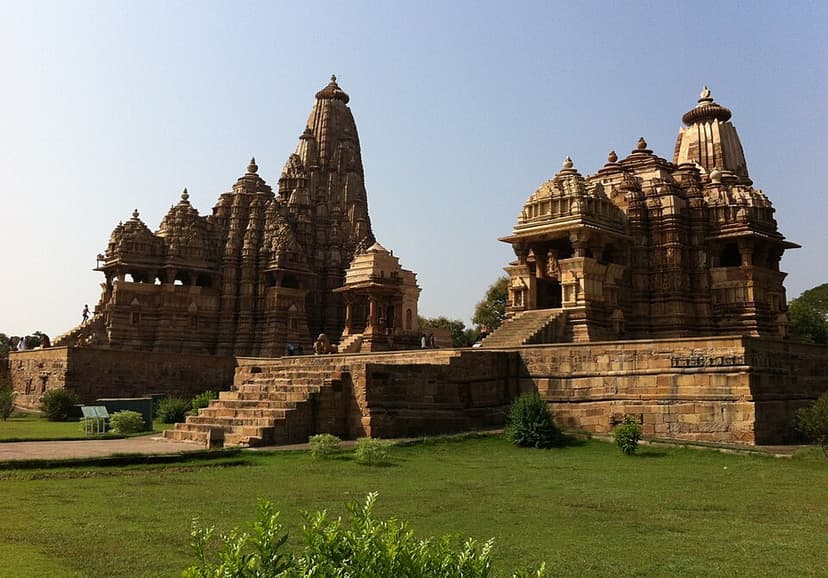
The Khajuraho Group of Monuments is a collection of Hindu and Jain temples located in Madhya Pradesh, India, renowned for their Nagara-style architecture and intricate sculptures, including notable erotic carvings. Primarily constructed by the Chandela dynasty between the 9th and 11th centuries, these temples showcase a blend of religious acceptance and artistic expression, reflecting aspects of medieval Indian life and Hindu philosophy.

Brihadeeswarar Temple
The Brihadeeswarar Temple, also known as Rajarajesvaram and Peruvudaiyar Kovil, is a magnificent Shaivite Hindu temple located in Thanjavur, Tamil Nadu, India. Built by the Chola emperor Rajaraja I between 1003 and 1010 CE, it is a prime example of Tamil architecture and a UNESCO World Heritage Site.

Gangaikonda Cholapuram Temple
The Gangaikonda Cholapuram Temple, located in Tamil Nadu, India, is a significant Hindu temple built by Chola emperor Rajendra I. It was intended to commemorate his victory over the Pala Dynasty and served as the Chola capital for approximately 250 years. The temple is renowned for its monumental scale and exceptional sculptural quality, surpassing even the Brihadishvara Temple at Thanjavur in the latter aspect.