
Gangaikonda Cholapuram Temple
The Gangaikonda Cholapuram Temple, located in Tamil Nadu, India, is a significant Hindu temple built by Chola emperor Rajendra I. It was intended to commemorate his victory over the Pala Dynasty and served as the Chola capital for approximately 250 years. The temple is renowned for its monumental scale and exceptional sculptural quality, surpassing even the Brihadishvara Temple at Thanjavur in the latter aspect.
Key Facts
- ›The temple was established as the capital of the Chola dynasty by Rajendra I around 1025 CE.
- ›It was built to commemorate Rajendra I's victory over the Pala Dynasty and his campaign across India.
- ›The temple is noted for its monumental nature and surpasses the Brihadishvara Temple at Thanjavur in sculptural quality.
- ›The primary deity worshipped at the temple is Shiva.
- ›The temple complex includes a massive statue of Nandi, the sacred bull of Shiva.
- ›It has been recognized as a UNESCO World Heritage site.

Shiva
Former Capital of the Chola Dynasty, Architectural Grandeur, Exceptional Sculptural Quality, Unesco World Heritage Site
Chola Dynasty
Granite, Stone, Burnt Brick
Rajendra I
Bronzes of Bhogasakti and Subrahmanya, Nandi Statue
Ganga River, Madhurantaka Vadavaru
About Gangaikonda Cholapuram Temple
The Gangaikonda Cholapuram Temple, situated in the Ariyalur district of Tamil Nadu, India, is a monumental testament to the architectural and artistic prowess of the Chola dynasty. Established as the capital of the Chola Empire by Emperor Rajendra I around 1025 CE, the city and its magnificent temple were built to commemorate his extensive military victories, particularly his campaign that reached the river Ganga. For approximately 250 years, Gangaikonda Cholapuram served as the political and cultural heart of the empire.
Historical Context and Construction
Rajendra I, after his triumphant campaigns across India, which reportedly extended to modern-day Odisha and Bengal, adopted the title "Gangaikonda Cholan" (the Chola who conquered the Ganga). To solidify his reign and celebrate his achievements, he decided to build a new capital city, Gangaikonda Cholapuram, relocating from the previous capital of Thanjavur. The temple itself was meticulously planned and constructed using principles outlined in Tamil Vastu and Agama Sastra texts. It was completed around 1035 CE and was designed to rival and even surpass the grandeur of his father's famous Brihadishvara Temple at Thanjavur.
Architectural Significance and Artistry
The temple is renowned for its monumental scale and is considered next only to the Brihadishvara Temple at Thanjavur in its magnificence. However, it surpasses the Thanjavur temple in its sculptural quality. The temple complex features intricate carvings of Hindu deities and is known for its exquisite bronze statues, considered masterpieces of Chola metal iconography. Notable among these are the bronzes of Bhogasakti and Subrahmanya. The temple also houses a massive statue of Nandi, the sacred bull of Shiva, and the Shiva lingam is carved from a single rock, highlighting the skill of the artisans.
Legacy and Recognition
While the ancient city of Gangaikonda Cholapuram has largely diminished to a village, the surviving temple stands as a powerful reminder of the Chola Empire's past glory. Despite periods of conflict and potential destruction by rival dynasties like the Pandyas or invasions from the Delhi Sultanate, the temple has endured and continued to receive patronage from subsequent rulers, including the Vijayanagara Empire. Its historical importance, architectural brilliance, and artistic merit have led to its recognition as a UNESCO World Heritage site, preserving its legacy for future generations.
Source: Wikipedia ↗
Frequently Asked Questions
What is the historical significance of Gangaikonda Cholapuram?
Gangaikonda Cholapuram served as the capital of the Chola dynasty for around 250 years, established by Emperor Rajendra I. The city was founded to commemorate his military victories, particularly over the Pala Dynasty and his extensive campaigns across India.
What is the architectural style of the Gangaikonda Cholapuram Temple?
The temple exemplifies the Dravidian architectural style prevalent during the Chola period. It is characterized by its monumental scale, intricate carvings, and the construction of a large stone temple complex, following plans recommended in Tamil Vastu and Agama Sastra texts.
Who was responsible for the construction of the Gangaikonda Cholapuram Temple?
The temple was built by Chola emperor Rajendra I, who also established Gangaikonda Cholapuram as his capital. He emulated the architectural grandeur of the temple built by his father, Rajaraja I, at Thanjavur.
What is the primary deity worshipped at Gangaikonda Cholapuram Temple?
The primary deity worshipped at the Gangaikonda Cholapuram Temple is Shiva. The temple complex features a prominent Shiva lingam made from a single rock and a massive statue of Nandi, Shiva's sacred bull.
Why is the temple considered a UNESCO World Heritage site?
The temple is recognized as a UNESCO World Heritage site due to its monumental nature, exceptional sculptural quality, and its historical significance as the former capital of the Chola Empire. It stands as a testament to the architectural and artistic achievements of the Chola period.
What materials were used in the construction of the temple?
The temple and its associated structures were primarily constructed using stone, particularly granite for pillar bases. The outer fortifications of the ancient city were built of burnt bricks made of well-burnt clay.
Related Temples (Hindu)

Hampi
Hampi, also known as the Group of Monuments at Hampi, is a UNESCO World Heritage Site located in Karnataka, India. Once the prosperous capital of the Vijayanagara Empire, Hampi is now a sprawling archaeological site featuring over 1,600 surviving remains of forts, temples, royal complexes, and water structures, spread across 4,100 hectares. It continues to be a significant religious center, particularly with the active Virupaksha Temple.

Shore Temple
The Shore Temple, located in Mahabalipuram, Tamil Nadu, India, is an 8th-century AD structural stone temple complex overlooking the Bay of Bengal. Built from granite blocks during the reign of the Pallava king Narasimhavarman II, it is one of the oldest such temples in South India and a significant UNESCO World Heritage Site.
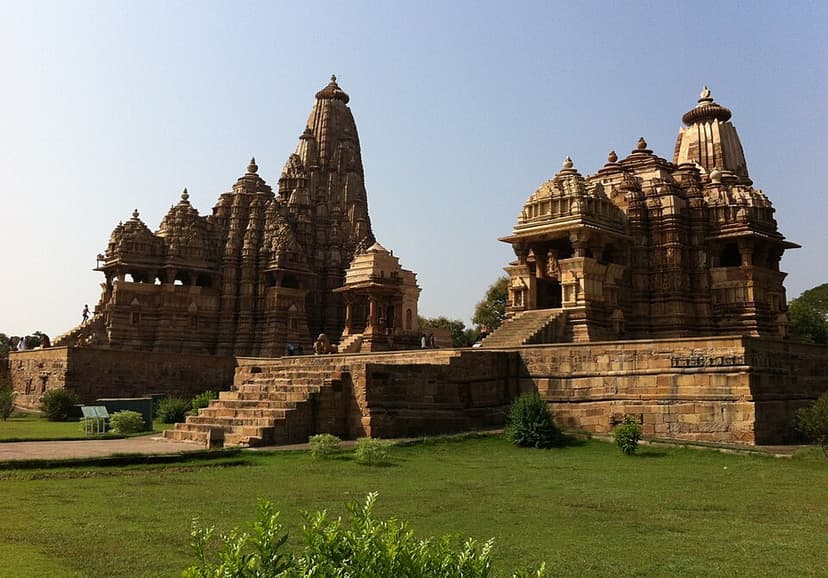
Khajuraho Group of Monuments
The Khajuraho Group of Monuments is a collection of Hindu and Jain temples located in Madhya Pradesh, India, renowned for their Nagara-style architecture and intricate sculptures, including notable erotic carvings. Primarily constructed by the Chandela dynasty between the 9th and 11th centuries, these temples showcase a blend of religious acceptance and artistic expression, reflecting aspects of medieval Indian life and Hindu philosophy.