
Kamakhya Temple
Nilachal·8th-9th·India
Kamakhya Temple, located on the Nilachal hills in Guwahati, Assam, is a prominent Hindu temple dedicated to the goddess Kamakhya and a significant center for Tantric practices. It is revered as one of the oldest Shaktipeethas and is the site of the annual Ambubachi Mela, a festival celebrating the goddess's menstruation. The temple complex showcases a unique Nilachal architectural style, a hybrid indigenous design with subsequent renovations and additions over centuries.
Key Facts
- ›Dedicated to the goddess Kamakhya, a form of Shakti.
- ›One of the oldest and most revered centers for Tantric practices.
- ›The primary worship is of an aniconic yoni set in natural stone.
- ›It is considered one of the oldest of the 51 Shaktipeethas in the Shakta tradition.
- ›The temple complex includes individual shrines dedicated to the ten Mahavidyas.
- ›The site is central to the annual Ambubachi Mela festival.

Kamakhya, Shakti
- Center of Kulachara Tantra Marga
- Site of the Ambubachi Mela
- One of the Oldest 4 of the 51 Pithas In the Shakta Tradition
- Important Pilgrimage Destination
Mleccha Dynasty, Pala Dynasty, Koch Dynasty, Ahom Kingdom
Ambubachi Mela, Manasha Puja, Durga Puja
Stone, Brick, Rock
Mleccha Dynasty, Palas, Koch Dynasty, Ahoms, Vishwasingha, Nara Narayan, Chilarai, Rudra Singha, Siba Singha
- Sculpted Ganesha and Other Hindu Gods and Goddesses
- Sculpted Images of Nar Narayana
- Stone Sculptures In High Relief
Underground Perennial Spring
About Kamakhya Temple
Kamakhya Temple, situated atop the Nilachal hills in Guwahati, Assam, is a renowned Hindu temple dedicated to the goddess Kamakhya and stands as a preeminent center for Tantric practices. It holds significant religious importance as one of the oldest and most revered Shaktipeethas in the Shakta tradition, and it is the primary site for the annual Ambubachi Mela, a festival that commemorates the goddess's menstruation.
Historical Context and Architecture
The temple's structural history suggests multiple periods of construction and renovation, with evidence pointing to its origins in the 8th-9th centuries. The current architectural form, largely from the 16th century, exemplifies a unique indigenous style known as the Nilachal type, characterized by its hemispherical dome atop a cruciform base. The shikhara, or spire, is primarily constructed of brick and is encircled by minaret-inspired angashikharas of the Bengali charchala type. The inner sanctum, or garbhagriha, is located below ground level and houses no idol, but rather a natural rock fissure in the shape of a yoni, which is perpetually filled with water from an underground spring.
Worship and Religious Significance
The worship at Kamakhya Temple is deeply rooted in Tantric traditions, with the aniconic yoni being the central focus of devotion. The temple is identified with the goddess Kamakhya, who is revered as the yielder of all desires and the giver of salvation. Historically, the worship is believed to have evolved through distinct phases, incorporating elements of both indigenous and Brahmanical traditions. The complex also features individual shrines dedicated to the ten Mahavidyas, a rare and significant aspect of its religious layout.
Patronage and Development
Over centuries, Kamakhya Temple has received patronage from various ruling dynasties, including the Mleccha, Pala, Koch, and Ahom kingdoms. The Kalika Purana, an ancient Sanskrit text, links the goddess Kamakhya with the legitimizing progenitor of the Kamarupa kings, Naraka. The temple underwent significant reconstruction and renovation under the Koch dynasty in the 16th century, and later under the Ahom rulers, who continued to support and maintain the site. The administration of the temple was transferred from the Kamakhya Debutter Board to the Bordeuri Samaj in 2015.
Festivals and Pilgrimage
Kamakhya Temple attracts a large number of devotees and tantra practitioners, particularly during the Ambubachi Mela and Durga Puja festivals. Its spiritual prominence has established it as an important pilgrimage destination, drawing visitors from across India, especially from Bengal, since the 19th century.
Source: Wikipedia ↗
Frequently Asked Questions
What is the significance of the Kamakhya Temple?
Kamakhya Temple is highly significant as a revered center for Tantric practices and is considered one of the oldest Shaktipeethas. It is a major pilgrimage destination, particularly for devotees of the goddess Kamakhya, and hosts the important Ambubachi Mela festival.
What is worshipped at Kamakhya Temple?
The primary object of worship at Kamakhya Temple is an aniconic yoni (female genitalia) set in natural stone, which is constantly filled with water from an underground spring. This vulva-shaped depression is worshiped as the goddess Kamakhya herself.
What is the Ambubachi Mela?
The Ambubachi Mela is an annual festival celebrated at Kamakhya Temple that signifies the menstruation of the goddess Kamakhya. This event is a major draw for Tantric devotees and is a significant part of the temple's religious calendar.
What is the architectural style of Kamakhya Temple?
The current structure of Kamakhya Temple, dating from the 16th century, exhibits a hybrid indigenous style known as the Nilachal type. This style features a hemispherical dome on a cruciform base, with a polygonal beehive-like dome made of brick, characteristic of temples in Kamrup.
When was Kamakhya Temple founded?
The current structural temple and rock-cut sculptures indicate that the temple has been built and renovated multiple times, with its origins possibly dating back to the 8th-9th centuries. Archaeological remains suggest older structures that could be as old as the 5th to 7th centuries.
What are the Mahavidyas associated with Kamakhya Temple?
The Kamakhya Temple complex is surrounded by individual temples dedicated to the ten Mahavidyas of Saktism: Kali, Tara, Tripura Sundari, Bhuvaneshwari, Bhairavi, Chhinnamasta, Dhumavati, Bagalamukhi, Matangi, and Kamalatmika. It is rare to find temples dedicated to the Mahavidyas as a group.
Related Temples (Hindu)

Taraknath Temple
The Taraknath Temple, located in Tarakeswar, West Bengal, India, is a significant Hindu pilgrimage site dedicated to Lord Shiva, worshiped here as Tarakanatha. Constructed in 1729, it features a distinct Bengal architectural style with an 'atchala' structure and an adjacent 'natmandir'. The temple is renowned for its belief that a dip in the nearby Dudhpukur tank fulfills prayers and is considered one of the 64 Jyotirlingas.

Tanot Mata Temple
The Tanot Mata Temple is a significant Hindu shrine located in the Jaisalmer district of Rajasthan, India, near the Pakistan border. Revered as a form of Goddess Hinglaj Mata, the temple is famously associated with the Indian victories in the Indo-Pakistani Wars of 1965 and 1971, with local folklore attributing the successful outcomes to divine intervention. The Border Security Force of India now manages the temple complex, which also includes a victory tower and a war museum.
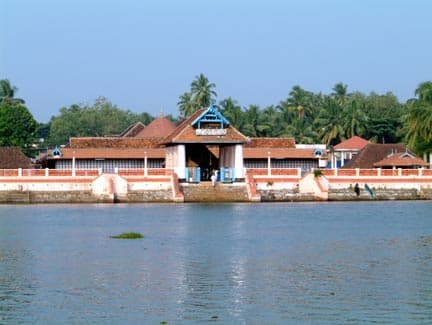
Thriprayar Temple
The Thriprayar Temple, also known as the Shree Ramaswami Temple, is a significant Hindu temple located in Triprayar, Thrissur district, Kerala, India. It is dedicated to Lord Rama, the seventh incarnation of Vishnu, who is depicted with four arms holding a conch, discus, bow, and garland. The temple's origin story involves the idol being worshipped by Krishna in Dwarka, later immersed in the sea, and eventually found by fishermen.