
Kala Ram Temple
The Kalaram Temple, located in the Panchavati area of Nashik, Maharashtra, is a significant Hindu temple dedicated to Lord Rama. Its name, meaning "black Rama," refers to the black stone idol of the deity housed within its sanctum, which also features statues of Sita and Lakshmana. The temple is a daily destination for thousands of devotees and holds historical importance, notably as the site of B.R. Ambedkar's Kalaram Mandir Satyagraha.
Key Facts
- ›The temple is dedicated to Lord Rama, with idols of Sita and Lakshmana also present.
- ›Its name, Kalaram, translates to "black Rama" due to the black stone idol of the deity.
- ›The current temple was rebuilt around the 1700s by Sardar Rangarao Odhekar.
- ›It is believed that Lord Rama, Lakshmana, and Sita spent time in the nearby Panchavati area during their exile.
- ›The temple was the site of the Kalaram Mandir Satyagraha, led by B.R. Ambedkar, which aimed to allow Dalits entry into the temple.
- ›The main temple features 14 steps, symbolizing Rama's 14 years of exile, and 84 pillars.

Rama, Sita, Lakshmana
Religious Pilgrimage Site, Site of Kalaram Mandir Satyagraha, Historical Importance In Nashik
Rashtrakuta Period
Rama Navami
Stone
Sardar Rangarao Odhekar
Black Idol of Rama, Idols of Sita and Lakshmana, Black Idol of Hanuman, Dattatreya's Footprint Impressions
Godavari River
About Kala Ram Temple
Kalaram Temple
The Kalaram Temple, situated in the Panchavati area of Nashik, Maharashtra, is a prominent Hindu temple dedicated to Lord Rama. The temple's name, Kalaram, translates to "black Rama," a direct reference to the black stone idol of the deity that is the central focus of worship. Within the sanctum sanctorum, alongside the idol of Rama, are statues of the goddess Sita and the god Lakshmana. This sacred site attracts thousands of devotees daily.
History and Reconstruction
The origins of the temple are ancient, with estimates suggesting a connection to the Rashtrakuta Period, spanning from the 7th to the 11th centuries. However, the claimed antiquity of the Rama idol itself, said to be over 2000 years old, remains unverified. According to local lore, during early Turkish invasions, the idol was cast into the Godavari River by temple Brahmins to protect it. The current temple structure was rebuilt around the 1700s, largely funded by Sardar Rangarao Odhekar. An anecdote recounts Odhekar having a dream in which the black statue of Rama appeared in the Godavari River. He subsequently organized an expedition to retrieve the idol, which he miraculously found. After recovering the statue, Odhekar, guided by divine instruction in his dream, sought a saint's guidance for its reconsecration before commissioning the temple's construction. Odhekar's endeavor is considered an important event in Nashik's history, and a statue of him is present within the temple complex.
Panchavati and the Ramayana Connection
The temple's location in Panchavati holds significance in relation to the epic Ramayana. It is believed that during their fourteen-year exile, Lord Rama, accompanied by Lakshmana and Sita, resided in this area on the northern bank of the Godavari River for approximately two and a half years.
Kalaram Mandir Satyagraha
The Kalaram Temple became a pivotal site in the struggle for social equality, particularly through the Kalaram Mandir Satyagraha, organized and led by B.R. Ambedkar. On March 2, 1930, Ambedkar initiated a large-scale protest outside the temple, advocating for the right of Dalits to enter. Thousands of Dalit protesters converged on Nashik, surrounding the temple and engaging in protests. The local populace of Nashik largely boycotted the demonstrators. A critical moment occurred on Rama Navami, April 9, 1930, when Dalit protesters attempted to disrupt the temple's ratha yatra. This led to clashes and stone-pelting between higher caste Hindus and the Dalit protesters. B.R. Ambedkar arrived at the scene of the riot, and he, along with other protesters, sustained minor injuries. During the ensuing chaos, a protester named Bhaskar Kendre managed to break through the police cordon protecting the temple and enter it, falling to the floor. This satyagraha movement continued until 1935.
Temple Complex Features
The main entrance of the Kalaram Temple features a black idol of Hanuman. Within the complex, there is also a very old tree with stone impressions of Dattatreya's footprints. Pilgrims often visit the nearby Kapaleshwar Mahadev temple. The main temple dedicated to Rama is designed with 14 steps, symbolizing the fourteen years of Rama's exile, and the entire temple structure is supported by 84 pillars.
Source: Wikipedia ↗
Frequently Asked Questions
What is the significance of the name Kalaram Temple?
The name Kalaram Temple translates to "black Rama." It is derived from the black stone idol of Lord Rama that is enshrined in the temple's sanctum sanctorum.
What is the history behind the Kalaram Temple's construction?
While the original temple may date back to the Rashtrakuta Period, the current structure was rebuilt around the 1700s. Sardar Rangarao Odhekar funded its reconstruction after reportedly having a dream about the black idol of Rama located in the Godavari River.
Why is the Kalaram Temple associated with B.R. Ambedkar?
The temple was the focal point of the Kalaram Mandir Satyagraha, a significant protest movement led by B.R. Ambedkar in the 1930s. The satyagraha aimed to secure the right for Dalits to enter the temple, which they were denied at the time.
What is the architectural significance of the Kalaram Temple?
The temple complex includes 84 pillars and the main temple has 14 steps, which represent the 14 years of Lord Rama's exile. The temple is designed so that Rama's idol is visible from the idol of Hanuman at the main entrance.
What is the connection between the Kalaram Temple and the Ramayana?
According to the Ramayana, Lord Rama, along with Lakshmana and Sita, spent two and a half years of their exile on the northern bank of the Godavari River near Nashik, in an area known as Panchavati, which is where the Kalaram Temple is situated.
Related Temples (Hindu)

Taraknath Temple
The Taraknath Temple, located in Tarakeswar, West Bengal, India, is a significant Hindu pilgrimage site dedicated to Lord Shiva, worshiped here as Tarakanatha. Constructed in 1729, it features a distinct Bengal architectural style with an 'atchala' structure and an adjacent 'natmandir'. The temple is renowned for its belief that a dip in the nearby Dudhpukur tank fulfills prayers and is considered one of the 64 Jyotirlingas.

Tanot Mata Temple
The Tanot Mata Temple is a significant Hindu shrine located in the Jaisalmer district of Rajasthan, India, near the Pakistan border. Revered as a form of Goddess Hinglaj Mata, the temple is famously associated with the Indian victories in the Indo-Pakistani Wars of 1965 and 1971, with local folklore attributing the successful outcomes to divine intervention. The Border Security Force of India now manages the temple complex, which also includes a victory tower and a war museum.
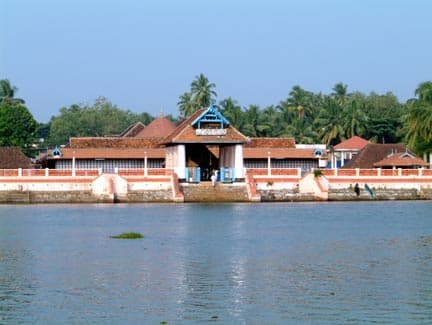
Thriprayar Temple
The Thriprayar Temple, also known as the Shree Ramaswami Temple, is a significant Hindu temple located in Triprayar, Thrissur district, Kerala, India. It is dedicated to Lord Rama, the seventh incarnation of Vishnu, who is depicted with four arms holding a conch, discus, bow, and garland. The temple's origin story involves the idol being worshipped by Krishna in Dwarka, later immersed in the sea, and eventually found by fishermen.