
Kadampuzha Devi Temple
Kadampuzha Devi Temple is a significant Hindu pilgrimage center located in Malappuram district, Kerala, India. The temple is dedicated to Goddess Parvati/Durga, worshipped in the form of a huntress without an idol, but rather in a pit. It is renowned for its unique ritualistic offerings and legends connected to the epic Mahabharata.
Key Facts
- ›The primary deity is Goddess Parvati/Durga, depicted as a huntress.
- ›There is no idol; the Goddess is worshipped in a pit.
- ›The temple's legend is linked to Arjuna's penance for the Pashupatastra in the Mahabharata.
- ›Key offerings include Poomoodal and Muttarukkal.
- ›The temple is managed by the Malabar Devaswom Board.
- ›It is a prominent pilgrimage center in Kerala.

Parvati, Durga
Pilgrimage Center, Religious
Rigveda Laksharchana, Dravya Kalasam, Murajapam
About Kadampuzha Devi Temple
The Kadampuzha Devi Temple is a significant Hindu place of worship and pilgrimage located in Kadampuzha, within the Malappuram district of Kerala, India. The temple is primarily dedicated to Goddess Parvati, who is revered here in the form of Durga, specifically as a huntress. A unique aspect of this temple is that it does not house an idol of the Goddess; instead, she is worshipped in a pit.
Legend and Significance
The temple's origins are closely tied to the epic Mahabharata. According to legend, Arjuna, during his exile, performed intense penance at this location to obtain the divine weapon Pashupatastra from Lord Shiva. To test Arjuna's resolve and humility, Shiva and Parvati are said to have appeared disguised as hunters. During this time, an asura named Mukasura, in the form of a wild boar, attacked Arjuna, leading to a dispute between Arjuna and Shiva over who had struck the killing blow.
The presence of Lord Ganesha is also acknowledged, with sub-shrines dedicated to Lord Sastha and serpent deities. Nearby, a separate Shiva temple known as 'Madambiyarkavu' exists. Both the Kadampuzha Devi Temple and Madambiyarkavu are administered by the Malabar Devaswom Board.
Rituals and Offerings
A distinctive feature of worship at Kadampuzha Devi Temple is the practice of 'Vazhivadus,' or special offerings. Devotees are allowed to witness the performance of these rituals from the doorstep of the Sreekovil, as there is no conventional 'Sopanam' (steps) leading to it. The most important Vazhivadus are 'Poomoodal' and 'Muttarukkal.' Online booking facilities are available for these offerings through the temple's official website.
Festivals and Timings
Key festivals celebrated at Kadampuzha Devi Temple include the Rigveda Laksharchana, held over eight days in the month of Dhanu, involving Vedic scholars and cultural performances. Another significant event is the Dravya Kalasam in Thulam, a week-long ritualistic ceremony. Additionally, a special tantric pooja followed by Murajapa by Vedic scholars takes place monthly.
The temple is open for darshan from 04:30 AM to 12:00 Noon and again from 03:30 PM to 07:00 PM. Vazhipadu counters operate from 05:00 AM to 11:00 AM and 03:30 PM to 05:00 PM.
Source: Wikipedia ↗
Frequently Asked Questions
What is the main deity worshipped at Kadampuzha Devi Temple?
The main deity is Goddess Parvati/Durga, worshipped in her form as a huntress. She is believed to be present without a physical idol, and devotees worship her in a pit.
What is unique about the idol or representation of the deity at this temple?
Unlike most Hindu temples, Kadampuzha Devi Temple does not have a physical idol of the Goddess. She is represented and worshipped in a pit within the sanctum.
What is the legend behind Kadampuzha Devi Temple?
The temple's legend is connected to the Mahabharata epic, where Arjuna performed penance to obtain the Pashupatastra from Lord Shiva. Shiva and Parvati, disguised as hunters, tested Arjuna, leading to an argument over killing a boar.
What are the most important offerings (Vazhivadus) at Kadampuzha Devi Temple?
The most significant offerings at the temple are Poomoodal and Muttarukkal. Devotees can book these special rituals through the temple's official online website.
What are the temple timings for darshan and vazhipadu counters?
The darshan timings are from 04:30 AM to 12:00 Noon and 03:30 PM to 07:00 PM. The vazhipadu counters are open from 05:00 AM to 11:00 AM and 03:30 PM to 05:00 PM.
What are some of the major festivals celebrated at Kadampuzha Devi Temple?
Key festivals include the Rigveda Laksharchana in the month of Dhanu, which involves an eight-day ritual with Vedic scholars and cultural programs. The Dravya Kalasam is celebrated in Thulam, a multi-day ritualistic ceremony. There is also a monthly special tantric pooja followed by Murajapa by Vedic scholars.
Related Temples (Hindu)

Taraknath Temple
The Taraknath Temple, located in Tarakeswar, West Bengal, India, is a significant Hindu pilgrimage site dedicated to Lord Shiva, worshiped here as Tarakanatha. Constructed in 1729, it features a distinct Bengal architectural style with an 'atchala' structure and an adjacent 'natmandir'. The temple is renowned for its belief that a dip in the nearby Dudhpukur tank fulfills prayers and is considered one of the 64 Jyotirlingas.

Tanot Mata Temple
The Tanot Mata Temple is a significant Hindu shrine located in the Jaisalmer district of Rajasthan, India, near the Pakistan border. Revered as a form of Goddess Hinglaj Mata, the temple is famously associated with the Indian victories in the Indo-Pakistani Wars of 1965 and 1971, with local folklore attributing the successful outcomes to divine intervention. The Border Security Force of India now manages the temple complex, which also includes a victory tower and a war museum.
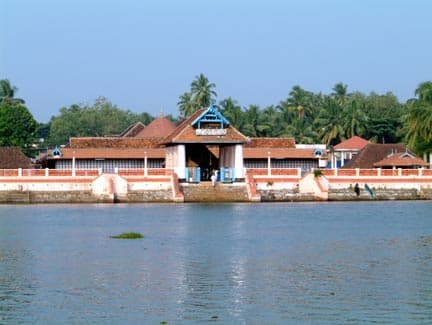
Thriprayar Temple
The Thriprayar Temple, also known as the Shree Ramaswami Temple, is a significant Hindu temple located in Triprayar, Thrissur district, Kerala, India. It is dedicated to Lord Rama, the seventh incarnation of Vishnu, who is depicted with four arms holding a conch, discus, bow, and garland. The temple's origin story involves the idol being worshipped by Krishna in Dwarka, later immersed in the sea, and eventually found by fishermen.