
Jwala Ji
Modern Muslim·14th century·India
The Jwalamukhi temple, located in Himachal Pradesh, India, is a significant Hindu shrine dedicated to the goddess Jwala Devi. It is renowned for an eternal flame that emanates from a rock fissure, over which the main shrine is constructed, and is considered a major Shakti Peetha.
Key Facts
- ›Dedicated to the goddess Jwala Devi.
- ›Features an eternal flame emerging from a rock fissure.
- ›Considered a major Shakti Peetha shrine.
- ›The current temple building exhibits a modern Muslim architectural style with a golden dome.
- ›The shrine is built over a fissure believed to be the mouth of the goddess.
- ›Mentioned in historical texts dating back to the 14th century.

Jwala Devi
Major Shakti Peetha Shrine, Site of An Eternal Flame
Tughlaq Dynasty
Gold, Silver
Firuz Shah Tughlaq, Kharak Singh
About Jwala Ji
Jwalamukhi Temple
The Jwalamukhi temple, located in the town of Jawalamukhi in Himachal Pradesh, India, is a prominent Hindu shrine dedicated to the goddess Jwala Devi. Its most striking feature is an eternal flame, fueled by natural combustible gas, that emanates from a fissure in the rock. The main shrine is constructed directly over this fissure, making it a unique site of worship.
Historically, early accounts from around 650 CE mention a place with hot and cold water emanating from calcareous rocks, which Alexander Cunningham identified as Jwalamukhi. The earliest extant text to specifically name the temple is Shams-i Siraj's Tarikh-i-Firuz-Shahi from the 14th century, detailing the visit of emperor Firuz Shah Tughlaq. Later, Abul Fazl in the 16th century described "mountain lights resembling lamps," attributing the flame to natural gas from a sulfur mine, while foreign travelers like Thomas Coryat and Jean de Thévenot also documented the site.
The temple complex comprises the main shrine built over the sacred fissure, surrounded by smaller temples dedicated to various deities. Devotees believe the fissure represents the mouth of the goddess, with her body believed to be at the Vajreshwari temple in Kangra. The architecture of the main temple building is noted for its modern Muslim style, featuring a golden dome and pinnacles, and a silver-plated folding door donated by Kharak Singh. The Jwalamukhi temple is considered one of the major Shakti Peetha shrines, drawing devotees for its spiritual significance and the miraculous eternal flame.
Source: Wikipedia ↗
Frequently Asked Questions
What is the main deity worshipped at the Jwalamukhi temple?
The main deity worshipped at the Jwalamukhi temple is the goddess Jwala Devi. The temple is dedicated to her divine manifestation.
What is the most distinctive feature of the Jwalamukhi temple?
The most distinctive feature of the Jwalamukhi temple is an eternal flame that continuously emanates from a natural rock fissure. This flame is believed to be a manifestation of the goddess.
When was the Jwalamukhi temple first mentioned in historical records?
The earliest extant text to mention Jwalamukhi by name is Shams-i Siraj's Tarikh-i-Firuz-Shahi, dating back to the 14th century. Emperor Firuz Shah Tughlaq visited the site during a campaign against Kangra.
What is the architectural style of the Jwalamukhi temple?
The temple building of Jwalamukhi is described as being of modern Muslim style, featuring a golden dome and pinnacles. It also has a silver-plated folding door.
What is the significance of the rock fissure at the temple?
The fissure over which the main temple is built is believed by devotees to be the mouth of the goddess Jwala Devi. Her body is traditionally believed to be present at the Vajreshwari temple in Kangra.
Related Temples (Hindu)
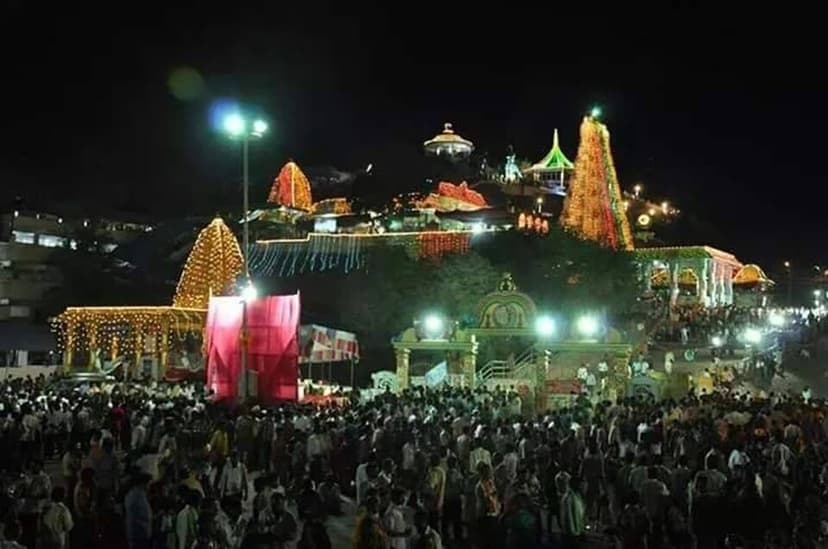
Kotappakonda
Kotappakonda is a significant Hindu pilgrimage site in Andhra Pradesh, India, centered around the ancient Sri Trikoteswara Swamy Temple, dedicated to Lord Shiva. Renowned for its three distinct peaks, the site is a major Shaivite center, drawing large crowds, especially during the annual Maha Shivaratri festival.

Kapilesvara Siva Temple
The Kapilesvara Siva Temple is a Hindu temple dedicated to Shiva, located in Bhubaneswar, Odisha, India. Situated in a precinct with 33 other monuments, it is considered a sacred site, with local legend identifying it as the birthplace of Lord Shiva. The temple complex, which includes various shrines and mandapas, has a rich architectural history, with some structures dating back to the 10th or 11th century and others renovated or built later.

Hampi
Hampi, also known as the Group of Monuments at Hampi, is a UNESCO World Heritage Site located in Karnataka, India. Once the prosperous capital of the Vijayanagara Empire, Hampi is now a sprawling archaeological site featuring over 1,600 surviving remains of forts, temples, royal complexes, and water structures, spread across 4,100 hectares. It continues to be a significant religious center, particularly with the active Virupaksha Temple.