
ISKCON Temple, Delhi
The Sri Sri Radha Parthasarathi Mandir, commonly known as ISKCON Temple Delhi, is a prominent Hindu temple dedicated to Radha and Krishna. Inaugurated in 1998, it is a large temple complex featuring the Glory of India Vedic Cultural Centre, which uses multimedia to educate visitors on Hindu scriptures like the Bhagavad Gita and Mahabharata.
Key Facts
- ›Dedicated to Radha and Krishna in the form of Radha Parthasarathi.
- ›Inaugurated on April 5, 1998, by Prime Minister Atal Bihari Vajpayee.
- ›Designed and built by Achyut Kanvinde.
- ›Houses the Glory of India Vedic Cultural Centre with multimedia exhibits.
- ›Features the 'Astounding Bhagavad Gita,' the world's largest printed Bhagavad Gita.
- ›Includes a 375-seater auditorium for cultural and religious functions.

Radha, Krishna
Major Hindu Pilgrimage Destination, Center For Vedic Culture Education, Architectural Design By Achyut Kanvinde
Srila Prabhupada
Ramayana Art Gallery
About ISKCON Temple, Delhi
Sri Sri Radha Parthasarathi Mandir (ISKCON Temple Delhi)
The Sri Sri Radha Parthasarathi Mandir, widely recognized as the ISKCON Temple Delhi, is a significant Hindu temple situated in the East of Kailash area of New Delhi, India. It is dedicated to the worship of Radha and Krishna, specifically in the form of Radha Parthasarathi. The temple was inaugurated on April 5, 1998, by the then Prime Minister of India, Atal Bihari Vajpayee, marking its official opening to the public.
Temple Complex and Cultural Center
The ISKCON Temple Delhi is noted for its expansive temple complex, designed and built by architect Achyut Kanvinde. The complex is one of the largest in India and houses numerous facilities, including rooms for priests and service personnel, a 375-seater auditorium for cultural and religious events, and administrative halls. A key attraction within the complex is the Glory of India Vedic Cultural Centre.
Glory of India Vedic Cultural Centre
This center serves as an educational hub for visitors interested in Hindu scriptures. It employs modern multimedia technologies to present major texts such as the Bhagavad Gita and the Mahabharata. Highlights include the 'Bhagavad Gita Animatronics,' which explains core concepts of the Bhagavad Gita through narration and visuals, and the 'Mahabharat Experience,' a light and sound show detailing the epic. The 'Ramayana Art Gallery' features over 30 original oil paintings by ISKCON members from various countries.
World's Largest Sacred Book
A notable exhibit within the cultural center is the 'Astounding Bhagavad Gita.' This book holds the distinction of being the largest printed Bhagavad Gita in the world, weighing 800 kg and measuring over 2.8 meters. Its unveiling in February 2019 by Prime Minister Narendra Modi underscored its significance as a representation of global religious literature.
Source: Wikipedia ↗
Frequently Asked Questions
When was the ISKCON Temple Delhi inaugurated?
The ISKCON Temple Delhi was inaugurated on April 5, 1998. The inauguration ceremony was attended by the then Prime Minister of India, Atal Bihari Vajpayee, along with former Chief Minister of Delhi, Sahib Singh Verma, and Sushma Swaraj.
What is the Glory of India Vedic Cultural Centre?
The Glory of India Vedic Cultural Centre is a part of the ISKCON Temple Delhi complex that offers visitors an educational experience about major Hindu texts. It utilizes various multimedia technologies, including animatronics, light and sound shows, and an art gallery, to present concepts from scriptures like the Bhagavad Gita, Mahabharata, and Ramayana.
What is the 'Astounding Bhagavad Gita'?
The 'Astounding Bhagavad Gita' is a significant exhibit within the Glory of India Vedic Cultural Centre. It is recognized as the largest printed book of the Bhagavad Gita in the world, weighing 800 kg and measuring over 2.8 meters. This Italian-printed book was unveiled by Prime Minister Narendra Modi in February 2019.
Who designed and built the ISKCON Temple Delhi?
The ISKCON Temple Delhi was designed and built by Achyut Kanvinde. He agreed to a pro-bono commission in 1993 to construct the temple complex for the followers of Srila Prabhupada.
What are some of the facilities within the ISKCON Temple complex?
The temple complex is quite extensive and includes numerous rooms for priests and service renders. It also features a 375-seater auditorium for cultural and religious events, as well as several halls used for administration and seminars. The complex is divided into four main sections.
Related Temples (Hindu)

Taraknath Temple
The Taraknath Temple, located in Tarakeswar, West Bengal, India, is a significant Hindu pilgrimage site dedicated to Lord Shiva, worshiped here as Tarakanatha. Constructed in 1729, it features a distinct Bengal architectural style with an 'atchala' structure and an adjacent 'natmandir'. The temple is renowned for its belief that a dip in the nearby Dudhpukur tank fulfills prayers and is considered one of the 64 Jyotirlingas.

Tanot Mata Temple
The Tanot Mata Temple is a significant Hindu shrine located in the Jaisalmer district of Rajasthan, India, near the Pakistan border. Revered as a form of Goddess Hinglaj Mata, the temple is famously associated with the Indian victories in the Indo-Pakistani Wars of 1965 and 1971, with local folklore attributing the successful outcomes to divine intervention. The Border Security Force of India now manages the temple complex, which also includes a victory tower and a war museum.
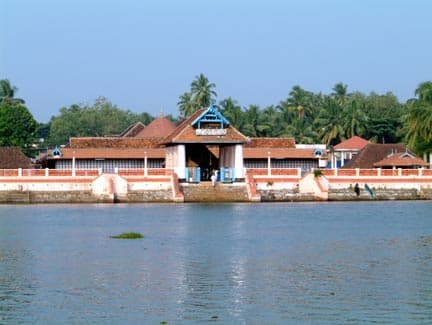
Thriprayar Temple
The Thriprayar Temple, also known as the Shree Ramaswami Temple, is a significant Hindu temple located in Triprayar, Thrissur district, Kerala, India. It is dedicated to Lord Rama, the seventh incarnation of Vishnu, who is depicted with four arms holding a conch, discus, bow, and garland. The temple's origin story involves the idol being worshipped by Krishna in Dwarka, later immersed in the sea, and eventually found by fishermen.