
ISKCON Temple
The Temple of the Vedic Planetarium, also known as ISKCON Temple, is a large Hindu temple and planetarium complex currently under construction in Mayapur, West Bengal, India. It is designed to be the global headquarters of the International Society for Krishna Consciousness (ISKCON) and is of particular importance to followers of Gaudiya Vaishnavism. Upon completion, it is slated to become the largest religious monument globally.
Key Facts
- ›Under construction since 2009 in Mayapur, West Bengal, India.
- ›Serves as the global headquarters for the International Society for Krishna Consciousness (ISKCON).
- ›Dedicated to Gaudiya Vaishnavism and Chaitanya Mahaprabhu.
- ›Will be the largest religious monument in the world upon completion.
- ›Its blue dome is inspired by the Capitol Building and features Vedic cosmological elements.
- ›Located in the Ganges Delta region at the confluence of the Ganges and Jalangi rivers.

Pancha Tattva, Radha Madhava, Ashta-Sakhis, Narasimha, Radhakrishna
Global Headquarters of Iskcon, Center For Gaudiya Vaishnavism, Pilgrimage Site, Largest Religious Monument In the World
Terra-Cotta
A. C. Bhaktivedanta Swami Prabhupada, Alfred Brush Ford
Terra-Cotta Art Depicting Srimad-Bhagavatam
Ganges River, Jalangi River
About ISKCON Temple
The Temple of the Vedic Planetarium (ISKCON Temple)
The Temple of the Vedic Planetarium, also known as the ISKCON Temple, is a significant under-construction Hindu temple and planetarium complex located in Mayapur, West Bengal, India. Since construction began in 2009, it has been designated as the global headquarters for the International Society for Krishna Consciousness (ISKCON). The temple holds particular importance for adherents of Gaudiya Vaishnavism, a spiritual tradition closely linked with Chaitanya Mahaprabhu.
Location and Setting
The complex is situated in the Ganges Delta, at the confluence of the Ganges and Jalangi rivers within the Nadia district of West Bengal. This area is recognized as the birthplace of Chaitanya Mahaprabhu, a fact identified by Bhaktivinoda Thakur in 1894. A. C. Bhaktivedanta Swami Prabhupada established Mayapur as a pilgrimage destination in the 20th century.
Architectural Vision
The Temple of the Vedic Planetarium's design features a striking blue dome, inspired by the United States Capitol Building. This dome is embellished with intricate Vedic cosmological motifs, including Mount Meru and a symbolic 'universal chandelier,' representing a distinctive fusion of architectural design and spiritual representation. The complex includes various structures such as the Sri Sri Radha Madhava Mandir, Srila Prabhupada's Pushpa Samadhi Mandir, and Srila Prabhupada's Bhajan Kutir.
Deities and Shrines
The main altar of the Sri Sri Radha Madhav Mandir houses life-size deities of Radha Madhava, accompanied by the Ashta-sakhis. A second altar is dedicated to the Pancha Tattva. The temple also features a deity of Narasimhadeva, installed after an attack in 1986. Within the Pushpa Samadhi Mandir, a large brass idol of Srila Prabhupada is venerated, and the surrounding gardens and mausoleum offer insights into his life and efforts to establish ISKCON. The outer walls are adorned with terra-cotta art illustrating narratives from the Srimad-Bhagavatam. The Bhajan Kutir is a renovated hut where Srila Prabhupada resided.
Future Significance
Upon its projected completion in 2027, the Temple of the Vedic Planetarium is anticipated to be the largest religious monument in the world. The project is chaired by Alfred Brush Ford (Ambarish Das).
Source: Wikipedia ↗
Frequently Asked Questions
When is the Temple of the Vedic Planetarium expected to open?
The Temple of the Vedic Planetarium is scheduled to open in 2027. Construction on the complex began in 2009.
What deities are worshipped at the ISKCON Temple in Mayapur?
Worship within the complex includes the Pancha Tattva deities, Radha Madhava along with the Ashta-sakhis, and Narasimha. The Temple of Vedic Planetarium itself will house the deity of Radhakrishna.
Who is credited with the vision for the Temple of the Vedic Planetarium?
The project chair is Alfred Brush Ford, also known as Ambarish Das, a great-grandson of Henry Ford. The vision for Mayapur has been a catalyst for development, accelerated by the construction of this temple.
What is the significance of Mayapur for ISKCON?
Mayapur is identified as the true birthplace of Chaitanya Mahaprabhu. A. C. Bhaktivedanta Swami Prabhupada founded Mayapur as a place of pilgrimage in the 20th century, and it now serves as ISKCON's global headquarters.
What architectural inspirations are evident in the Temple of the Vedic Planetarium?
The temple's blue dome is inspired by the Capitol Building and incorporates intricate Vedic cosmological elements such as Mount Meru and a 'universal chandelier', symbolizing a blend of architecture and spirituality.
Related Temples (Hindu)

Taraknath Temple
The Taraknath Temple, located in Tarakeswar, West Bengal, India, is a significant Hindu pilgrimage site dedicated to Lord Shiva, worshiped here as Tarakanatha. Constructed in 1729, it features a distinct Bengal architectural style with an 'atchala' structure and an adjacent 'natmandir'. The temple is renowned for its belief that a dip in the nearby Dudhpukur tank fulfills prayers and is considered one of the 64 Jyotirlingas.

Tanot Mata Temple
The Tanot Mata Temple is a significant Hindu shrine located in the Jaisalmer district of Rajasthan, India, near the Pakistan border. Revered as a form of Goddess Hinglaj Mata, the temple is famously associated with the Indian victories in the Indo-Pakistani Wars of 1965 and 1971, with local folklore attributing the successful outcomes to divine intervention. The Border Security Force of India now manages the temple complex, which also includes a victory tower and a war museum.
Thriprayar Temple
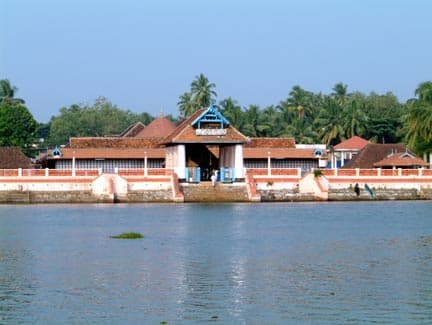
The Thriprayar Temple, also known as the Shree Ramaswami Temple, is a significant Hindu temple located in Triprayar, Thrissur district, Kerala, India. It is dedicated to Lord Rama, the seventh incarnation of Vishnu, who is depicted with four arms holding a conch, discus, bow, and garland. The temple's origin story involves the idol being worshipped by Krishna in Dwarka, later immersed in the sea, and eventually found by fishermen.