
Hayagriva Madhava Temple
The Hayagriva Madhava Temple is located on Manikut hill in Hajo, Assam, India, approximately 30 km west of Guwahati. It is renowned for its continuous row of carved elephants on its lower walls, similar to the rock-cut temples of Ellora, and its outer walls adorned with relief figures depicting Vishnu's ten incarnations, devotees, and scenes from epics. The temple is an active worship site and celebrates several prominent Hindu festivals.
Key Facts
- ›The temple is situated on Manikut hill in Hajo, Kamrup District, Assam, India.
- ›A distinctive feature is the continuous row of carved elephants on the lowest level of the temple walls.
- ›The outer walls are decorated with relief figures of Vishnu's ten incarnations, devotees, and epic scenes.
- ›Major festivals celebrated annually include Doul, Bihu, and Janmastami.
- ›The temple maintains an unbroken lamp (akhanda deep) in the sanctum sanctorum.
- ›Sayani, wife of Kalia Bhomora Borphukan, donated land and people for the temple's maintenance during the reign of Ahom King Kamaleswar Singha.

Hayagriva, Vishnu
Architectural Features, Religious Pilgrimage, Active Worship Site
Ahom Dynasty
Doul, Bihu, Janmastami
Stone
Sayani
- Continuous Row of Elephants
- Relief Figures of Ten Incarnations of Vishnu
- Depictions of Devotees In Procession
- Episodic Scenes From the Ramayana and Mahabharata
Madhab Pukhuri
About Hayagriva Madhava Temple
The Hayagriva Madhava Temple is a significant Hindu place of worship located on Manikut hill in Hajo, within the Kamrup District of Assam, India. Positioned approximately 30 kilometers west of Guwahati, the temple is a notable religious and architectural site.
Architectural Highlights
A particularly striking feature of the Hayagriva Madhava Temple is the continuous band of carved elephants encircling the lowest level of its walls, a design element that draws parallels to the renowned rock-cut temples found in Ellora. The external walls of the shrine are further embellished with intricate relief figures. These carvings depict the ten principal incarnations of Vishnu, scenes of devotees participating in processions, and narrative episodes drawn from the epic tales of the Ramayana and the Mahabharata.
Religious Significance and Practices
The temple is dedicated to Hayagriva, a form of Vishnu. It is an active site of worship, with the lamps in the sanctum sanctorum being continuously lit, a practice known as 'akhanda deep'. This unbroken illumination is maintained by a simple system where oil flows through a tube from an oil tin to the large earthen lamps. The temple also marks the celebration of important Hindu festivals annually, including Doul, Bihu, and Janmastami, attracting numerous devotees.
Historical Patronage
Historical accounts indicate patronage from the Ahom dynasty. During the reign of Ahom king Kamaleswar Singha, Sayani, the first wife of Kalia Bhomora Borphukan, made a notable donation. She endowed the Hayagriva Madhava Temple with a family of paiks (servants or soldiers) and a plot of land, ensuring the temple's ongoing maintenance and support.
Source: Wikipedia ↗
Frequently Asked Questions
Where is the Hayagriva Madhava Temple located?
The Hayagriva Madhava Temple is located on Manikut hill in Hajo, within the Kamrup District of Assam, India. It is situated about 30 km west of the city of Guwahati.
What are the notable architectural features of the Hayagriva Madhava Temple?
A striking architectural element is the continuous row of elephants carved into the lowest level of the temple walls, reminiscent of the rock-cut temples of Ellora. The outer walls are further adorned with relief figures depicting the ten incarnations of Vishnu, processions of devotees, and scenes from the Ramayana and Mahabharata.
What festivals are celebrated at the Hayagriva Madhava Temple?
The temple observes several significant Hindu festivals annually. These include Doul, Bihu, and Janmastami, drawing devotees and visitors to participate in the celebrations.
Is there a continuous flame maintained at the temple?
Yes, the lamps in the sanctum sanctorum of the Hayagriva Madhava Temple are kept perpetually lit, a practice known as 'akhanda deep'. Oil is supplied to these large earthen lamps through a simple tube connected to an oil tin.
Who has historically supported the Hayagriva Madhava Temple?
During the reign of Ahom king Kamaleswar Singha, Sayani, the first wife of Kalia Bhomora Borphukan, made a significant donation. She provided a family of paiks (servants/soldiers) and a plot of land specifically for the temple's upkeep and maintenance.
Related Temples (Hindu)

Taraknath Temple
The Taraknath Temple, located in Tarakeswar, West Bengal, India, is a significant Hindu pilgrimage site dedicated to Lord Shiva, worshiped here as Tarakanatha. Constructed in 1729, it features a distinct Bengal architectural style with an 'atchala' structure and an adjacent 'natmandir'. The temple is renowned for its belief that a dip in the nearby Dudhpukur tank fulfills prayers and is considered one of the 64 Jyotirlingas.

Tanot Mata Temple
The Tanot Mata Temple is a significant Hindu shrine located in the Jaisalmer district of Rajasthan, India, near the Pakistan border. Revered as a form of Goddess Hinglaj Mata, the temple is famously associated with the Indian victories in the Indo-Pakistani Wars of 1965 and 1971, with local folklore attributing the successful outcomes to divine intervention. The Border Security Force of India now manages the temple complex, which also includes a victory tower and a war museum.
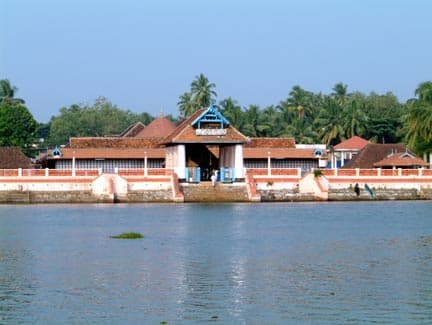
Thriprayar Temple
The Thriprayar Temple, also known as the Shree Ramaswami Temple, is a significant Hindu temple located in Triprayar, Thrissur district, Kerala, India. It is dedicated to Lord Rama, the seventh incarnation of Vishnu, who is depicted with four arms holding a conch, discus, bow, and garland. The temple's origin story involves the idol being worshipped by Krishna in Dwarka, later immersed in the sea, and eventually found by fishermen.