
Har Ki Pauri
1st century BC·India
Har Ki Pauri is a sacred ghat located on the banks of the Ganges River in the holy city of Haridwar, Uttarakhand, India. Believed to be where the Ganges emerges from the mountains onto the plains, it is a significant pilgrimage site, especially during major festivals like the Kumbh Mela. The name translates to "the feet of Vishnu," reflecting its deep religious importance.
Key Facts
- ›Located in Haridwar, Uttarakhand, India.
- ›Believed to be the spot where the Ganges River leaves the mountains and enters the plains.
- ›Associated with Lord Vishnu, with its name meaning "the feet of Vishnu."
- ›A major pilgrimage site, particularly during the Kumbh Mela and Ardh Kumbh Mela.
- ›Features the Brahmakund, considered the most sacred area where drops of Amrit are said to have fallen.
- ›The ghat was expanded and steps were added by the British government in response to a fatal crush incident in 1819.

Vishnu
- Sacred Site For Vishnu Worship
- Gateway of Ganges River From Mountains To Plains
- Site of Amrit Drops Falling
- Major Pilgrimage Destination
- Central Location For Kumbh Mela and Ardh Kumbh Mela
Kumbha Mela, Ardh Kumbh Mela, Vaisakhi, Dussehra, Diwali, Bhai Dooj
King Vikramaditya
Ganges River
About Har Ki Pauri
Har Ki Pauri is a profoundly sacred ghat situated on the banks of the Ganges River in Haridwar, a prominent Hindu holy city located in the Indian state of Uttarakhand. It is revered as the place where the Ganges River transitions from its mountainous course to the plains, marking a significant geographical and spiritual threshold.
Religious Significance
The name Har Ki Pauri translates to "the feet of Vishnu," underscoring its deep connection to Lord Vishnu, who is believed to have visited the Brahmakund within the ghat during Vedic times. The Brahmakund itself is considered the holiest part of Har Ki Pauri, reputed to be the spot where drops of Amrit, the celestial nectar of immortality, fell from a pitcher carried by Garuda after the cosmic churning known as Samudra Manthan.
Historical Development and Festivals
Historical accounts suggest that King Vikramaditya built Har Ki Pauri in the 1st century BC in memory of his brother, Bharthari, who meditated there. The ghat has undergone significant expansions over time. Initially described as a narrow passage, it was widened and steps were added by the British government following a tragic crush incident during the 1819 Kumbh Mela. Further extensions occurred in 1938 and 1986, with a landmark clock tower erected in 1938.
Har Ki Pauri serves as a vital pilgrimage destination, drawing vast crowds for major religious festivals. It is a central site for the Kumbh Mela, which takes place every twelve years, and the Ardh Kumbh Mela, held every six years. The Punjabi harvest festival of Vaisakhi, celebrated in April, also draws devotees to its sacred waters.
Ganga Aarti and Rituals
Each evening at sunset, the ghat hosts the revered Ganga Aarti. Priests perform this ritual by holding large fire bowls, ringing bells, and chanting sacred verses, while lights are set afloat on the river. Devotees also release diyas made of leaves and flowers into the Ganges as a symbol of their hopes and wishes. Annually, around the festival of Dussehra, the waters in the adjacent Ganga Canal are partially dried for cleaning and repairs, with the waters typically restored by Diwali. The Ganga Aarti continues daily, regardless of these maintenance activities.
Source: Wikipedia ↗
Frequently Asked Questions
What is the significance of Har Ki Pauri?
Har Ki Pauri is a highly sacred site in Hinduism, believed to be where the Ganges River emerges from the mountains. It is considered to be the place where Lord Vishnu visited the Brahmakund, and its name signifies "the feet of Vishnu."
What does the name Har Ki Pauri mean?
The name Har Ki Pauri translates to "the feet of Vishnu." "Har" refers to God, specifically Vishnu, and "Pauri" means feet. It signifies the divine presence of Vishnu at this location.
What is the Brahmakund at Har Ki Pauri?
The Brahmakund is an area within Har Ki Pauri considered the most sacred spot. It is believed to be where drops of Amrit, the elixir of immortality, fell from a pitcher carried by Garuda after the Samudra Manthan.
What major festivals are celebrated at Har Ki Pauri?
Har Ki Pauri is a crucial site for religious festivals such as the Kumbh Mela, which occurs every twelve years, and the Ardh Kumbh Mela, held every six years. The Punjabi festival of Vaisakhi in April is also celebrated here.
What is the Ganga Aarti performed at Har Ki Pauri?
Each evening at sunset, priests at Har Ki Pauri perform the Ganga Aarti, a ritual involving large fire bowls, ringing bells, and chanting praises to the Ganges. Lights are set afloat on the water as part of the ceremony, with many people gathering to witness it.
Has Har Ki Pauri always been this size?
Historically, the ghat was described as a narrow passage. Following a tragic crush incident in 1819, the ghat was expanded by the British government. Further extensions took place in 1938 and again in 1986.
Related Temples (Hindu)

Taraknath Temple
The Taraknath Temple, located in Tarakeswar, West Bengal, India, is a significant Hindu pilgrimage site dedicated to Lord Shiva, worshiped here as Tarakanatha. Constructed in 1729, it features a distinct Bengal architectural style with an 'atchala' structure and an adjacent 'natmandir'. The temple is renowned for its belief that a dip in the nearby Dudhpukur tank fulfills prayers and is considered one of the 64 Jyotirlingas.

Tanot Mata Temple
The Tanot Mata Temple is a significant Hindu shrine located in the Jaisalmer district of Rajasthan, India, near the Pakistan border. Revered as a form of Goddess Hinglaj Mata, the temple is famously associated with the Indian victories in the Indo-Pakistani Wars of 1965 and 1971, with local folklore attributing the successful outcomes to divine intervention. The Border Security Force of India now manages the temple complex, which also includes a victory tower and a war museum.
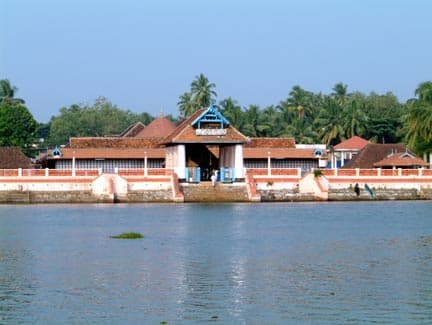
Thriprayar Temple
The Thriprayar Temple, also known as the Shree Ramaswami Temple, is a significant Hindu temple located in Triprayar, Thrissur district, Kerala, India. It is dedicated to Lord Rama, the seventh incarnation of Vishnu, who is depicted with four arms holding a conch, discus, bow, and garland. The temple's origin story involves the idol being worshipped by Krishna in Dwarka, later immersed in the sea, and eventually found by fishermen.