
Govardhan Shila
The Govardhana Shila refers to a sacred rock from Govardhana Hill in Braj, Uttar Pradesh, India, which is revered as a natural form of Lord Krishna. This stone, typically brown, is a significant object of worship for devotees, particularly those following the Vallabhacharya tradition, who consider the hill itself as non-different from Krishna. The Govardhana Shila is central to the legend of Krishna lifting the hill to protect the villagers from Indra's wrath.
Key Facts
- ›The Govardhana Shila is a sacred rock from Govardhana Hill in Braj, Uttar Pradesh.
- ›Govardhana Hill is identified as a natural form of Lord Krishna in Hindu scriptures.
- ›Devotees, especially followers of Vallabhacharya, worship the Govardhana Shila as an aniconic symbol of Krishna.
- ›The rock is usually brown in color.
- ›The legend of Krishna lifting Govardhana Hill to protect villagers from Indra is closely associated with the Shila.
- ›Govardhana is a major Hindu pilgrimage site located near Mathura.

Krishna
Religious Pilgrimage, Sacred Site In Krishna Lore, Aniconic Representation of Krishna
Govardhan Puja, Ankut/Annakuta
Sandstone, Rock
Vallabhacharya
Manasi Ganga Kund
About Govardhan Shila
Govardhana Shila
The Govardhana Shila is a sacred rock originating from Govardhana Hill, situated in the Braj region of Uttar Pradesh, India. This region is deeply significant in Hindu scriptures as the land where Lord Krishna spent his childhood. Govardhana Hill, also known as Giriraj, is revered as a divine manifestation and is considered by many devotees to be non-different from Lord Krishna himself.
Legend and Worship
The primary legend associated with Govardhana involves Lord Krishna lifting the entire hill on his pinky finger for seven days to shield the villagers of Vrindavan from the torrential rains sent by the angered god Indra. This act earned Krishna the epithet Govardhandhari. Following this divine event, Krishna declared his identity with the hill, leading his devotees, particularly those in the Vallabhacharya tradition, to worship the Govardhana Shila and the hill as an embodiment of the Supreme Being.
The Govardhana Shila itself is typically a brown-colored stone, often worshipped as an aniconic symbol of Vishnu, predating the common iconic representations in Hindu art. Its use in worship is considered to have solar significance and roots that predate the formal Hindu period in India.
Pilgrimage and Rituals
Govardhana is a prominent Hindu pilgrimage destination, located approximately 26 km west of Mathura. The hill, a narrow sandstone formation about 8 km long, is central to several religious practices. The most significant ritual is the Govardhana Parikrama, a circumambulation of the hill covering about 38 km. This sacred walk is undertaken by countless devotees, with some performing an arduous 'dandavata' parikrama, involving full prostrations, which can extend over weeks or months.
Another important observance is Govardhan Puja, celebrated the day after Deepawali (the festival of lights). This festival commemorates Krishna lifting the hill and involves worshipping Govardhan Hill, often accompanied by the Ankut or Annakuta ceremony, a massive offering of fifty-six or 108 different food preparations to the deity, which are then distributed as prasada. The parikrama route itself encompasses various sacred sites, including lakes like Manasi Ganga Kund, and temples dedicated to Radha and Krishna.
Source: Wikipedia ↗
Frequently Asked Questions
What is the Govardhana Shila?
The Govardhana Shila is a sacred rock originating from Govardhana Hill in Braj, Uttar Pradesh, India. It is considered by many devotees to be a natural, aniconic form of Lord Krishna himself.
Why is Govardhana Hill considered sacred?
Govardhana Hill holds a unique position in Hindu scriptures, particularly those related to Lord Krishna's life in Braj. It is identified as a natural form of Krishna, and a central legend recounts Krishna lifting the entire hill to protect his devotees from the wrath of the rain god Indra.
How is the Govardhana Shila worshipped?
Devotees, especially those in the Vallabhacharya tradition, worship the Govardhana Shila similarly to how they worship the Deity of Krishna in temples. They consider the Shila and the hill to be identical with Lord Krishna.
What is the significance of the Govardhana Puja festival?
Govardhana Puja is a festival commemorating the incident where Krishna lifted Mount Govardhan. Celebrated the day after Deepawali, it involves worshipping Mount Govardhan, often with a large offering of food called 'Ankut'.
What is Govardhana Parikrama?
Govardhana Parikrama is a sacred ritual of circumambulating Govardhana Hill, a pilgrimage route approximately 38 km (24 miles) long. Some devotees undertake an arduous 'dandavata' parikrama, involving full prostrations, which can take weeks or months.
Related Temples (Hindu)

Taraknath Temple
The Taraknath Temple, located in Tarakeswar, West Bengal, India, is a significant Hindu pilgrimage site dedicated to Lord Shiva, worshiped here as Tarakanatha. Constructed in 1729, it features a distinct Bengal architectural style with an 'atchala' structure and an adjacent 'natmandir'. The temple is renowned for its belief that a dip in the nearby Dudhpukur tank fulfills prayers and is considered one of the 64 Jyotirlingas.

Tanot Mata Temple
The Tanot Mata Temple is a significant Hindu shrine located in the Jaisalmer district of Rajasthan, India, near the Pakistan border. Revered as a form of Goddess Hinglaj Mata, the temple is famously associated with the Indian victories in the Indo-Pakistani Wars of 1965 and 1971, with local folklore attributing the successful outcomes to divine intervention. The Border Security Force of India now manages the temple complex, which also includes a victory tower and a war museum.
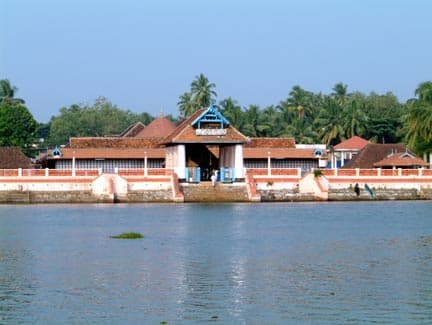
Thriprayar Temple
The Thriprayar Temple, also known as the Shree Ramaswami Temple, is a significant Hindu temple located in Triprayar, Thrissur district, Kerala, India. It is dedicated to Lord Rama, the seventh incarnation of Vishnu, who is depicted with four arms holding a conch, discus, bow, and garland. The temple's origin story involves the idol being worshipped by Krishna in Dwarka, later immersed in the sea, and eventually found by fishermen.