
Gopinath Mandir
The Gopinath Mandir is an ancient Hindu temple dedicated to Lord Shiva, located in Gopeshwar village within the Chamoli District of Uttarakhand, India. It is renowned for its architectural skill, featuring a striking dome and a substantial sanctum sanctorum. The temple complex also houses a unique trident made of eight metals, dating back to the 12th century, which bears inscriptions from the 13th-century Nepalese king Ashokchalla.
Key Facts
- ›Dedicated to Lord Shiva.
- ›Features a magnificent dome and a 30 sq ft sanctum sanctorum.
- ›Possesses a 5-meter high trident made of eight metals, dating to the 12th century.
- ›The trident has inscriptions attributed to King Ashokchalla of Nepal.
- ›Legend states the trident was thrown by Lord Shiva to kill Kamadeva.
- ›The temple is situated in Gopeshwar village, now part of Gopeshwar town.

Shiva
Architectural Proficiency, Historical Inscriptions, Religious Legend
Eight Different Metals
Ashokchalla
About Gopinath Mandir
The Gopinath Mandir is an ancient Hindu temple situated in Gopeshwar village, which is now part of Gopeshwar town in the Chamoli District of Uttarakhand, India. This temple is primarily dedicated to Lord Shiva and is recognized for its distinguished architectural design.
Architectural Significance
The temple stands out due to its architectural skill, featuring a magnificent dome that crowns the structure. The sanctum sanctorum, measuring 30 square feet, is notably accessible through 24 doors. The presence of broken idols found around the temple grounds suggests that several other temples may have existed in this vicinity during ancient times.
The Eight-Metal Trident
A significant feature within the temple courtyard is a 5-meter high trident, meticulously crafted from eight different metals. This artifact dates back to the 12th century and carries inscriptions attributed to Ashokchalla, who was the king of Nepal in the 13th century. While four short inscriptions in Devanagri from a later period are present, most remain undeciphered, with only one yielding its meaning.
Legends and Beliefs
Local legends imbue the trident with mystical properties. It is believed that the trident was once wielded by Lord Shiva himself, who used it to vanquish Kamadeva, the God of Love. The legend states that the trident became fixed in its current spot after this divine act. Furthermore, it is a widely held belief that while ordinary force cannot dislodge the trident, even the slightest touch by a devout follower can cause it to tremble. Remarkably, the metal of the trident shows no signs of weathering, despite enduring centuries of exposure to the elements.
Source: Wikipedia ↗
Frequently Asked Questions
What is the Gopinath Mandir dedicated to?
The Gopinath Mandir is an ancient Hindu temple dedicated to Lord Shiva. It is located in Gopeshwar village, within the Chamoli District of Uttarakhand, India.
What are the notable architectural features of the Gopinath Mandir?
The temple is recognized for its architectural proficiency, topped by a magnificent dome. Its sanctum sanctorum measures 30 square feet and is accessible through 24 doors.
What is the significance of the trident in the Gopinath Mandir's courtyard?
The courtyard contains a 5-meter high trident made of eight different metals, dating back to the 12th century. It is believed by legend that Lord Shiva threw this trident at Kamadeva to kill him, and it became fixed at this spot. The trident's metal has remarkably withstood the elements over centuries.
Are there any historical inscriptions found at the Gopinath Mandir?
Yes, the trident in the courtyard bears inscriptions attributed to Ashokchalla, the king of Nepal who reigned in the 13th century. Additionally, four short inscriptions in Devanagri from a later period are present but mostly undeciphered.
What does the legend say about the trident?
Legend has it that the trident belongs to Lord Shiva, who threw it at Kamadeva (the God of Love) to kill him, and it became permanently fixed at the temple's location. It is also said that while brute force cannot move it, a true devotee's touch can cause it to tremble.
Related Temples (Hindu)
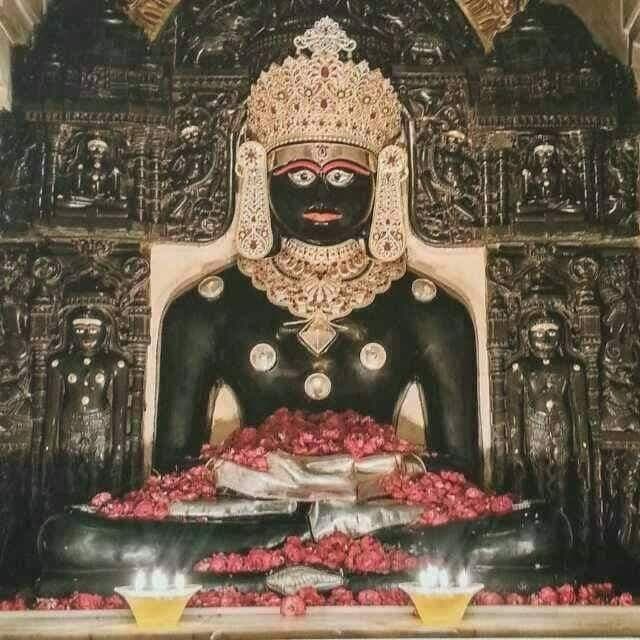
Neminath Jain Temple, Girnar
The Neminath Jain Temple, originally known as Karnavihara, is a significant Jain temple dedicated to the 24th Tirthankara, Neminatha, situated on Girnar hill in Gujarat, India. It is recognized as the foremost among the Girnar Jain temples, with its oldest existing structure dating back to the 12th century and built in the Māru-Gurjara architectural style.

Yogmaya Temple
The Yogmaya Temple, also known as Jogmaya Temple, is a Hindu temple in Mehrauli, New Delhi, dedicated to the goddess Yogmaya, an aspect of Maya and the sister of Krishna. It is considered one of the few surviving temples from the pre-Sultanate period in India and has undergone numerous reconstructions.

Triloknath Temple
The Triloknath Temple, located in Himachal Pradesh, India, is a significant religious site revered by both Tibetan Buddhists and Hindus. Originally believed to be a Buddhist vihara, it now houses a marble statue of Avalokiteshvara, worshipped as Shiva by Hindus and as Avalokiteshvara by Buddhists. The temple's architecture and history suggest a blend of influences, with its columns dating to the 9th century CE.