
Golu Devata
Golu Devata, also known as Goljyu and the god of justice, is a revered deity of the Kumaoni community in India. He is believed to be an incarnation of Gaur Bhairav and is known for dispensing justice and aiding his devotees. Many temples are dedicated to him, with the Chitai Golu Devta temple being the most prominent.
Key Facts
- ›Worshipped as the god of justice by the Kumaoni community.
- ›Considered an incarnation of Gaur Bhairav.
- ›Historically, he was the son of King Jhal Rai and a general of the Katyuri king.
- ›Temples are prominent in Kumaun, with notable ones in Chitai, Champawat, and Ghorakhal.
- ›Devotees often submit written petitions to the deity seeking justice.
- ›Traditionally believed to travel on a white horse to help his people.

Golu Devata
Dispenser of Justice, Deity of the Kumaoni Community, Incarnation of Gaur Bhairav
Katyuri
King Jhal Rai, Kalinka
About Golu Devata
Golu Devata, also known by the Kumaoni name Goljyu, is a revered deity central to the Kumaoni community in India. He is widely recognized as the god of justice, embodying fairness and swift resolution for his devotees. Historically, he is considered an incarnation of Gaur Bhairav and is prayed to as a primary deity (Ista/Kula Devta) in numerous villages across the Kumaon and Garhwal regions of Uttarakhand.
Historical Context and Legends
Historically, Golu Devata is regarded as the brave son of King Jhal Rai and his consort Kalinka, and served as a general under the Katyuri king. Champawat is often cited as his place of origin. Tales surrounding his birth vary, but a popular narrative describes his mother's exceptional ability to separate two fighting bulls, impressing the king who then married her. After his birth, jealous co-queens replaced him with a stone and cast him into a river. He was found and raised by a fisherman. Upon growing up, he demonstrated his wisdom and courage, leading to his recognition and an eventual coronation.
Worship and Temples
Golu Devata's reputation for dispensing justice draws many devotees who submit written petitions to his temples. The most prominent temple dedicated to him is the Chitai Golu Devta temple, situated near the Binsar wildlife sanctuary and Almora. Other significant temples are located near Bhowali in Ghorakhal and in Champawat. His worship often involves elaborate pujas, typically lasting three or nine days, during which he is offered various foodstuffs like ghee, milk, curd, halwa, poori, and pakauri, as well as white cloths and pagari.
Significance and Practice
The practice of 'Golu Darbar,' where Golu Devata would address the problems of his people, is believed to continue in spirit. In contemporary times, this is often manifested through 'Jagar,' a ritualistic performance. It is also a common belief that Golu Devata still travels on his white horse to aid his followers. His mantra, "Jai Nyay Devta Goljyu Tumar Jai ho. Sabuk lije dain haije," encapsulates his role as a benevolent protector and dispenser of justice for all.
Source: Wikipedia ↗
Frequently Asked Questions
Who is Golu Devata?
Golu Devata, also known as Goljyu, is a prominent deity worshipped by the Kumaoni community in India. He is revered as the god of justice and is believed to be an incarnation of Gaur Bhairav.
What is Golu Devata known for?
Golu Devata is primarily known for dispensing justice to his devotees. He is believed to listen to their problems and provide help, a practice historically known as Golu Darbar, which continues today through forms like Jagar.
What are the most famous temples dedicated to Golu Devata?
The most notable temple dedicated to Golu Devata is the Chitai Golu Devta temple, located near Almora. Other significant temples are found in Champawat and Ghorakhal.
What is the origin story of Golu Devata?
Popular tales suggest Golu Devata was the son of King Jhal Rai and Kalinka, and a general for the Katyuri king. One story recounts his birth to a queen who was later jealous of her, leading to him being cast into a river and raised by a fisherman before being recognized by the king.
How is Golu Devata worshipped?
Golu Devata is worshipped as a key deity in many villages. Pujas, often lasting three or nine days, are performed, and he is offered ghee, milk, curd, halwa, poori, and pakauri. Devotees also offer white cloths, pagari, and shawls.
What is the significance of Golu Devata in Uttarakhand?
Golu Devata is highly respected in Uttarakhand and is often considered akin to Lord Ganesh in importance for the region. He is typically invited to all pujas and religious activities.
Related Temples (Hindu)

Taraknath Temple
The Taraknath Temple, located in Tarakeswar, West Bengal, India, is a significant Hindu pilgrimage site dedicated to Lord Shiva, worshiped here as Tarakanatha. Constructed in 1729, it features a distinct Bengal architectural style with an 'atchala' structure and an adjacent 'natmandir'. The temple is renowned for its belief that a dip in the nearby Dudhpukur tank fulfills prayers and is considered one of the 64 Jyotirlingas.

Tanot Mata Temple
The Tanot Mata Temple is a significant Hindu shrine located in the Jaisalmer district of Rajasthan, India, near the Pakistan border. Revered as a form of Goddess Hinglaj Mata, the temple is famously associated with the Indian victories in the Indo-Pakistani Wars of 1965 and 1971, with local folklore attributing the successful outcomes to divine intervention. The Border Security Force of India now manages the temple complex, which also includes a victory tower and a war museum.
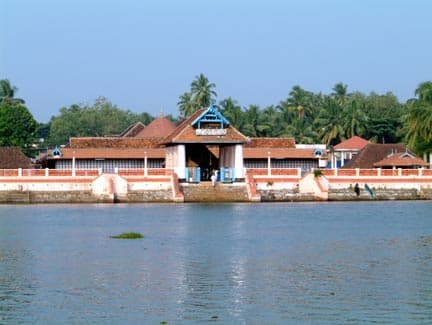
Thriprayar Temple
The Thriprayar Temple, also known as the Shree Ramaswami Temple, is a significant Hindu temple located in Triprayar, Thrissur district, Kerala, India. It is dedicated to Lord Rama, the seventh incarnation of Vishnu, who is depicted with four arms holding a conch, discus, bow, and garland. The temple's origin story involves the idol being worshipped by Krishna in Dwarka, later immersed in the sea, and eventually found by fishermen.