
Gangotri
Gangotri is a significant Hindu pilgrim town located in the Uttarkashi district of Uttarakhand, India, situated on the banks of the Bhagirathi River at an altitude of 3,100 meters. It is revered as the place where the goddess Ganga descended to Earth and is a key site in the Chota Char Dham pilgrimage circuit. The town is also considered the origin of the Ganges River, originating from the Gangotri Glacier.
Key Facts
- ›Gangotri is a major Hindu pilgrim town in Uttarakhand, India.
- ›It is located on the banks of the Bhagirathi River, considered the origin of the Ganges.
- ›The town is a part of the Chota Char Dham pilgrimage circuit.
- ›According to legend, the goddess Ganga descended to Earth at this location.
- ›The original Gangotri Temple was built by Nepalese general Amar Singh Thapa.
- ›Hindus believe bathing in the Bhagirathi here cleanses sins and performing ancestral rites frees spirits from the cycle of rebirth.

Ganga
- Origin of the Ganges River
- Seat of the Goddess Ganga
- Site of the Chota Char Dham Pilgrimage
- Location Where King Bhagiratha Performed Penance
- Site Where Pandavas Performed 'Deva Yajna'
Diwali, Akshaya Tritiya
Amar Singh Thapa, King Bhagiratha, Pandavas
Bhagirathi River, Ganges River
About Gangotri
Gangotri is a revered Hindu pilgrim town situated in the Uttarkashi district of Uttarakhand, India. Nestled within the Greater Himalayan Range at an elevation of 3,100 meters, it lies on the banks of the Bhagirathi River, which is considered the primary source of the Ganges River. The town is a critical destination within the Chota Char Dham pilgrimage circuit, drawing devotees from across the country.
Religious Significance and Legends
Central to Gangotri's spiritual importance is the legend that the goddess Ganga descended to Earth at this very spot, released from the locks of Lord Shiva's hair. The Bhagirathi River, originating from the nearby Gangotri Glacier, eventually merges with the Alakananda River at Devprayag to form the Ganges. A stone near the river is believed to be where King Bhagiratha performed rigorous penance to appease Shiva and bring the sacred river to Earth to absolve his ancestors' sins. Another significant tradition holds that the Pandavas performed the great 'Deva Yajna' here to seek atonement for the deaths of their kinsmen during the epic Mahabharata war. Hindus hold strong beliefs that performing ancestral rites on the banks of the Bhagirathi can liberate ancestral spirits from the cycle of rebirth, and a sacred dip in its waters is considered a means to cleanse sins from present and past lives.
The Gangotri Temple
The Gangotri Temple, dedicated to the goddess Ganga, has a history dating back to its original construction by the Nepalese general Amar Singh Thapa. The temple underwent restoration in the 19th century. The temple observes a specific seasonal closure; it is closed annually on the day of Diwali and reopens on Akshaya Tritiya. During the harsh winter months, the idol of the goddess is transferred to Mukhba village, located near Harsil, for safekeeping and continued worship. The ritualistic duties at the temple are traditionally managed by the Semwal family of pujaris.
Source: Wikipedia ↗
Frequently Asked Questions
Where is Gangotri located?
Gangotri is a town and municipality in the Uttarkashi district in the state of Uttarakhand, India. It is situated on the Greater Himalayan Range, at a height of 3,100 meters (10,200 ft) on the banks of the Bhagirathi River.
What is the religious significance of Gangotri?
Gangotri is a highly significant Hindu pilgrim town, revered as the place where the goddess Ganga descended to Earth. It is also considered the origin of the Ganges River and is a crucial site in the Chota Char Dham pilgrimage circuit. Hindus believe that a holy dip in the Bhagirathi River here cleanses sins and performing ancestral rites can free spirits from the cycle of rebirth.
What is the origin of the Ganges River according to Hindu belief?
According to popular Hindu legend, the goddess Ganga descended to this spot when Lord Shiva released the mighty river from the locks of his hair. The actual source of the Ganges River is the Bhagirathi River, which originates from the Gangotri Glacier.
What legends are associated with Gangotri?
One prominent legend states that the goddess Ganga descended here when Shiva released the river from his hair. Another legend recounts that King Bhagiratha performed penance to Shiva at a stone near the river to bring Ganga down to Earth. It is also believed that the Pandavas performed a great 'Deva Yajna' here to atone for the deaths of their kinsmen in the Mahabharata.
What is the history of the Gangotri Temple?
The original Gangotri Temple was constructed by the Nepalese general Amar Singh Thapa. The temple underwent restoration in the 19th century. Ritual duties at the temple are overseen by the Semwal family of pujaris.
When is the Gangotri Temple open?
The Gangotri Temple is closed annually on the day of Diwali and reopens on Akshaya Tritiya. During the winter months, the idol of the goddess Ganga is moved to Mukhba village near Harsil for safekeeping.
Related Temples (Hindu)

Taraknath Temple
The Taraknath Temple, located in Tarakeswar, West Bengal, India, is a significant Hindu pilgrimage site dedicated to Lord Shiva, worshiped here as Tarakanatha. Constructed in 1729, it features a distinct Bengal architectural style with an 'atchala' structure and an adjacent 'natmandir'. The temple is renowned for its belief that a dip in the nearby Dudhpukur tank fulfills prayers and is considered one of the 64 Jyotirlingas.

Tanot Mata Temple
The Tanot Mata Temple is a significant Hindu shrine located in the Jaisalmer district of Rajasthan, India, near the Pakistan border. Revered as a form of Goddess Hinglaj Mata, the temple is famously associated with the Indian victories in the Indo-Pakistani Wars of 1965 and 1971, with local folklore attributing the successful outcomes to divine intervention. The Border Security Force of India now manages the temple complex, which also includes a victory tower and a war museum.
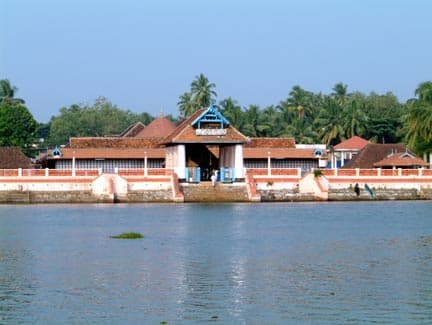
Thriprayar Temple
The Thriprayar Temple, also known as the Shree Ramaswami Temple, is a significant Hindu temple located in Triprayar, Thrissur district, Kerala, India. It is dedicated to Lord Rama, the seventh incarnation of Vishnu, who is depicted with four arms holding a conch, discus, bow, and garland. The temple's origin story involves the idol being worshipped by Krishna in Dwarka, later immersed in the sea, and eventually found by fishermen.