
Firinghi Kalibari
Firinghi Kalibari is a Hindu temple located in Kolkata, West Bengal, dedicated to Goddess Kali, particularly in her form as Maa Siddheshwari. The temple is noted for its historical associations, including a popular but unproven link to Anthony Firingee, a European convert to Hinduism, which is believed to have given the temple its "Firingi" prefix.
Key Facts
- ›Dedicated to Goddess Kali, worshipped as Maa Siddheshwari.
- ›Located on B.B. Ganguly Street in the Bowbazar locality of Kolkata, West Bengal, India.
- ›The temple is associated with Anthony Firingee, a European devotee of Kali.
- ›A date stone inside the temple suggests an establishment year of 905 AD, though this is debated by historians.
- ›Currently managed and worshipped by descendants of the Bandopadhyay family.
- ›Animal sacrifices, once performed, are no longer practiced.

Kali, Maa Siddheshwari, Durga, Jagaddhatri, Shitala, Manasha, Vishnu, Shiva
Historical Association With Anthony Firingee, One of the Oldest Kali Temples In Kolkata, Site For Significant Religious Observances
Kali Puja, Kaushiki Amavasya, Phalaharini Amavasya, Kartik Amavasya
Moonstones, Clay, Concrete, Ashtadhatu
Anthony Firingee, Dom Srimanta, Bandopadhyay Family
Bhagirathi River
About Firinghi Kalibari
Firinghi Kalibari is a significant Hindu temple located in the Bowbazar locality of Kolkata, West Bengal, India, dedicated to the worship of Goddess Kali. The temple is particularly known for its association with the form of the Goddess as Maa Siddheshwari. While popular legends link its origins to Anthony Firingee, a European who converted to Hinduism and became a devotee of Kali, historical evidence for this direct connection remains inconclusive.
History and Origins
The temple's history is subject to various legends and historical interpretations. A date stone within the temple suggests an establishment year of 905 AD, which would make it over 525 years old. However, many historians question this date, citing a lack of evidence for human settlements in the region during that period. An alternative narrative suggests the site was initially a Shiv Mandir established by Dom Srimanta, who later also worshipped Maa Shitala. It is noted that this early temple was situated in a dense forest near the Bhagirathi River.
The "Firingi" prefix in the temple's name is widely attributed to Anthony Firingee (1786-1839). The story goes that he was influenced by Hindu culture after marrying a Hindu widow and became a fervent devotee of Kali. Some accounts suggest he performed renovations to the temple after receiving divine instructions, and that he may have been involved in establishing the idol of Maa Kali.
Over time, the temple came under the stewardship of the Bandopadhyay family of Kolkata, who have managed its rituals and upkeep for generations. According to current caretakers, their ancestors acquired the temple in 1880 AD. While animal sacrifices were historically part of the temple's practices, this ritual is no longer observed.
Deities and Worship
The principal deity is Maa Siddheshwari, whose idol is approximately five-and-a-half feet tall, possesses three eyes, and is positioned on a "panchamundi ashan" facing the south. Initially crafted from clay, the idol is now made of concrete. The temple complex also houses idols of Maa Durga and Maa Jagaddhatri made from "ashtadhatu," as well as figures of Maa Shitala and Maa Manasha. Additionally, a "Narayan Shila" for the worship of Lord Vishnu and a Shiv Lingam dedicated to Lord Shiva are present.
Religious Significance and Practice
Firinghi Kalibari is a place of active worship, attracting hundreds of devotees, especially during significant occasions like Kali Puja, Kaushiki Amavasya, and Phalaharini Amavasya. Special pujas are conducted on the monthly amavasyas, and Narayan Puja takes place on purnimas. The temple experiences its peak attendance on Kartik Amavasya, which is observed with day-long religious ceremonies and is akin to an annual festival.
Source: Wikipedia ↗
Frequently Asked Questions
What is the primary deity worshipped at Firinghi Kalibari?
The primary deity worshipped at Firinghi Kalibari is Goddess Kali, specifically in her form as Maa Siddheshwari. The idol is three-eyed, about five-and-a-half feet tall, and is placed on a "panchamundi ashan" facing south.
What is the origin of the name "Firinghi" in Firinghi Kalibari?
The name "Firinghi" is popularly believed to originate from Anthony Firingee, a European who converted to Hinduism and was a devoted follower of Kali. While this association is widely circulated, historical proof of his direct involvement with the temple's establishment has not been found.
When was Firinghi Kalibari established?
Historians have differing opinions on the temple's establishment date. A date stone inside the temple indicates 905 AD, suggesting it is over 525 years old. However, many historians doubt this date due to the lack of human settlements in the area at that time. Another account suggests it was originally a Shiv Mandir established by Dom Srimanta.
Who currently manages Firinghi Kalibari?
The temple has been managed and its deities worshipped by descendants of the Bandopadhyay family for generations. Their ancestors reportedly received the temple in 1880 AD.
What are the main festivals celebrated at Firinghi Kalibari?
Hundreds of devotees gather at the temple for worship on the occasions of Kali Puja, Kaushiki Amavasya, and Phalaharini Amavasya. The temple also registers its highest number of devotees on Kartik Amavasya, which is observed as an annual celebration.
Related Temples (Hindu)

Taraknath Temple
The Taraknath Temple, located in Tarakeswar, West Bengal, India, is a significant Hindu pilgrimage site dedicated to Lord Shiva, worshiped here as Tarakanatha. Constructed in 1729, it features a distinct Bengal architectural style with an 'atchala' structure and an adjacent 'natmandir'. The temple is renowned for its belief that a dip in the nearby Dudhpukur tank fulfills prayers and is considered one of the 64 Jyotirlingas.

Tanot Mata Temple
The Tanot Mata Temple is a significant Hindu shrine located in the Jaisalmer district of Rajasthan, India, near the Pakistan border. Revered as a form of Goddess Hinglaj Mata, the temple is famously associated with the Indian victories in the Indo-Pakistani Wars of 1965 and 1971, with local folklore attributing the successful outcomes to divine intervention. The Border Security Force of India now manages the temple complex, which also includes a victory tower and a war museum.
Thriprayar Temple
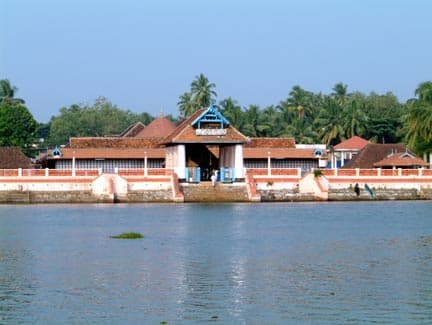
The Thriprayar Temple, also known as the Shree Ramaswami Temple, is a significant Hindu temple located in Triprayar, Thrissur district, Kerala, India. It is dedicated to Lord Rama, the seventh incarnation of Vishnu, who is depicted with four arms holding a conch, discus, bow, and garland. The temple's origin story involves the idol being worshipped by Krishna in Dwarka, later immersed in the sea, and eventually found by fishermen.