
Ekteswar Temple
Ekteswar Temple, located in Bankura district, West Bengal, is a Hindu temple primarily dedicated to Lord Shiva, specifically in his form as Ekapada Murthy. The temple is situated on the banks of the Dwarakeswar River and is associated with a legend of Lord Shiva resolving a boundary dispute between the kingdoms of Mallabhum and Samantabhum.
Key Facts
- ›Dedicated to Lord Shiva, particularly in his Ekapada Murthy form.
- ›Located in Ekteswar, Bankura district, West Bengal.
- ›Situated on the bank of the Dwarakeswar River.
- ›Associated with a legend of Lord Shiva resolving a boundary dispute.
- ›The temple's deity form, Ekapada Murti, is considered extremely rare.
- ›The name 'Ekteswar' is believed to have evolved from 'Eka Padeshwar' mentioned in the Vedas.

Shiva
Religious Pilgrimage Site, Unique Depiction of Shiva, Historical Legend of Dispute Resolution
Malla Dynasty
Ekteswar's Gajan Festival
King Raghunath Malla of Mallabhum
Ekapada Murti
Dwarakeswar River
About Ekteswar Temple
Ekteswar Temple is a significant Hindu temple located in the Bankura district of West Bengal, India. It is situated in the village of Ekteswar, on the banks of the Dwarakeswar River, approximately 10 kilometers from the town of Bankura.
Religious Significance
The temple is primarily dedicated to Lord Shiva, with a particular emphasis on his form known as Ekapada Murthy. This depiction of Shiva as a one-legged deity is exceptionally rare and is a key feature that distinguishes Ekteswar Temple. The name 'Ekteswar' itself is believed by some scholars, such as Acharya Jogeshchandra Roy Bidyanidhi, to be derived from 'Eka Padeshwar,' a term found in the Vedas.
Historical Legends and Patronage
Local legends imbue Ekteswar Temple with historical narrative. One prominent legend recounts how Lord Mahadev himself intervened to resolve a boundary dispute between the ancient kingdoms of Mallabhum and Samantabhum. In accordance with another popular version of this legend, Lord Shiva meditated to settle the border conflict. As a symbol of unity at the junction of these two territories, King Raghunath Malla of Mallabhum is credited with constructing the Ekteswar Shiva Temple. He also initiated the annual celebration of Ekteswar's Gajan festival, a tradition that continues to be associated with the temple.
Architectural and Cultural Context
While specific details about the temple's architectural style are not elaborated, its location on the riverbank and its association with the Malla dynasty suggest a historical context within the region's cultural heritage. The presence of the unique Ekapada Murti form of Shiva makes it a site of considerable religious and artistic interest, drawing devotees and scholars alike.
Source: Wikipedia ↗
Frequently Asked Questions
What deity is worshipped at Ekteswar Temple?
Ekteswar Temple is dedicated to Lord Shiva. He is particularly worshipped in a unique form known as Ekapada Murthy, or the one-legged deity, which is considered extremely rare and distinct.
Where is Ekteswar Temple located?
The temple is situated in Ekteswar, within the Bankura district of West Bengal. It lies on the banks of the Dwarakeswar River, approximately 10 kilometers from Bankura town.
What is the historical significance of Ekteswar Temple?
According to popular legend, Lord Shiva himself mediated a boundary dispute between Mallabhum and Samantabhum. King Raghunath Malla of Mallabhum is credited with building the temple at the border junction as a symbol of unity and initiating the Ekteswar's Gajan festival.
Is the form of Shiva worshipped at Ekteswar Temple common?
No, the form of Shiva worshipped at Ekteswar Temple as 'Ekapada Murti' (one-legged deity) is considered extremely rare. This unique representation of Shiva is not found elsewhere.
Related Temples (Hindu)

Taraknath Temple
The Taraknath Temple, located in Tarakeswar, West Bengal, India, is a significant Hindu pilgrimage site dedicated to Lord Shiva, worshiped here as Tarakanatha. Constructed in 1729, it features a distinct Bengal architectural style with an 'atchala' structure and an adjacent 'natmandir'. The temple is renowned for its belief that a dip in the nearby Dudhpukur tank fulfills prayers and is considered one of the 64 Jyotirlingas.

Tanot Mata Temple
The Tanot Mata Temple is a significant Hindu shrine located in the Jaisalmer district of Rajasthan, India, near the Pakistan border. Revered as a form of Goddess Hinglaj Mata, the temple is famously associated with the Indian victories in the Indo-Pakistani Wars of 1965 and 1971, with local folklore attributing the successful outcomes to divine intervention. The Border Security Force of India now manages the temple complex, which also includes a victory tower and a war museum.
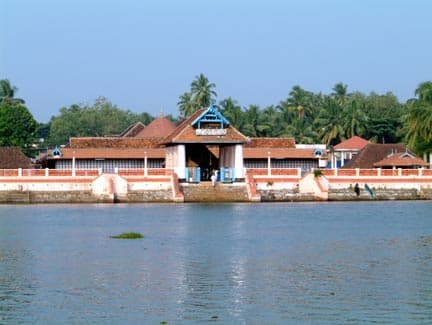
Thriprayar Temple
The Thriprayar Temple, also known as the Shree Ramaswami Temple, is a significant Hindu temple located in Triprayar, Thrissur district, Kerala, India. It is dedicated to Lord Rama, the seventh incarnation of Vishnu, who is depicted with four arms holding a conch, discus, bow, and garland. The temple's origin story involves the idol being worshipped by Krishna in Dwarka, later immersed in the sea, and eventually found by fishermen.