
Dwarkadhish Temple
2nd century BC·India
The Dwarkadhish Temple, also known as Jagat Mandir, is a prominent Hindu temple in Dwarka, Gujarat, India, dedicated to Lord Krishna, who is worshipped as Dwarkadhish, the 'Lord of Dwarka'. This ancient temple is a significant destination on the Char Dham pilgrimage circuit and is believed to have been originally built around 200 BCE, with substantial rebuilding in the 15th-16th centuries.
Key Facts
- ›The temple is dedicated to Krishna, worshipped as Dwarkadhish.
- ›It is located in Dwarka, Gujarat, a key site on the Hindu Char Dham pilgrimage circuit.
- ›Archaeological evidence suggests the original temple dates to at least 200 BCE.
- ›The current structure was largely rebuilt in the 15th-16th century after destruction in 1473.
- ›It is considered the 98th Divya Desam of Vishnu.
- ›The temple faces west and is supported by 72 pillars.

Krishna
- Major Pilgrimage Site On the Char Dham Circuit
- Associated With the Ancient City of Dwarka and Krishna of the Mahabharata
- One of the Sapta Puri
- Associated With Adi Shankara and the Advaita School of Hinduism
Krishna Janmashtami
Limestone, Sandstone
Adi Shankara
Gomati River
About Dwarkadhish Temple
The Dwarkadhish Temple, also known as Jagat Mandir, is a highly revered Hindu temple situated in the coastal city of Dwarka, Gujarat, India. It is dedicated to Lord Krishna, worshipped here in the form of Dwarkadhish, meaning 'Lord of Dwarka'. The temple holds immense religious significance as it is one of the primary destinations on the Char Dham pilgrimage circuit, a sacred journey undertaken by many Hindus across India.
Historical and Legendary Origins
Archaeological findings suggest that the earliest construction of the temple may date back to around 200 BCE. The temple has undergone significant rebuilding and expansion over centuries, notably in the 15th and 16th centuries. According to Hindu legend, the city of Dwarka itself was built by Krishna on land reclaimed from the sea. The temple's history is intertwined with epic narratives, including the Mahabharata, and it is associated with the sage Durvasa and Krishna's consort, Rukmini.
Architectural Features and Rebuilding
The present structure of the Dwarkadhish Temple is a five-storied edifice constructed primarily from limestone and sandstone. It is supported by a framework of 72 pillars. The temple features two main entrances: the northern Moksha Dwara (Door to Salvation) and the southern Swarga Dwara (Gate to Heaven), the latter leading to a flight of steps descending to the Gomati River ghats. The original temple structure was reportedly destroyed by Mahmud Begada in 1473, and the existing temple is largely dated to the 16th century, with the current idol of Dwarkadhish installed in 1559.
Religious and Pilgrimage Significance
The Dwarkadhish Temple is considered one of the Sapta Puri, the seven holy cities of India, and is a vital component of the Char Dham pilgrimage, which includes Badrinath, Puri, and Rameswaram. The temple is also recognized as the 98th Divya Desam of Vishnu, a designation of importance within Vaishnavism. The 8th-century philosopher Adi Shankara, who played a pivotal role in unifying Hindu religious thought, visited the shrine, and a memorial within the temple commemorates his visit. The temple complex is located at an elevation of approximately 12.19 meters (40.0 ft) above sea level and faces west. The flag hoisted on its spire, bearing the sun and moon, symbolizes Krishna's eternal presence until the end of time.
Source: Wikipedia ↗
Frequently Asked Questions
What is the Dwarkadhish Temple known as besides its main name?
The Dwarkadhish Temple is also widely known as Jagat Mandir. It is sometimes spelled as Dwarakadheesh, and the deity is worshipped as Dwarkadhish, meaning 'Lord of Dwarka'.
What is the historical significance of the Dwarkadhish Temple?
The temple is believed to have been originally built around 200 BCE, making it an ancient site deeply connected to the epic Mahabharata. It was destroyed in 1473 and subsequently rebuilt, retaining its importance as a pilgrimage destination.
Is the Dwarkadhish Temple part of a larger Hindu pilgrimage circuit?
Yes, the Dwarkadhish Temple is a crucial part of the Char Dham pilgrimage, a sacred circuit considered essential for Hindus. It represents the westernmost destination among the four cardinal points of this pilgrimage.
What architectural features does the Dwarkadhish Temple have?
The five-storied temple is constructed primarily of limestone and sandstone, supported by 72 pillars. It features two main gateways: the Moksha Dwara (northern) and the Swarga Dwara (southern), which leads to the Gomati River ghats.
Who was instrumental in the rebuilding or installation of deities at the temple?
Following its destruction in 1473, the current image of Dwarkadhish was installed in 1559 by Aniruddhaśrama Śaṅkarācārya. The 8th-century philosopher Adi Shankara also visited the shrine, and a memorial exists within the temple dedicated to his visit.
What is the legend associated with Rukmini at this temple?
According to legend, Sage Durvasa cursed Rukmini to remain at the spot where she requested water from Krishna after an arduous chariot ride. The shrine where Rukmini's shrine is found is believed to be this sacred location.
Related Temples (Hindu)

Taraknath Temple
The Taraknath Temple, located in Tarakeswar, West Bengal, India, is a significant Hindu pilgrimage site dedicated to Lord Shiva, worshiped here as Tarakanatha. Constructed in 1729, it features a distinct Bengal architectural style with an 'atchala' structure and an adjacent 'natmandir'. The temple is renowned for its belief that a dip in the nearby Dudhpukur tank fulfills prayers and is considered one of the 64 Jyotirlingas.

Tanot Mata Temple
The Tanot Mata Temple is a significant Hindu shrine located in the Jaisalmer district of Rajasthan, India, near the Pakistan border. Revered as a form of Goddess Hinglaj Mata, the temple is famously associated with the Indian victories in the Indo-Pakistani Wars of 1965 and 1971, with local folklore attributing the successful outcomes to divine intervention. The Border Security Force of India now manages the temple complex, which also includes a victory tower and a war museum.
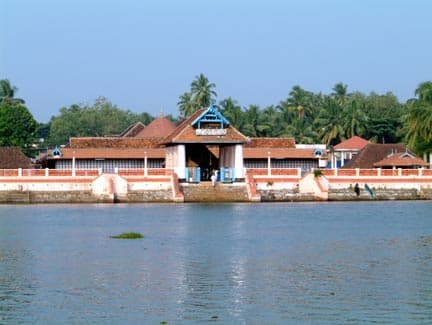
Thriprayar Temple
The Thriprayar Temple, also known as the Shree Ramaswami Temple, is a significant Hindu temple located in Triprayar, Thrissur district, Kerala, India. It is dedicated to Lord Rama, the seventh incarnation of Vishnu, who is depicted with four arms holding a conch, discus, bow, and garland. The temple's origin story involves the idol being worshipped by Krishna in Dwarka, later immersed in the sea, and eventually found by fishermen.