
Danteshwari Temple
The Danteshwari Temple, located in Dantewada, Chhattisgarh, is a significant Hindu shrine dedicated to Goddess Danteshwari. It is believed to be one of the 52 Shakti Pithas, sites where parts of the goddess Sati's body are said to have fallen. The temple, built in the 14th century, is a major pilgrimage site, especially during the annual Bastar Dussehra festival.
Key Facts
- ›Dedicated to Goddess Danteshwari, a form of Shakti.
- ›Considered one of the 52 Shakti Pithas.
- ›Built in the 14th century.
- ›The idol of the goddess is chiseled from black stone.
- ›The temple is a central site for the famous Bastar Dussehra festival.
- ›Dantewada town is named after the presiding deity.

Danteshwari
Shakti Pitha, Pilgrimage Site, Center of Bastar Dussehra Festival, Kuldevi of Bastar State and Kakatiya Rulers
Kakatiya Rulers
Bastar Dussehra, Navaratri
Black Stone, Stone Pieces
Kakatiya Rulers
- Idol of Danteshwari Mai Chiseled Out of Black Stone
About Danteshwari Temple
The Danteshwari Temple is a significant Hindu temple located in Dantewada, Chhattisgarh, India. Dedicated to Goddess Danteshwari, it holds a prominent place as one of the 52 Shakti Pithas, which are sacred shrines dedicated to Shakti, the divine feminine energy, scattered across India.
Legend and Mythology
According to ancient legends, the Danteshwari Temple is believed to be the site where the tooth (Daanth) of Goddess Sati fell. This event is part of the widely accepted mythological narrative of the creation of the Shakti Pithas. Following an insult by her father Daksha, Goddess Sati immolated herself, leading to Lord Shiva's destructive 'Taandav' dance with her body. Lord Vishnu then used his Sudarshan Chakra to sever Sati's body into 52 pieces, with each part consecrating a specific location as a Shakti Pitha.
History and Architecture
The temple itself was constructed in the 14th century. The central idol of Goddess Danteshwari is carved from a single piece of black stone. Architecturally, the temple is divided into four distinct parts: the Garbh Griha (sanctum sanctorum), Maha Mandap, Mukhya Mandap, and Sabha Mandap. The Garbh Griha and Maha Mandap were built using stone pieces, and a Garuda Pillar is situated in front of the temple's entrance. The temple complex is enclosed by massive walls, and its shikhara (tower) is adorned with fine sculptural work.
Religious Significance and Festivals
Traditionally, Goddess Danteshwari is revered as the Kuldevi (family goddess) of the Bastar state and was the presiding deity of the earlier Kakatiya rulers. The temple plays a central role in the famous Bastar Dussehra festival. During this annual celebration, thousands of tribal people from surrounding villages gather to pay homage to the goddess. Her idol is ceremoniously taken out of the ancient temple and paraded through the city in an elaborate procession, which has become a significant tourist attraction. The temple also observes the tradition of lighting Jyoti Kalashas during the Navaratri festival.
Source: Wikipedia ↗
Frequently Asked Questions
What is the mythological significance of the Danteshwari Temple?
According to legend, the Danteshwari Temple marks the spot where the tooth (Daanth) of Goddess Sati fell. This event is part of the narrative of how the 52 Shakti Pithas were established across India after Lord Vishnu scattered Sati's dismembered body.
When was the Danteshwari Temple constructed?
The Danteshwari Temple was built in the 14th century. Its construction dates back to this period, making it an ancient site of worship.
What is the connection between the temple and the Bastar Dussehra festival?
The Danteshwari Temple is the focal point of the famous Bastar Dussehra. Each year during this festival, the idol of the goddess is taken out of the ancient temple for an elaborate procession around the city, drawing thousands of tribal devotees.
What is the architecture of the Danteshwari Temple?
The temple is divided into four sections: Garbh Griha, Maha Mandap, Mukhya Mandap, and Sabha Mandap. The Garbh Griha and Maha Mandap are constructed from stone pieces, and a Garuda Pillar stands before the entrance. The shikhara is decorated with sculptural details.
Who is Goddess Danteshwari?
Goddess Danteshwari is the presiding deity of the temple and was traditionally the Kuldevi (family goddess) of the Bastar state and the earlier Kakatiya rulers. She is a form of the divine feminine, Shakti.
Related Temples (Hindu)
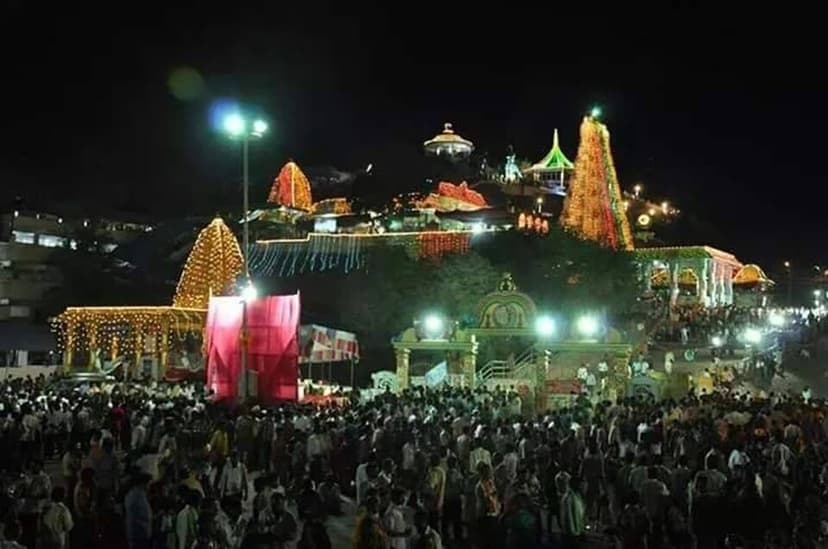
Kotappakonda
Kotappakonda is a significant Hindu pilgrimage site in Andhra Pradesh, India, centered around the ancient Sri Trikoteswara Swamy Temple, dedicated to Lord Shiva. Renowned for its three distinct peaks, the site is a major Shaivite center, drawing large crowds, especially during the annual Maha Shivaratri festival.

Kapilesvara Siva Temple
The Kapilesvara Siva Temple is a Hindu temple dedicated to Shiva, located in Bhubaneswar, Odisha, India. Situated in a precinct with 33 other monuments, it is considered a sacred site, with local legend identifying it as the birthplace of Lord Shiva. The temple complex, which includes various shrines and mandapas, has a rich architectural history, with some structures dating back to the 10th or 11th century and others renovated or built later.

Hampi
Hampi, also known as the Group of Monuments at Hampi, is a UNESCO World Heritage Site located in Karnataka, India. Once the prosperous capital of the Vijayanagara Empire, Hampi is now a sprawling archaeological site featuring over 1,600 surviving remains of forts, temples, royal complexes, and water structures, spread across 4,100 hectares. It continues to be a significant religious center, particularly with the active Virupaksha Temple.