
Chottanikkara Temple
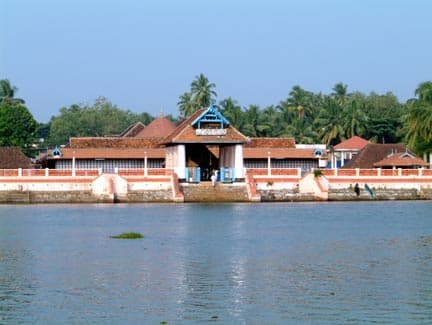
The Chottanikkara Bhagavathy Temple, dedicated to Goddess Bhagavathy, is a prominent Hindu shrine located in Kerala, India. Managed by the Cochin Devaswom Board, it is renowned for its central deity, the Divine Mother, who is worshipped in three forms – Saraswathi, Lakshmi, and Durga – throughout the day. The temple's unique deity is a self-manifested laterite formation known as Rudrākṣa Śilā.
Key Facts
- ›The central deity is Goddess Bhagavathy, worshipped as Rajarajeswari (Adiparashakthi).
- ›The deity manifests in three forms daily: Saraswathi (morning), Lakshmi (noon), and Durga (evening).
- ›An idol of Mahavishnu is present on the same pedestal as the main deity.
- ›The deity is a self-manifested laterite formation called Rudrākṣa ŚILā.
- ›The temple is located in the village of Chottanikkara within the Ernakulam District of Kerala, India.
- ›It is one of the most significant shrines managed by the Cochin Devaswom Board.

Goddess Bhagavathy, Rajarajeswari, Adiparashakthi, Saraswathi, Lakshmi, Durga, Mahavishnu, Lakshmi Narayana, Ammenarayana, Devinarayana, Bhadrenarayana, Brahma, Shiva, Ganapathi, Subramanya, Sastha
- Prominent Hindu Shrine
- One of the Most Significant Shrines Under the Cochin Devaswom Board
- Home To A Self-Manifested Deity
Laterite
Kannappan
About Chottanikkara Temple
Chottanikkara Bhagavathy Temple
The Chottanikkara Bhagavathy Temple is a significant Hindu temple located in the village of Chottanikkara, within the Ernakulam District of Kerala, India. Dedicated to Goddess Bhagavathy, this shrine is managed by the Cochin Devaswom Board and is considered one of the most important among the 409 temples under its administration.
Deity and Forms of Worship
The central deity of the temple is the Divine Mother, worshipped as Rajarajeswari, also identified as Adiparashakthi. The goddess is venerated in three distinct forms throughout the day: as Saraswathi in the morning, Lakshmi at noon, and Durga in the evening. Notably, an idol of Mahavishnu is situated on the same pedestal as the main deity, leading to collective worship under names such as Lakshmi Narayana, Ammenarayana, Devinarayana, and Bhadrenarayana. The same sacred pedestal also accommodates idols of Brahma, Shiva, Ganapathi, Subramanya, and Sastha.
The Sacred Formation
Structurally, the deity is not a man-made idol but a Svayambhū, meaning 'self-manifested.' This divine presence is a laterite formation referred to as the Rudrākṣa Śilā.
Legend and Origin
According to legend, the area where the temple stands was once a dense jungle. A tribesman named Kannappan, a devout worshipper of Mahakali, performed ritual sacrifices. One day, he found a calf and was about to sacrifice it when his daughter, Pavizham, intervened and pleaded for its life. Kannappan allowed her to keep the calf as a pet. Tragically, Pavizham later died, possibly from a snake bite. While attempting to cremate her body, Kannappan was astonished to find it disappear. A local priest explained that as punishment for his past cruelties to calves, he met a similar fate when his daughter died. Upon searching for the calf, Kannappan discovered the sacrifice altar shining in its place. The priest revealed that the calf represented the divine couple, Lord Vishnu and Lakshmi, and advised Kannappan to pray at the altar daily to atone for his sins.
Source: Wikipedia ↗
Frequently Asked Questions
What is the primary deity worshipped at Chottanikkara Temple?
The primary deity at Chottanikkara Temple is Goddess Bhagavathy, also known as the Divine Mother and worshipped as Rajarajeswari (Adiparashakthi). She is revered in three distinct forms throughout the day, representing Saraswathi in the morning, Lakshmi at noon, and Durga in the evening.
What is unique about the deity's form at Chottanikkara Temple?
The deity at Chottanikkara Temple is a self-manifested (Svayambhū) laterite formation known as the Rudrākṣa Śilā. This natural formation is considered the divine presence.
Are there other deities besides Goddess Bhagavathy at the temple?
Yes, an idol of Mahavishnu shares the same pedestal as the main deity, leading to collective nomenclatures like Lakshmi Narayana and Ammenarayana. Idols of Brahma, Shiva, Ganapathi, Subramanya, and Sastha are also housed on the same pedestal.
Where is Chottanikkara Temple located?
Chottanikkara Temple is situated in the village of Chottanikkara, within the Ernakulam District of Kerala, India. The region was historically a dense jungle.
Who manages the Chottanikkara Temple?
The Chottanikkara Temple is managed by the Cochin Devaswom Board. It is noted as one of the most significant shrines among the 409 temples administered by this board.
Related Temples (Hindu)

Taraknath Temple
The Taraknath Temple, located in Tarakeswar, West Bengal, India, is a significant Hindu pilgrimage site dedicated to Lord Shiva, worshiped here as Tarakanatha. Constructed in 1729, it features a distinct Bengal architectural style with an 'atchala' structure and an adjacent 'natmandir'. The temple is renowned for its belief that a dip in the nearby Dudhpukur tank fulfills prayers and is considered one of the 64 Jyotirlingas.

Tanot Mata Temple
The Tanot Mata Temple is a significant Hindu shrine located in the Jaisalmer district of Rajasthan, India, near the Pakistan border. Revered as a form of Goddess Hinglaj Mata, the temple is famously associated with the Indian victories in the Indo-Pakistani Wars of 1965 and 1971, with local folklore attributing the successful outcomes to divine intervention. The Border Security Force of India now manages the temple complex, which also includes a victory tower and a war museum.
Thriprayar Temple
The Thriprayar Temple, also known as the Shree Ramaswami Temple, is a significant Hindu temple located in Triprayar, Thrissur district, Kerala, India. It is dedicated to Lord Rama, the seventh incarnation of Vishnu, who is depicted with four arms holding a conch, discus, bow, and garland. The temple's origin story involves the idol being worshipped by Krishna in Dwarka, later immersed in the sea, and eventually found by fishermen.