
Chandika Sthan, Munger
Chandika Sthan, located in Munger, Bihar, India, is a significant Hindu temple dedicated to the goddess Shakti. It is recognized as one of the fifty-one Shakta pithas, believed to be a place where Sati's left eye fell, making it a sacred site for the cure of eye ailments and a major pilgrimage destination in the Ang Pradesh region.
Key Facts
- ›Recognized as one of the fifty-one Shakta pithas.
- ›Believed to be the site where Sati's left eye fell.
- ›Associated with the cure of eye pain and ailments.
- ›Connected to the legend of King Karna of Anga, who worshipped Goddess Chandi Mata.
- ›Considered a Siddhi-Peetha, a highly sacred and sanctified temple.
- ›A major Hindu pilgrimage center in the Ang Pradesh region of Bihar.

Shakti, Chandi Mata
Shakta Pitha, Pilgrimage Site, Cure of Eye Ailments
Anga Kingdom
King Karna
About Chandika Sthan, Munger
Chandika Sthan is a prominent Hindu temple located in Munger, within the state of Bihar, India. It holds significant religious importance as one of the fifty-one Shakta pithas, consecrated to the goddess Shakti. The temple is situated on the northeast corner of Munger, approximately two kilometers from the main town.
Religious Significance and Legend
Revered as a Siddhi-Peetha, Chandika Sthan is considered one of the most sacred and sanctified temples, often equated in importance to the Kamakshya temple near Guwahati. According to Hindu folklore and legendary tales, the temple's origin is tied to the mythology of Sati's self-immolation and Lord Shiva's grief. It is widely believed that Sati's left eye fell at this very spot, leading to its consecration. Consequently, a strong traditional belief associates the temple with the cure of eye pain and other eye-related ailments.
Historical Associations
Another notable legend connected with Chandika Sthan involves King Karna of the ancient Indian kingdom of Anga. It is said that King Karna was a devout worshipper of Goddess Chandi Mata. The folklore recounts that the Goddess, in return for his devotion, bestowed upon him daily a substantial amount of gold, equivalent to approximately 50 kilograms, which he then distributed among the needy and downtrodden in the vicinity, known locally as Karanchaura.
Pilgrimage and Accessibility
Chandika Sthan serves as a major Hindu pilgrimage center within the Ang Pradesh region of Bihar. Its proximity to Munger Junction railway station and Deoghar Airport (with Patna Airport also being a nearby option) makes it accessible to devotees and visitors.
Source: Wikipedia ↗
Frequently Asked Questions
What is Chandika Sthan and where is it located?
Chandika Sthan is a Hindu temple situated in Munger, in the Indian state of Bihar. It is located on the northeast corner of Munger, approximately two kilometers from the town center.
What is the religious significance of Chandika Sthan?
Chandika Sthan is revered as one of the fifty-one Shakta pithas, consecrated to the goddess Shakti. According to legend, Sati's left eye fell at this location, making it a powerful site for worship and believed to offer relief from eye pain.
What is the connection between Chandika Sthan and King Karna?
Legend states that King Karna, ruler of the ancient Indian kingdom of Anga, was a devotee of Goddess Chandi Mata. It is said that the Goddess provided him with a significant amount of gold daily for distribution among the needy.
Why is Chandika Sthan considered a Siddhi-Peetha?
Chandika Sthan is considered a Siddhi-Peetha, which signifies it as a highly sacred and sanctified temple. Its importance is often compared to that of the Kamakshya temple near Guwahati.
What is the origin story behind the Shakta pitha shrines, including Chandika Sthan?
The origin of Shakta pitha shrines is linked to the mythology of Daksha Yaga and Sati's self-immolation. After Sati's death, Lord Shiva carried her corpse, and various parts of her body are believed to have fallen at different locations, forming these sacred sites.
Related Temples (Hindu)

Taraknath Temple
The Taraknath Temple, located in Tarakeswar, West Bengal, India, is a significant Hindu pilgrimage site dedicated to Lord Shiva, worshiped here as Tarakanatha. Constructed in 1729, it features a distinct Bengal architectural style with an 'atchala' structure and an adjacent 'natmandir'. The temple is renowned for its belief that a dip in the nearby Dudhpukur tank fulfills prayers and is considered one of the 64 Jyotirlingas.

Tanot Mata Temple
The Tanot Mata Temple is a significant Hindu shrine located in the Jaisalmer district of Rajasthan, India, near the Pakistan border. Revered as a form of Goddess Hinglaj Mata, the temple is famously associated with the Indian victories in the Indo-Pakistani Wars of 1965 and 1971, with local folklore attributing the successful outcomes to divine intervention. The Border Security Force of India now manages the temple complex, which also includes a victory tower and a war museum.
Thriprayar Temple
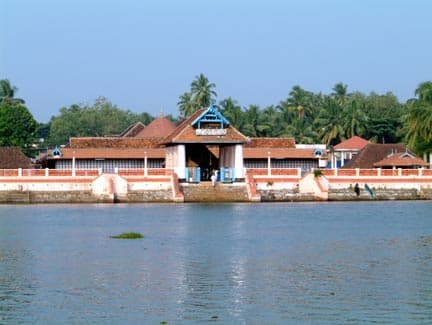
The Thriprayar Temple, also known as the Shree Ramaswami Temple, is a significant Hindu temple located in Triprayar, Thrissur district, Kerala, India. It is dedicated to Lord Rama, the seventh incarnation of Vishnu, who is depicted with four arms holding a conch, discus, bow, and garland. The temple's origin story involves the idol being worshipped by Krishna in Dwarka, later immersed in the sea, and eventually found by fishermen.