
Bijli Mahadev
Kath-Kuni·India
The Bijli Mahadev temple, located in Himachal Pradesh, India, is an ancient Hindu temple dedicated to Lord Shiva. It is renowned for a unique phenomenon where lightning strikes the lingam every 12 years, which the priest then repairs using a special mixture.
Key Facts
- ›Dedicated to Lord Shiva, an ancient deity in Hinduism.
- ›The temple is named for the lightning strikes that break the lingam every 12 years.
- ›The lingam is repaired by the temple priest using a mixture of homemade butter, pulse flour, and cereal.
- ›Built in the traditional Kath-Kuni architectural style.
- ›Believed to have been constructed by the Pandavas during their exile.
- ›Situated at an altitude of 2,460 meters, offering panoramic views of Kullu and Parvati valleys.

Shiva
- Ancient Temple Dedicated To Lord Shiva
- Unique Phenomenon of Lightning Striking the Lingam
- Traditional Kath-Kuni Architecture
Sawan
Deodar Wood, Stone Sculptures
Pandavas
Stone Sculptures of Shiva and Nandi
About Bijli Mahadev
Bijli Mahadev Temple
The Bijli Mahadev temple is an ancient and significant Hindu shrine dedicated to Lord Shiva, located in the picturesque Kullu Valley of Himachal Pradesh, India. Situated at an altitude of approximately 2,460 meters, the temple offers breathtaking panoramic views of the Kullu and Parvati valleys.
Legend and Significance
According to Hindu legend, the temple was built to honor Lord Shiva after he vanquished the demon Jalandhara, thereby saving the Kullu valley from submersion. Another legend recounts Shiva defeating the serpent-demon Kulanta, who threatened to submerge the world. The temple's unique name, Bijli Mahadev, derives from the extraordinary phenomenon where lightning, known as 'bijli', strikes the temple's lingam every twelve years, shattering it into pieces. The temple priest then performs a sacred ritual, reassembling the broken lingam using a special mixture of homemade butter, pulse flour, and cereal.
Architecture and Construction
The Bijli Mahadev temple is constructed in the traditional Kath-Kuni architectural style, a distinct Pahari method of building prevalent in the Mahasu region. Local lore attributes the temple's construction to the Pandavas during their years of exile. In front of the sanctum sanctorum, which houses the lingam, stands a striking 60-foot-high wooden staff made from deodar trees. The sides of the temple are adorned with stone sculptures of Lord Shiva and his bull Nandi, and devotees circumambulate the sanctum through a wooden rectangular corridor.
Location and Accessibility
The temple's elevated location provides stunning vistas of the surrounding valleys. While historically accessible only by a long trek, modern transport developments now allow access from the Kullu valley, Parvati valley, and the town of Naggar. A popular trekking route for visitors is via Jana village, passing through dense deodar forests, with a final 3-kilometer trek from the last motorable point to reach the temple. The months of April to June and September to November are considered the best times to visit, as winters are characterized by heavy snowfall that blankets the entire mountain.
Source: Wikipedia ↗
Frequently Asked Questions
What is the origin of the Bijli Mahadev temple's name?
The temple is named Bijli Mahadev due to a legendary event where lightning, or 'bijli', strikes the temple's lingam every 12 years, breaking it into pieces.
How is the lingam repaired at Bijli Mahadev temple?
After the lingam is broken by lightning, the temple priest meticulously reassembles the pieces. This is done using a traditional mixture of 'chopad' (homemade butter), pulse flour, and cereal.
What is the architectural style of the Bijli Mahadev temple?
The temple is built in the Kath-Kuni architectural style, which is a traditional Pahari style of construction commonly found in the Mahasu region, where the temple is located.
Who is believed to have built the Bijli Mahadev temple?
According to local belief, the Bijli Mahadev temple was built by the Pandavas during their period of exile, as mentioned in Hindu epics.
What is the significance of the lingam breaking at Bijli Mahadev temple?
The breaking of the lingam by lightning is a central and unique event associated with the temple, symbolizing a divine occurrence that requires ritualistic repair by the priest.
What is the best time to visit Bijli Mahadev temple?
The ideal times to visit the Bijli Mahadev temple are between April and June and from September to November. Winters see heavy snowfall, burying the mountain in snow, making travel difficult.
Related Temples (Hindu)

Taraknath Temple
The Taraknath Temple, located in Tarakeswar, West Bengal, India, is a significant Hindu pilgrimage site dedicated to Lord Shiva, worshiped here as Tarakanatha. Constructed in 1729, it features a distinct Bengal architectural style with an 'atchala' structure and an adjacent 'natmandir'. The temple is renowned for its belief that a dip in the nearby Dudhpukur tank fulfills prayers and is considered one of the 64 Jyotirlingas.

Tanot Mata Temple
The Tanot Mata Temple is a significant Hindu shrine located in the Jaisalmer district of Rajasthan, India, near the Pakistan border. Revered as a form of Goddess Hinglaj Mata, the temple is famously associated with the Indian victories in the Indo-Pakistani Wars of 1965 and 1971, with local folklore attributing the successful outcomes to divine intervention. The Border Security Force of India now manages the temple complex, which also includes a victory tower and a war museum.
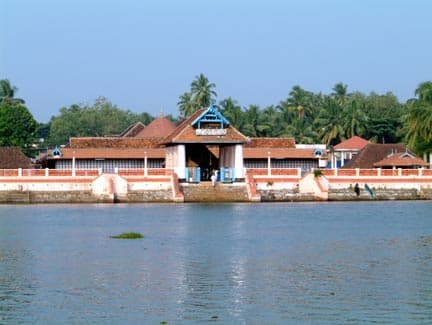
Thriprayar Temple
The Thriprayar Temple, also known as the Shree Ramaswami Temple, is a significant Hindu temple located in Triprayar, Thrissur district, Kerala, India. It is dedicated to Lord Rama, the seventh incarnation of Vishnu, who is depicted with four arms holding a conch, discus, bow, and garland. The temple's origin story involves the idol being worshipped by Krishna in Dwarka, later immersed in the sea, and eventually found by fishermen.