
Bajreshwari Mata Temple
The Bajreshwari Mata Temple, also known as Vajreshwari Devi Temple or Brajeshwari Devi Temple, is a significant Hindu temple located in the Kangra district of Himachal Pradesh, India. Dedicated to Goddess Durga in her fierce form as Vajreshwari, the goddess of the thunderbolt, it is revered as one of the 51 sacred Shakta pithas.
Key Facts
- ›The temple is dedicated to Goddess Durga as Vajreshwari, the goddess of the thunderbolt.
- ›It is considered one of the 51 sacred Shakta pithas, believed to be the site where Sati's left breast fell.
- ›The name Bajreshwari derives from Sanskrit words meaning "thunderbolt" and "goddess."
- ›Legends suggest the original temple was built by the Pandavas during their exile.
- ›The current structure was rebuilt after being destroyed by the 1905 Kangra earthquake.
- ›The temple is particularly famous for its Navratri festival, celebrated twice annually.

Durga, Vajreshwari
Shakta Pitha, Pilgrimage Site, Religious Significance
Navratri, Makar Sankranti
Stone
Pandavas
Idol of Dhayanu Bhagat
About Bajreshwari Mata Temple
The Bajreshwari Mata Temple, also known by variations such as Vajreshwari Devi Temple or Brajeshwari Devi Temple, is a highly revered Hindu shrine located in the Kangra district of Himachal Pradesh, India. This prominent temple is dedicated to Goddess Durga, specifically in her fierce manifestation as Vajreshwari, the goddess embodying the power of the thunderbolt. Its spiritual significance is deeply rooted in its identification as one of the 51 sacred Shakta pithas, believed to be the divine location where the left breast of Goddess Sati fell to earth, symbolizing a potent center of feminine divine energy.
Legends and Religious Importance
The temple's name, Bajreshwari, is derived from Sanskrit words meaning "thunderbolt" (Vajra) and "goddess" (Ishwari). According to local legends, Goddess Durga, in this form, used a divine thunderbolt to vanquish the demon Kalikala. The Shakta pitha tradition further elaborates on its sacredness, narrating that after Goddess Sati's self-immolation in her father's Yagya, Lord Shiva's grief-stricken Tandav dance was halted when Lord Vishnu's chakra divided her body into 51 parts. The falling of Sati's left breast at this specific spot consecrated it as a major pitha. The Jnanarnava Tantra refers to this site as "Bhrigupuri Shakta pitha," and the Brihad Nila Tantra identifies the presiding goddess as "Brajeshwari." Historically, the area was known as Guptapura, and the pitha is also referred to as Jalandhara Adi Shakta Pitha.
Historical Context
The Bajreshwari Mata Temple has been a significant pilgrimage site since antiquity, with its inclusion among the Shakta pithas greatly enhancing its religious importance. While legend attributes the construction of the original temple to the Pandavas during their period of exile, as mentioned in the Mahabharatha epic, the current architectural form is a reconstruction. The temple suffered extensive damage and was subsequently rebuilt by the government following the devastating 1905 Kangra earthquake.
Temple Structure and Worship
The temple complex features an entrance reminiscent of a fort, complete with a Nagarkhana (drum house) and surrounded by a stone wall. Inside the main sanctuary, Goddess Vajreshvari is represented in the form of a Pindi. The temple also houses a smaller shrine dedicated to Bhairava. An idol of Dhayanu Bhagat, who is said to have offered his head to the Goddess during Emperor Akbar's reign, is also present before the main temple. Uniquely, the present structure incorporates three tombs.
Festivals and Access
The temple is particularly renowned for its vibrant Navratri festival, celebrated twice annually, which attracts a multitude of devotees. During this time, rituals are performed to invoke the goddess as the vanquisher of evil. Makar Sankranti, observed in the second week of January, is also a significant festival. Legends state that after defeating Mahishasura, the Goddess applied butter to heal her wounds in Nagarkot; thus, the Pindi is covered with butter during this week-long celebration. Tantric rituals, reflective of the Shakta pitha tradition, are also occasionally conducted by ascetic groups.
The temple is located in Kangra town, easily accessible by road, rail, and air. It is situated near the Kangra bus stand and is also close to the Kangra railway station. Kangra Airport (Gaggal Airport) is approximately 10–13 km away, with regular flights connecting to major cities. The nearby Kangra Fort adds to the historical allure of the region.
Source: Wikipedia ↗
Frequently Asked Questions
What is the religious significance of the Bajreshwari Mata Temple?
The temple is a prominent Shakta pitha, a sacred site where a part of Goddess Sati's body is believed to have fallen. Specifically, it is said to be the location where Sati's left breast landed, making it a powerful center of divine feminine energy. Its name, derived from "thunderbolt goddess," reflects her fierce protective nature.
What legends are associated with the Bajreshwari Mata Temple?
One legend states that the Pandavas built the original temple after a divine dream instructed them to do so for their security. Another legend explains the temple's name, describing how Goddess Durga used a thunderbolt to defeat the demon Kalikala. The Shakta pitha legend recounts how Lord Vishnu's chakra divided Sati's body after her self-immolation.
What is the history of the Bajreshwari Mata Temple?
The temple has been a major pilgrimage destination since ancient times, its status as a Shakta pitha contributing to its prominence. While legends attribute its origin to the Pandavas, the current structure was reconstructed by the government following its destruction in the devastating 1905 Kangra earthquake.
What are the main festivals celebrated at the Bajreshwari Mata Temple?
The temple is renowned for its fervent celebration of the Navratri festival, which occurs twice a year and draws thousands of devotees. Another significant festival is Makar Sankranti, during which the goddess's idol is covered with butter, commemorating a legend about her healing after a battle.
How can one reach the Bajreshwari Mata Temple?
The temple is situated in Kangra town, Himachal Pradesh. It is accessible via road from Kangra bus stand, with HRTC and private buses available. The nearest railway station is Kangra railway station, and Kangra Airport (Dharamshala) is approximately 10-13 km away, with taxi and bus services connecting to the temple.
Related Temples (Hindu)

Taraknath Temple
The Taraknath Temple, located in Tarakeswar, West Bengal, India, is a significant Hindu pilgrimage site dedicated to Lord Shiva, worshiped here as Tarakanatha. Constructed in 1729, it features a distinct Bengal architectural style with an 'atchala' structure and an adjacent 'natmandir'. The temple is renowned for its belief that a dip in the nearby Dudhpukur tank fulfills prayers and is considered one of the 64 Jyotirlingas.

Tanot Mata Temple
The Tanot Mata Temple is a significant Hindu shrine located in the Jaisalmer district of Rajasthan, India, near the Pakistan border. Revered as a form of Goddess Hinglaj Mata, the temple is famously associated with the Indian victories in the Indo-Pakistani Wars of 1965 and 1971, with local folklore attributing the successful outcomes to divine intervention. The Border Security Force of India now manages the temple complex, which also includes a victory tower and a war museum.
Thriprayar Temple
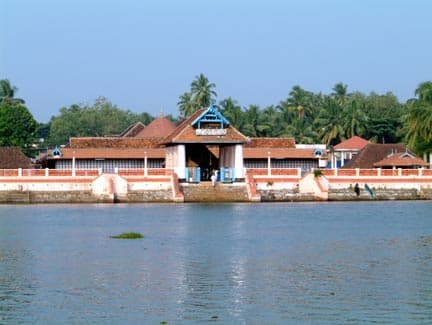
The Thriprayar Temple, also known as the Shree Ramaswami Temple, is a significant Hindu temple located in Triprayar, Thrissur district, Kerala, India. It is dedicated to Lord Rama, the seventh incarnation of Vishnu, who is depicted with four arms holding a conch, discus, bow, and garland. The temple's origin story involves the idol being worshipped by Krishna in Dwarka, later immersed in the sea, and eventually found by fishermen.