
Badami cave temples
Badami Chalukya·6th century·India
The Badami cave temples are a significant complex of rock-cut caves located in Badami, Karnataka, India, renowned for their early examples of Indian rock-cut architecture, particularly the Badami Chalukya style. Dating back to the 6th century, these temples showcase a blend of Hindu, Jain, and possibly Buddhist influences, and are crucial for understanding the evolution of temple architecture in the Deccan region.
Key Facts
- ›The Badami cave temples are a group of four main caves carved into soft sandstone cliffs.
- ›They represent some of the earliest Hindu temples in the Deccan region.
- ›The caves showcase architectural styles including Nagara, Dravida, and Vesara.
- ›Notable Hindu deities depicted include Shiva (as Nataraja and Ardhanarishvara) and Vishnu (in various avatars like Trivikrama and Varaha).
- ›Cave 4 is dedicated to Jainism, featuring carvings of Tirthankaras like Bahubali and Parshvanatha.
- ›The temples date from the 6th century, with Cave 3 being the oldest firmly-dated Hindu cave temple in India.

Shiva, Vishnu, Jain Tirthankaras
- Early Examples of Indian Rock-Cut Architecture
- Important Examples of Badami Chalukya Architecture
- Transformed the Mallaprabha River Valley Into A Cradle of Temple Architecture
- Influenced Components of Later Hindu Temples
Chalukya Dynasty
Badami Sandstone
Mangalesha
Nataraja, Vishnu As Trivikrama, Vishnu As Varaha, Harihara, Ardhanarishvara, Bahubali, Parshvanatha, Mahavira, Fresco Paintings
Agastya Teertha
About Badami cave temples
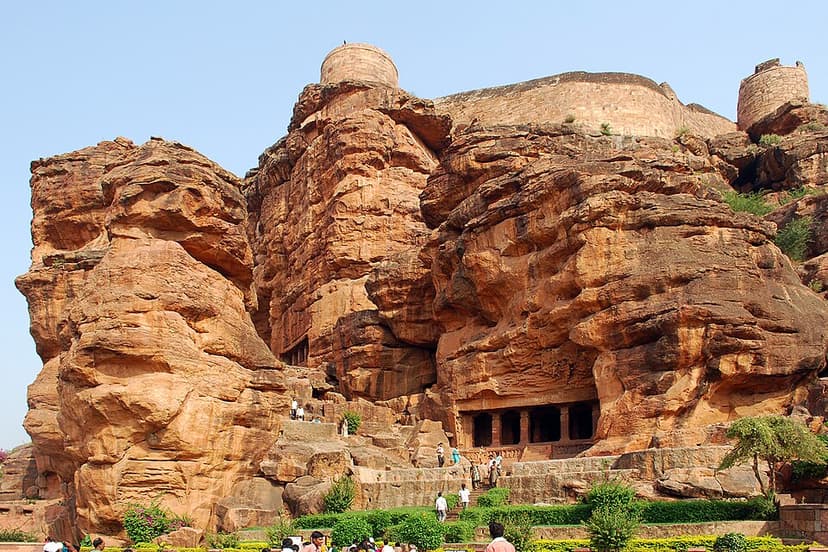
The Badami cave temples, located in the town of Badami in Karnataka, India, are a remarkable complex of rock-cut cave monuments that stand as significant examples of early Indian architecture, particularly the Badami Chalukya style. Carved into the soft sandstone cliffs of a hill, these temples represent some of the earliest known rock-cut structures in the Deccan region, with the earliest dating back to the 6th century CE. The complex consists of four main caves, numbered 1 to 4 in ascending order, dedicated to Hindu deities and Jain Tirthankaras, along with other minor caves.
Historical Context and Architecture
Badami, previously known as Vatapi, was the capital of the early Chalukya dynasty, which ruled from the 6th to the 8th century. The cave temples were carved from the natural cliff face, with each cave typically featuring a verandah, a columned hall (mantapa), and a shrine (garbha griha). The architectural styles found within the caves display a blend of the northern Nagara and southern Dravida traditions, with some examples of the Vesara style, a synthesis of both.
Religious Significance and Iconography
The first three caves are dedicated to Hindu deities, primarily Shiva and Vishnu. Cave 1 features a prominent sculpture of Shiva as Nataraja in a dynamic dance pose, alongside depictions of Harihara (a fused form of Shiva and Vishnu) and Ardhanarishvara (Shiva and Parvati as one). Cave 2 showcases Vishnu in his Trivikrama and Varaha avatars, while Cave 3, the largest and earliest dated Hindu cave temple, elaborately depicts Vishnu in various forms, including Anantasayana and Narasimha. Cave 4 is dedicated to Jainism, housing images of Tirthankaras such as Bahubali, Parshvanatha, and Mahavira.
Artistic and Cultural Importance
Beyond their religious significance, the Badami cave temples are celebrated for their exquisite sculptural details and early fresco paintings, some of which are still visible. The artwork demonstrates a sophisticated understanding of anatomy, iconography, and artistic composition, providing insights into the culture, clothing, and beliefs of the 6th and 7th centuries. The complex is situated near other historically important sites like Aihole and Pattadakal, which together form a crucial area for the study of the evolution of Indian temple architecture.
Source: Wikipedia ↗
Frequently Asked Questions
What are the Badami cave temples and where are they located?
The Badami cave temples are a collection of rock-cut caves in Badami, a town in the Bagalkot district of Karnataka, India. They are important examples of Indian rock-cut architecture, dating back to the 6th century.
What deities are primarily worshipped at the Badami cave temples?
The first three caves are dedicated to Hindu deities, featuring prominent sculptures of Shiva and Vishnu. Cave 1 has a notable carving of Shiva as Nataraja, while Cave 2 and 3 focus on Vishnu in various forms and avatars. Cave 4 is dedicated to Jainism.
What is the architectural style of the Badami cave temples?
The temples are notable for their rock-cut architecture, showcasing elements of the Badami Chalukya style. They also exhibit a fusion of northern Nagara and southern Dravida styles, with some examples of the Vesara style.
When were the Badami cave temples constructed?
The earliest of the Badami cave temples date from the 6th century. An inscription in Cave 3 indicates its dedication in 578/579 CE, making it the oldest firmly-dated Hindu cave temple in India.
Are the Badami cave temples a UNESCO World Heritage Site?
The Badami cave temples are part of a UNESCO-designated World Heritage Site candidate titled "Evolution of Temple Architecture – Aihole-Badami-Pattadakal" in the Malaprabha river valley.
What are some of the famous sculptures found in the Badami cave temples?
The temples are known for their intricate carvings, including a 5-foot tall Nataraja (dancing Shiva) in Cave 1, depictions of Vishnu as Trivikrama and Varaha in Cave 2, and elaborate friezes of Vishnu in various avatars in Cave 3. Cave 4 features significant Jain figures.
Related Temples (Hindu)

Harishchandragad
Harishchandragad is an ancient hill fort located in the Ahilyanagar district of India, with a history stretching back to the 6th century. It served as a strategic defensive point and cultural hub, featuring ancient caves, temples, and significant geological formations. The fort is renowned for its historical importance, architectural remnants, and natural beauty.
Badami
Badami, formerly known as Vātāpi, served as the regal capital of the Badami Chalukyas from 540 to 757 CE. This town is renowned for its rock-cut monuments, including the Badami cave temples, and structural temples like the Bhutanatha group. Situated in a ravine surrounded by red sandstone cliffs and the Agastya lake, Badami is a significant heritage city in India.

Tirupparankunram Murugan Temple
The Tirupparankunram Murugan Temple is a significant rock-cut Hindu temple dedicated to Lord Murugan, located in Thiruparankundram, Tamil Nadu, India. It is recognized as one of the Six Abodes of Murugan and holds mythological importance as the site where Murugan married Deivanai. The temple features intricate rock-cut architecture and has a history dating back to the 6th century CE.