
Harishchandragad
Harishchandragad is an ancient hill fort located in the Ahilyanagar district of India, with a history stretching back to the 6th century. It served as a strategic defensive point and cultural hub, featuring ancient caves, temples, and significant geological formations. The fort is renowned for its historical importance, architectural remnants, and natural beauty.
Key Facts
- ›The fort's history dates back to the 6th century during the Kalachuri dynasty.
- ›Ancient caves, some carved in the 11th century, contain idols of Lord Vishnu.
- ›The Kedareshwar Cave houses a Shiva Linga submerged in waist-deep, ice-cold water.
- ›Kokan Kada, a west-facing cliff, offers views and exhibits phenomena like the Brocken spectre and vertical cloud bursts.
- ›Taramati peak, the highest point at 1429 meters, provides panoramic views of surrounding forts and regions.
- ›The Nageshwar temple near Khireshwar features a rare 1.5-meter long sculpture of 'Sheshshayi Vishnu'.

Shiva, Vishnu, Mahadeva
Historical Defensive Fort, Ancient Cultural Hub, Geological Formations, Pilgrimage Site
Kalachuri Dynasty, Mahadev Koli, Moguls, Marathas
Stone
Kalachuri Dynasty
Sheshshayi Vishnu, Faces of Guards of the Temple, Sculptures Carved Out In the Cave
River Mangalganga, Pimpalgaon Joge Dam
About Harishchandragad
Harishchandragad is a significant hill fort situated in the Ahilyanagar district of India, recognized for its profound historical and cultural importance. The fort's origins are traced back to the 6th century, during the reign of the Kalachuri dynasty, who were instrumental in its initial construction. Its strategic location has historically made it a key point for guarding and controlling the surrounding territories.
History and Culture
The fort's history is layered, with evidence of Microlithic human presence found at the site. The various Puranas, ancient Hindu scriptures, contain numerous references to Harishchandragad, highlighting its long-standing significance. The citadel was established during the Kalachuri era, and the numerous caves, likely carved around the 11th century, often contain idols of Lord Vishnu. The presence of diverse cultures is indicated by the architectural styles and carvings found in temples like Nageshwar and Harishchandreshwar, and the Kedareshwar cave, which are associated with the Mahadev Koli tribes who controlled the fort before the Mughals. The fort later came under Mughal control before being captured by the Marathas in 1747.
Notable Sites
Harishchandragad is home to several remarkable sites. The Saptatirtha Pushkarni is a well-constructed lake with temple-like structures housing idols of Lord Vishnu. The Kedareshwar Cave is a striking natural formation featuring a large Shiva Linga submerged in perpetually cold, waist-deep water, believed to be the origin of the River Mangalganga. Kokan Kada, a dramatic west-facing cliff, offers breathtaking views and showcases natural phenomena like the Brocken spectre and vertical cloud bursts. Taramati peak, the highest point on the fort at 1429 meters, provides panoramic vistas of the surrounding mountain ranges and forts. The caves spread across the fort served as shelters and places of accommodation. The Nageshwar temple near Khireshwar is celebrated for its artistic works, particularly a rare sculpture of 'Sheshshayi Vishnu'. The main Temple of Harishchandreshwar is a testament to ancient Indian stone carving artistry, with architectural similarities to North Indian temples and a nearby temple, Kashitirtha, carved from a single rock.
Access and Trekking
Harishchandragad is accessible from the converging boundaries of Thane, Pune, and Ahmednagar districts. Several trekking routes lead to the fort, with popular ones originating from Khireshwar and Pachnai villages. These routes involve ascending through varied terrains, including rocky patches and dense forests, offering a challenging yet rewarding experience for trekkers. Basic amenities like drinking water are available from natural sources and tanks, and temporary shacks provide meals and accommodation on weekends.
Source: Wikipedia ↗
Frequently Asked Questions
What is the historical significance of Harishchandragad?
Harishchandragad is an ancient hill fort with a history linked to the 6th century and the Kalachuri dynasty, playing a role in guarding and controlling the surrounding region. Remnants of Microlithic man have also been discovered here, indicating a very early human presence.
What are the notable natural and architectural features of Harishchandragad?
The fort boasts several key attractions, including the Kedareshwar Cave with its submerged Shiva Linga, the dramatic Kokan Kada cliff known for unique atmospheric phenomena, and Taramati peak, the highest point offering expansive views. Ancient caves with idols and temples like the Harishchandreshwar temple showcase its historical architecture.
What is special about the Kedareshwar Cave?
The Kedareshwar Cave is famous for its large Shiva Linga which is permanently submerged in waist-deep, ice-cold water. The cave is also noted for water seeping daily from its walls and is considered the origin of the River Mangalganga.
Can you describe Kokan Kada?
Kokan Kada is a prominent west-facing cliff on Harishchandragad that overlooks the Konkan region. It is known for its overhang, offering stunning views, and for exhibiting phenomena like the Brocken spectre and vertical cloud bursts.
What is the significance of the Nageshwar temple?
The Nageshwar temple, located near Khireshwar village, is an antique construction noted for its diverse artistic works. Its main attraction is a rare 1.5-meter long sculpture of Lord Vishnu in a sleeping posture, known as 'Sheshshayi Vishnu'.
What are the different routes to reach Harishchandragad?
There are multiple trekking routes to Harishchandragad, including popular ones from Khireshwar and Pachnai villages. Other less common routes exist, such as the one via Sadhleghat from Belpada, offering different experiences and challenges for hikers.
Related Temples (Hindu)
Badami
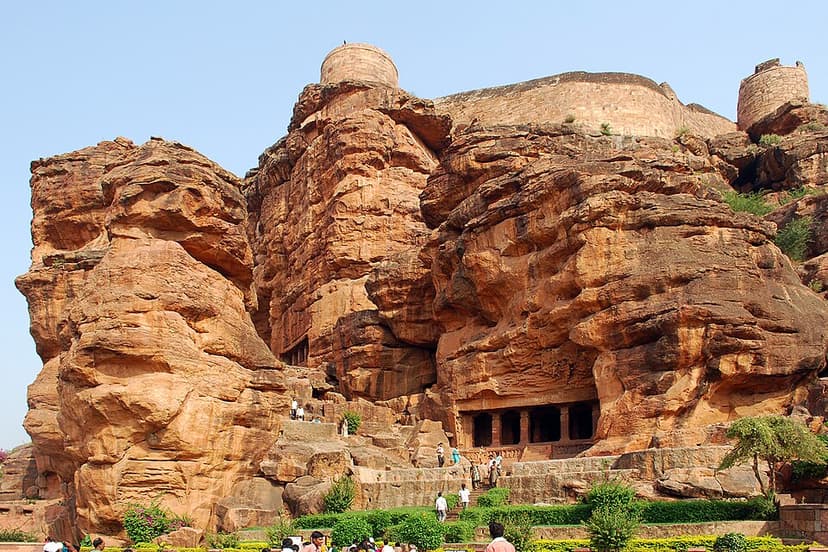
Badami, formerly known as Vātāpi, served as the regal capital of the Badami Chalukyas from 540 to 757 CE. This town is renowned for its rock-cut monuments, including the Badami cave temples, and structural temples like the Bhutanatha group. Situated in a ravine surrounded by red sandstone cliffs and the Agastya lake, Badami is a significant heritage city in India.

Tirupparankunram Murugan Temple
The Tirupparankunram Murugan Temple is a significant rock-cut Hindu temple dedicated to Lord Murugan, located in Thiruparankundram, Tamil Nadu, India. It is recognized as one of the Six Abodes of Murugan and holds mythological importance as the site where Murugan married Deivanai. The temple features intricate rock-cut architecture and has a history dating back to the 6th century CE.

Badami cave temples
The Badami cave temples are a significant complex of rock-cut caves located in Badami, Karnataka, India, renowned for their early examples of Indian rock-cut architecture, particularly the Badami Chalukya style. Dating back to the 6th century, these temples showcase a blend of Hindu, Jain, and possibly Buddhist influences, and are crucial for understanding the evolution of temple architecture in the Deccan region.