
Alopi Devi Mandir
The Alopi Devi Mandir is a significant Hindu temple located in Alopibagh, Prayagraj, Uttar Pradesh, India. Peculiarly, it lacks a statue of any deity, instead venerating a wooden carriage or 'doli'. The temple is associated with the belief of the goddess Sati's body parts falling at various holy sites, with one tradition suggesting this location as the final resting place of her body, hence the name 'Alopi' meaning 'disappeared'.
Key Facts
- ›The temple is situated in Alopibagh, Prayagraj, Uttar Pradesh, India.
- ›It is located near the holy Sangam, the confluence of the Ganges, Yamuna, and the mythical Sarasvati rivers.
- ›Instead of a deity idol, a wooden carriage or 'doli' is worshipped within the temple.
- ›The name 'Alopi' signifies 'disappeared', linked to legends of the goddess Sati or a bride.
- ›The temple's prominence and following have increased significantly since the 1990s.
- ›It is a place where locals share life events with their guarding deity.

Alopi Devi
Religious Pilgrimage, Local Devotion, Association With the Sangam and Kumbh Mela
Kumbh Mela
Wood
Ganges, Yamuna, Sarasvati
About Alopi Devi Mandir
The Alopi Devi Mandir is a significant Hindu temple situated in the Alopibagh area of Prayagraj, Uttar Pradesh, India. Its unique characteristic lies in the absence of a traditional idol; instead, devotees worship a wooden carriage, known as a 'doli'. The temple's name, 'Alopi', which means 'disappeared', is central to its lore and is linked to compelling legends that underscore its spiritual importance.
Legends and Origins
Two primary narratives explain the temple's name and significance. One tradition connects it to the Hindu belief surrounding the goddess Sati. Following her demise, a grieving Shiva is said to have carried her body, and Vishnu's discus then dismembered it, with parts falling at various sacred sites across India. This location is believed by some to be where the final part of Sati's body fell, marking the conclusion of her disappearance and sanctifying the site. However, this interpretation is debated, as the Lalita Devi temple in Prayagraj is recognized as the sole Shakti Peeth in the city, where Sati's fingers are said to have fallen.
A more widely accepted account, rooted in oral history, recounts an incident from a time when the region was heavily forested and prone to banditry. A marriage procession passing through the area was ambushed by robbers who looted the attendees. When the robbers attempted to steal the bride's carriage, they discovered it was empty; the bride had miraculously vanished. This event led to the bride being venerated as 'Alopi Devi', the 'virgin goddess who had disappeared', and a temple was subsequently established at the site.
Religious and Cultural Significance
The Alopi Devi Mandir is located in close proximity to the holy Sangam, the sacred confluence of the Ganges, Yamuna, and the mythical Sarasvati rivers, a site of immense religious importance and a focal point for the Kumbh Mela. The temple has historically been a prominent neighborhood shrine, but its influence and following have seen a substantial increase since the 1990s. This surge in devotion has led to considerable renovations of the surrounding area, reflecting its growing importance in the spiritual landscape of Prayagraj. Locals continue to share their life's significant events, including festivals, marriages, births, and deaths, with their guarding deity at the Alopi Devi Mandir.
Source: Wikipedia ↗
Frequently Asked Questions
What is unique about the worship at Alopi Devi Mandir?
Unlike most Hindu temples, Alopi Devi Mandir does not house a statue of any deity. Instead, worship is directed towards a wooden carriage, known as a 'doli'.
What is the significance of the name 'Alopi Devi'?
The name 'Alopi' translates to 'disappeared'. This name is linked to two prominent legends: one involving the goddess Sati and another about a bride who magically vanished from her carriage.
Where is Alopi Devi Mandir located?
The temple is situated in Alopibagh, within the city of Prayagraj in the state of Uttar Pradesh, India. It is notably close to the sacred Sangam, the confluence of three holy rivers.
Are there any historical connections to the temple's location?
The temple is near the Sangam, a site developed by the Maratha warrior Shreenath Mahadji Shinde in the late 18th century. Later renovations to the Sangam ghats and temples were undertaken by Maharani Baizabai Scindia in the 19th century.
What is the origin of the Alopi Devi legend?
One legend suggests that the name originates from the belief that after the death of his wife Sati, Shiva's grief led to parts of her body falling at various sacred sites; this location is believed to be where her disappearance was concluded. Another, more credible, oral tradition speaks of a bride who disappeared from her carriage when attacked by robbers.
Related Temples (Hindu)

Taraknath Temple
The Taraknath Temple, located in Tarakeswar, West Bengal, India, is a significant Hindu pilgrimage site dedicated to Lord Shiva, worshiped here as Tarakanatha. Constructed in 1729, it features a distinct Bengal architectural style with an 'atchala' structure and an adjacent 'natmandir'. The temple is renowned for its belief that a dip in the nearby Dudhpukur tank fulfills prayers and is considered one of the 64 Jyotirlingas.

Tanot Mata Temple
The Tanot Mata Temple is a significant Hindu shrine located in the Jaisalmer district of Rajasthan, India, near the Pakistan border. Revered as a form of Goddess Hinglaj Mata, the temple is famously associated with the Indian victories in the Indo-Pakistani Wars of 1965 and 1971, with local folklore attributing the successful outcomes to divine intervention. The Border Security Force of India now manages the temple complex, which also includes a victory tower and a war museum.
Thriprayar Temple
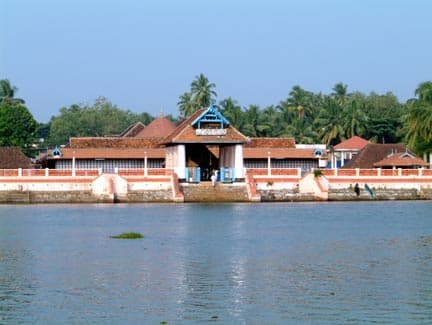
The Thriprayar Temple, also known as the Shree Ramaswami Temple, is a significant Hindu temple located in Triprayar, Thrissur district, Kerala, India. It is dedicated to Lord Rama, the seventh incarnation of Vishnu, who is depicted with four arms holding a conch, discus, bow, and garland. The temple's origin story involves the idol being worshipped by Krishna in Dwarka, later immersed in the sea, and eventually found by fishermen.