
Wudang Shan
The Wudang Mountains are a sacred mountain range in Hubei, China, renowned as a major center for Taoism and the practice of tai chi. They are home to a significant complex of Taoist temples and monasteries, recognized as a UNESCO World Heritage Site for their religious importance and architectural achievements. Historically, Wudang Shan has been a focal point for Taoist pilgrimages and the development of internal martial arts.
Key Facts
- ›The Wudang Mountains are considered one of the "four Sacred Mountains of Taoism" in China.
- ›The mountains are famous for their Taoist temples and monasteries, with the largest complex built during the Ming Dynasty.
- ›The Golden Hall and the Ancient Bronze Shrine, dating to 1307, are among the oldest surviving structures.
- ›The Wudang Mountains are intrinsically linked to the practice and legend of tai chi, with sage Zhang Sanfeng credited with its creation.
- ›The monasteries and their surroundings were designated a UNESCO World Heritage Site in 1994.
- ›The area is a significant destination for Taoist pilgrimages.
Wudangshan
- Center For Taoist Practice and Philosophy
- Origin and Practice of Tai Chi and Wudangquan Martial Arts
- Destination For Taoist Pilgrimages
- Architectural Heritage of Taoist Temples and Monasteries
Visiting Taoist Temples and Monasteries, Practicing Tai Chi and Martial Arts, Spiritual Reflection
Xuantian Shangdi, Zhang Sanfeng
About Wudang Shan
Wudang Mountains
The Wudang Mountains (Wǔdāng Shān) are a significant mountain range located in the northwestern region of Hubei province, China. This sacred mountain range is deeply intertwined with Taoism, serving as a renowned center for its practices, philosophy, and the development of internal martial arts, most notably tai chi.
History and Development
The Wudang Mountains have been recognized as an important Taoist center for centuries. The first sacred site, the Five Dragons Temple, was established during the Tang Dynasty. Subsequent dynasties, including the Song and Yuan, saw the addition of further structures. The most extensive temple complexes were constructed during the Ming Dynasty (14th–17th centuries), partly due to the Yongle Emperor's claimed divine protection from the god Beidi, or Xuantian Shangdi. At its peak during the Ming era, the site boasted numerous palaces, monasteries, nunneries, and temples. Today, 53 ancient buildings remain, with the oldest surviving structures being the Golden Hall and the Ancient Bronze Shrine, both dating back to 1307. Other significant historical buildings include Nanyang Palace and the Purple Cloud Temple.
Spiritual and Martial Arts Significance
The Wudang Mountains are considered one of the "Four Sacred Mountains of Taoism" in China and are a vital destination for Taoist pilgrimages. They are famously associated with the practice of tai chi, with legend attributing its creation to the Taoist sage Zhang Sanfeng, who is said to have lived in the mountains. Martial arts styles categorized as Wudangquan, which often incorporate Taoist internal exercises, are central to the mountain's cultural identity. The area continues to be a focal point for traditional Wushu festivals.
Recognition and Geography
In recognition of their religious importance and architectural achievements, the complex of Taoist monasteries within the Wudang Mountains was designated a UNESCO World Heritage Site in 1994. The name "Wudangshan" can refer to the entire mountain range or a specific group of peaks within the Wudangshan subdistrict of Danjiangkou, Shiyan, which is the primary Taoist center. The highest peak in the "proper" Wudang Shan area reaches an elevation of 1612 meters, though the broader range contains somewhat higher elevations. Some geologists consider the Wudang Mountains to be a branch of the larger Daba Mountains range.
Source: Wikipedia ↗
Frequently Asked Questions
What is the Wudang Mountains known for?
The Wudang Mountains are primarily known as a sacred site for Taoism and a major center for the practice of tai chi and other internal martial arts. They are also famous for their extensive complexes of Taoist temples and monasteries.
What is the significance of the Wudang Mountains in Taoism?
They are considered one of the Four Sacred Mountains of Taoism in China and are an important destination for Taoist pilgrimages. The mountains are associated with the Lord of the North, Xuantian Shangdi, and have been a hub for Taoist philosophy and practice for centuries.
Are the Wudang Mountains a UNESCO World Heritage Site?
Yes, the Wudang Mountains, specifically the famous complex of Taoist temples and monasteries, were inscribed as a UNESCO World Heritage Site in 1994. This designation recognizes their profound religious significance and exceptional architectural achievements.
What is the connection between Wudang Mountains and Tai Chi?
The Wudang Mountains are strongly associated with the origins and practice of tai chi. According to legend, the Taoist sage Zhang Sanfeng, who lived in the mountains, created tai chi. Styles of martial arts considered part of Wudangquan often have a strong element of Taoist neidan (internal elixir) exercises.
What are some of the oldest structures in the Wudang Mountains?
Among the oldest existing structures in the Wudang Mountains are the Golden Hall and the Ancient Bronze Shrine, both made in 1307. Other notable ancient structures include Nanyang Palace and the stone-walled Forbidden City of the Taihe Palace.
Related Sacred Mountains
Tai Shan
Mount Tai is a mountain of immense historical and cultural significance in China, revered as the foremost of the Five Sacred Mountains. For over 3,000 years, it has been a vital ceremonial center, particularly for imperial sacrifices to Heaven and Earth, and is associated with sunrise, birth, and renewal. Its profound spiritual importance and dramatic landscape led to its designation as a UNESCO World Heritage Site.
Hua Shan
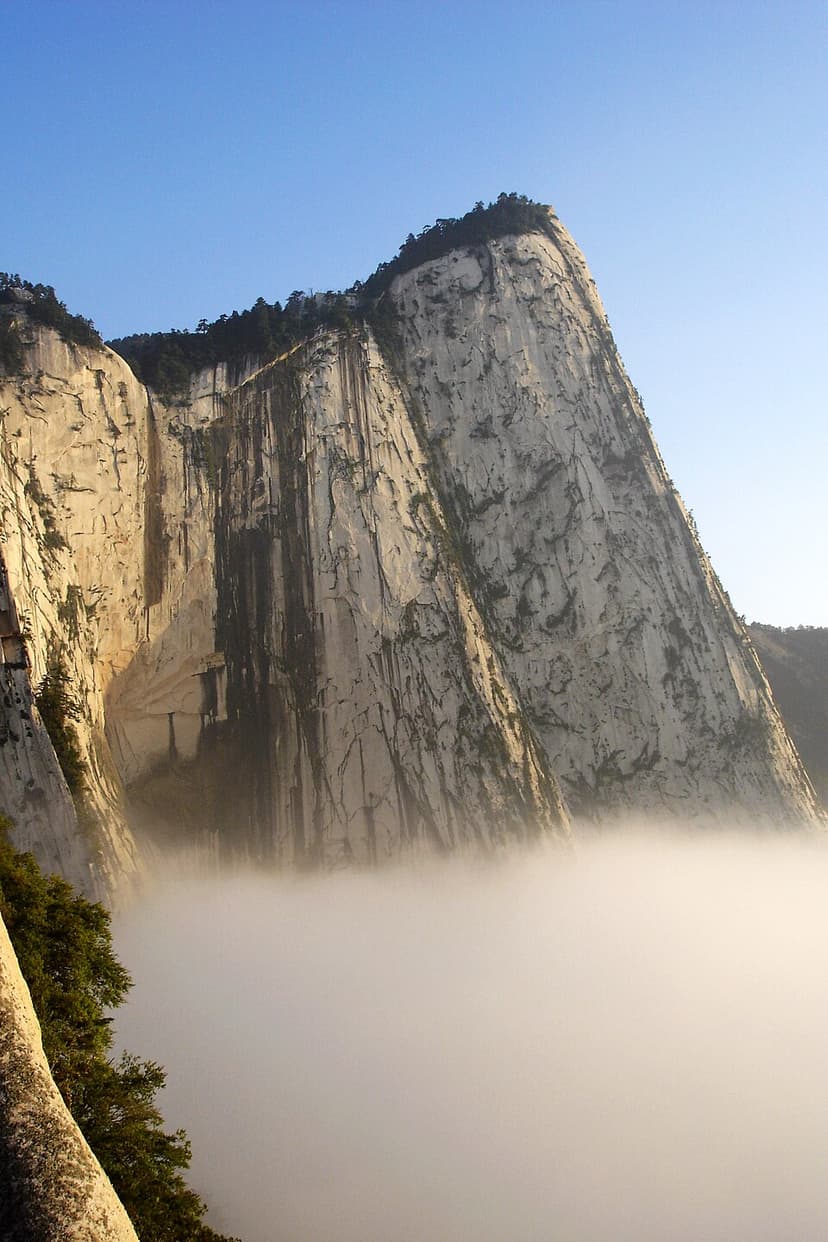
Mount Hua, also known as Huashan, is a sacred mountain in Shaanxi Province, China, renowned for its dramatic cliffs and religious significance. As one of China's Five Great Mountains, it has been a site of reverence, particularly in Taoism, with a history of pilgrimage and spiritual seeking dating back to the 2nd century BC.

Mount Lao
Mount Lao, also known as Laoshan, is a significant mountain located on the southeastern coast of China's Shandong Peninsula. It is renowned as a cradle of Taoism, housing numerous temples and being associated with the development of the Complete Perfection School. The mountain is also recognized for its geological formations, rich cultural traditions, and natural beauty, attracting both pilgrims and tourists.