
Tai Shan
Mount Tai is a mountain of immense historical and cultural significance in China, revered as the foremost of the Five Sacred Mountains. For over 3,000 years, it has been a vital ceremonial center, particularly for imperial sacrifices to Heaven and Earth, and is associated with sunrise, birth, and renewal. Its profound spiritual importance and dramatic landscape led to its designation as a UNESCO World Heritage Site.
Key Facts
- ›The tallest peak, Jade Emperor Peak, reaches 1,545 meters (5,069 ft).
- ›Mount Tai is considered the easternmost of the five Sacred Mountains of China.
- ›It has been a site of worship and imperial sacrifice for at least 3,000 years.
- ›Designated a UNESCO World Heritage Site in 1987, meeting 7 out of 10 evaluation standards.
- ›The mountain's geological formation is complex, with uplift occurring over millions of years.
- ›Over 1,800 stone inscriptions and steles are found on Mount Tai, documenting its history and cultural significance.
Mount Dai
- Easternmost of the Five Sacred Mountains of China.
- Associated With Sunrise, Birth, and Renewal.
- Imperial Ceremonial Center For Sacrifices To Heaven and Earth.
- Place of Worship For At Least 3,000 Years.
- Inspiration For Poets, Writers, and Artists.
- Site of Numerous Historical Inscriptions and Temples.
Climbing the Mountain Via Stone Steps., Visiting Temples and Shrines., Observing and Performing Sacrifices .
Confucius, Qin Shi Huang, Emperor Shun, Emperor Wu Di of Han, Emperor Gaozong of Tang, Pangu, Dongyue Dadi, Bixia Yuanjun, Yanguang Niangniang, Songzi Niangniang, Shi Gandang
About Tai Shan
What is Mount Tai?
Mount Tai (Tài Shān) is a mountain of profound historical and cultural significance in China, revered as the foremost of the Five Sacred Mountains. Located in western Shandong province, north of Tai'an city, it is the highest point in the province and is associated with concepts of sunrise, birth, and renewal. For at least 3,000 years, Mount Tai has served as one of China's most important ceremonial and religious centers, drawing emperors, scholars, and pilgrims alike.
History and Religious Significance
The worship of Mount Tai has a tradition dating back over three millennia, evolving into the significant imperial rite known as the Feng and Shan sacrifices. Emperors performed these ceremonies on the summit (Feng) and at the foot of the mountain (Shan) to pay homage to Heaven and Earth, marking periods of peace and imperial unity. Historical records indicate that 72 emperors visited Mount Tai for these rituals. The mountain also holds importance in Confucianism, Buddhism, and Taoism, with numerous temples, shrines, and inscriptions detailing its spiritual and cultural legacy.
Geological and Natural Features
Geologically, Mount Tai is a tilted fault-block mountain, formed over millions of years through complex processes of uplift and folding. The oldest strata date back to the Archean Era. The mountain exhibits a vertical climate gradient, with distinct vegetation zones from its warm temperate foothills to its medium temperate summit. It is known for its rich flora, comprising nearly 1,000 species, and ancient trees like the Han Dynasty Cypresses.
Cultural Heritage and Tourism
Mount Tai is a UNESCO World Heritage Site, recognized for its exceptional natural beauty and cultural importance. The mountain is adorned with over 1,800 stone inscriptions and steles, including those at the Dai Temple, a grand building complex at its base that replicates imperial palace architecture. Pilgrims and tourists ascend the mountain via a famous route of approximately 7,200 stone steps, passing numerous historical monuments and scenic sites. The peak offers panoramic views, and the inscription "Most Revered of the Five Sacred Mountains" (Wǔyuè Dúzūn) on Sun Viewing Peak is particularly renowned.
Source: Wikipedia ↗
Frequently Asked Questions
What is the elevation of Mount Tai?
The tallest peak, Jade Emperor Peak, is commonly reported as being 1,545 meters (5,069 ft) tall. The mountain's elevation ranges from 150 to 1,545 meters above sea level.
What is Mount Tai's significance in Chinese culture and religion?
Mount Tai is highly significant as the easternmost of the Five Sacred Mountains of China. It is associated with sunrise, birth, and renewal, and has been a crucial imperial ceremonial center for over 3,000 years. Emperors performed sacrifices here to pay homage to Heaven and Earth.
Is Mount Tai a UNESCO World Heritage Site?
Yes, Mount Tai was made a UNESCO World Heritage Site in 1987 due to its sacred importance and dramatic landscape. It is noted for meeting a high number of the evaluation standards for World Heritage sites.
What geological processes formed Mount Tai?
Mount Tai was formed primarily in the mid-Cenozoic era, about 30 million years ago, after a long geological history involving subsidence, uplift, folding, and fracturing. Its foundation includes ancient rocks like gneiss.
What are some notable features or structures on Mount Tai?
Notable features include the Dai Temple at the foot of the mountain, the Shrine of the Blue Dawn near the summit, and the famous 'Shibapan' (18 levels stairs). Numerous stone inscriptions, steles, and temples are also scattered across the mountain.
Can you climb Mount Tai?
Yes, visitors can climb Mount Tai, with a popular route featuring approximately 7,200 stone steps leading to the summit. Access to the peak is also available via bus and cable car.
What is the history of worship at Mount Tai?
Religious worship at Mount Tai dates back 3,000 years, evolving into the Feng and Shan sacrifices, an official imperial rite. Emperors visited for millennia to perform sacrifices and pay homage.
Are there any deities associated with Mount Tai?
Yes, the supreme god of Mount Tai is the Great Deity of Mount Tai (Dongyue Dadi). Other venerated deities include Bixia Yuanjun (Goddess of the Blue Dawn), Yanguang Niangniang (goddess of eyesight), and Songzi Niangniang (goddess of fertility).
Related Sacred Mountains
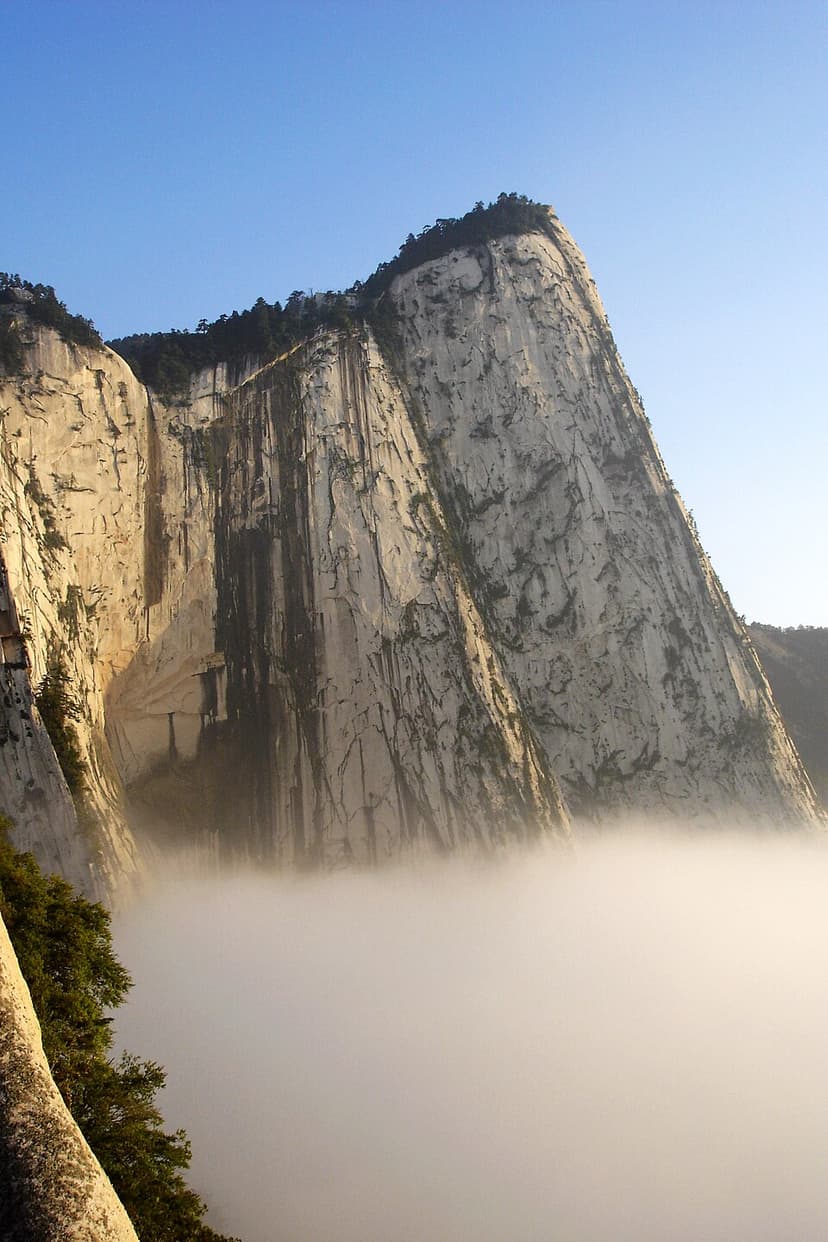
Hua Shan
Mount Hua, also known as Huashan, is a sacred mountain in Shaanxi Province, China, renowned for its dramatic cliffs and religious significance. As one of China's Five Great Mountains, it has been a site of reverence, particularly in Taoism, with a history of pilgrimage and spiritual seeking dating back to the 2nd century BC.

Mount Lao
Mount Lao, also known as Laoshan, is a significant mountain located on the southeastern coast of China's Shandong Peninsula. It is renowned as a cradle of Taoism, housing numerous temples and being associated with the development of the Complete Perfection School. The mountain is also recognized for its geological formations, rich cultural traditions, and natural beauty, attracting both pilgrims and tourists.
Wudang Shan
The Wudang Mountains are a sacred mountain range in Hubei, China, renowned as a major center for Taoism and the practice of tai chi. They are home to a significant complex of Taoist temples and monasteries, recognized as a UNESCO World Heritage Site for their religious importance and architectural achievements. Historically, Wudang Shan has been a focal point for Taoist pilgrimages and the development of internal martial arts.