
Hua Shan
Mount Hua, also known as Huashan, is a sacred mountain in Shaanxi Province, China, renowned for its dramatic cliffs and religious significance. As one of China's Five Great Mountains, it has been a site of reverence, particularly in Taoism, with a history of pilgrimage and spiritual seeking dating back to the 2nd century BC.
Key Facts
- ›Recognized as the "Western Mountain" of China's five Great Mountains.
- ›Traditionally had three main peaks, now recognized as five, with the South Peak being the highest at 2,154.9 meters.
- ›Has a history of Taoist temples and was considered inhabited by the god of the underworld.
- ›Kou Qianzhi and Chen Tuan, prominent Taoist figures, had significant connections to the mountain.
- ›The mountain is known for its perilous ascent routes, carved into cliff faces with chains for support.
- ›Considered one of Taoism's five holiest sites.
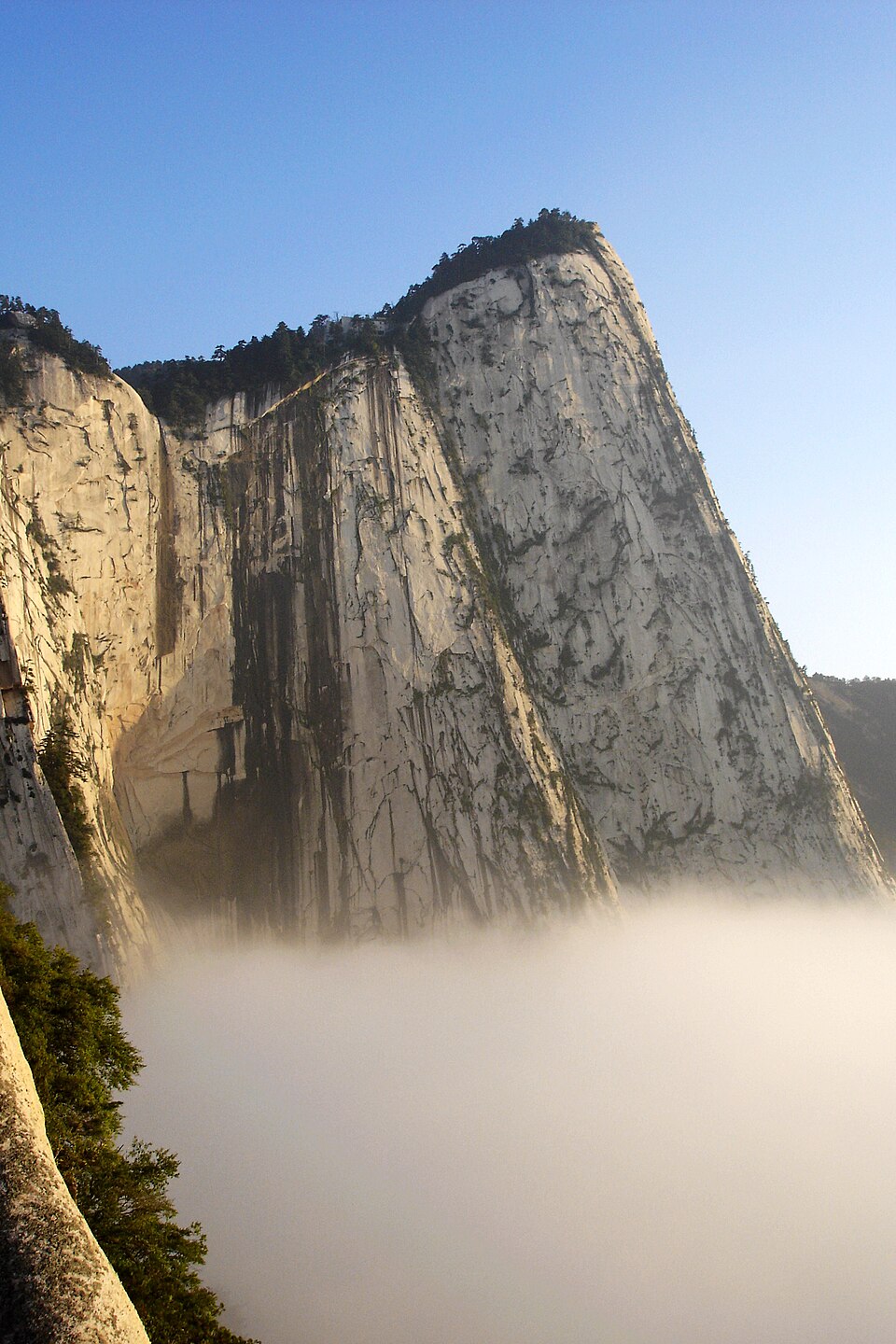
Huashan, Taihua Shan, Great Flower Mountain, Number One Steepest Mountain Under Heaven
- One of the 'Five Great Mountains' of China.
- Considered A Sacred Place In Taoism, One of Its Five Holiest Sites.
- Revered As the Western Marchmount and Received Offerings Since the Han Dynasty.
- Officially Designated As the Sacred Mountain of the Tang Royal Family.
- Associated With Legends of Gods and Heroic Figures.
- A Saying Among Chinese Scholars Emphasizes Its Importance: 'If You Do Not Visit Huashan, You Are Not A True Hero.'
- Ascent of the Mountain Via Various Trails.
- Visiting Temples and Shrines On the Slopes and Peaks.
- Seeking Immortality and Medicinal Plants.
- Climbing At Night To Reach the East Peak For Dawn.
Juling Shen, Xiyue Dadi, Huayue Sanniang, Chenxiang, Kou Qianzhi, Chen Tuan, Qin Shihuang, Tang Taizong, Sun Yat-Sen, Liu Xiang
About Hua Shan
Hua Shan: The Western Sacred Mountain
Mount Hua, known by its pinyin name Huashan, stands as one of China's Five Great Mountains and is particularly revered as the "Western Mountain." Located near Huayin city in Shaanxi Province, its dramatic landscape of steep cliffs and perilous ascents has captivated pilgrims and adventurers for centuries. The mountain's spiritual significance is deeply rooted in Taoism, where it is considered one of the faith's five holiest sites. Its history as a place of worship and spiritual seeking dates back to at least the 2nd century BC, with a Taoist temple established at its base.
Geography and Peaks
Geographically, Mount Hua is part of the Qinling Mountains, a significant range that divides northern and southern Shaanxi. The mountain is characterized by five main peaks, with the South Peak being the highest at 2,154.9 meters (7,070 ft). The ascent to these peaks is famously challenging, with ancient trails carved into the rock face, often featuring narrow pathways and chains for support. These routes, particularly the Canglong Ling (Dark Dragon Ridge), have earned Hua Shan the nickname "Number One Steepest Mountain Under Heaven."
Religious and Historical Importance
Mount Hua has been an important site for religious practices and imperial reverence. It was revered as the Western Marchmount, receiving offerings from the Han dynasty onwards. During the Tang dynasty, Emperor Xuanzong officially designated it as the sacred mountain of the Tang royal family, bestowing a prestigious title upon its revered deity. Prominent Taoist figures, such as Kou Qianzhi and Chen Tuan, spent significant time on the mountain, contributing to its spiritual legacy. The mountain also features numerous temples, including the Cloister of the Jade Spring dedicated to Chen Tuan and the Xiyue Temple, which served as a site for rulers to pay homage.
Legends and Modern Accessibility
Legends surrounding Hua Shan speak of its creation by the god Juling Shen and feature tales of divine daughters and heroic rescues, such as the story of Chenxiang splitting a massive rock to free his mother. In modern times, while retaining its challenging nature, Mount Hua has become more accessible with the development of new trails and the installation of a cable car. Despite enhanced safety measures, the mountain's dramatic geography continues to offer a formidable and awe-inspiring experience, attracting visitors seeking both spiritual connection and physical challenge.
Source: Wikipedia ↗
Frequently Asked Questions
What is the highest peak of Mount Hua?
The highest peak of Mount Hua is the South Peak, which reaches an elevation of 2,154.9 meters (7,070 ft). This peak features several summits, with Luoyan Feng (Landing Goose Summit) being the highest among them.
What is the historical religious significance of Mount Hua?
Mount Hua has been revered since at least the 2nd century BC, with a Taoist temple at its base. Taoists believed it was inhabited by the god of the underworld, and it became one of Taoism's five holiest sites.
Why is Mount Hua considered dangerous?
Mount Hua is known for its extremely steep and narrow pathways, often carved directly into cliff faces with chains for hikers to hold onto. While safety measures have been improved, its dramatic topography still contributes to its reputation as a dangerous hike.
Are there any famous legends associated with Mount Hua?
One prominent legend attributes the mountain's formation to the god Juling Shen, who severed it with an axe. Another legend tells of Huayue Sanniang, the mountain god's daughter, who married a mortal and was imprisoned beneath the mountain, later rescued by her son Chenxiang who split a large rock with his axe.
What are the main ascent routes to Mount Hua?
There are several routes leading to Mount Hua's peaks. The traditional Hua Shan Gorge route, developed over centuries, winds for 6 km to the North Peak. Other routes include one that follows a cable car and an ancient trail, and paths that ascend via the dramatic Canglong Ling ridge to reach the other major peaks.
Related Sacred Mountains
Tai Shan
Mount Tai is a mountain of immense historical and cultural significance in China, revered as the foremost of the Five Sacred Mountains. For over 3,000 years, it has been a vital ceremonial center, particularly for imperial sacrifices to Heaven and Earth, and is associated with sunrise, birth, and renewal. Its profound spiritual importance and dramatic landscape led to its designation as a UNESCO World Heritage Site.

Mount Lao
Mount Lao, also known as Laoshan, is a significant mountain located on the southeastern coast of China's Shandong Peninsula. It is renowned as a cradle of Taoism, housing numerous temples and being associated with the development of the Complete Perfection School. The mountain is also recognized for its geological formations, rich cultural traditions, and natural beauty, attracting both pilgrims and tourists.
Wudang Shan
The Wudang Mountains are a sacred mountain range in Hubei, China, renowned as a major center for Taoism and the practice of tai chi. They are home to a significant complex of Taoist temples and monasteries, recognized as a UNESCO World Heritage Site for their religious importance and architectural achievements. Historically, Wudang Shan has been a focal point for Taoist pilgrimages and the development of internal martial arts.