
Nevado Ojos del Salado
Argentina–Chile Border·South America
Nevado Ojos del Salado is a dormant complex volcano located in the Andes on the border of Argentina and Chile. It holds the distinction of being the highest volcano on Earth and the highest peak in Chile. The mountain is significant for its extremely dry conditions, which limit ice cover, yet it hosts the world's highest lake within its summit crater. Its volcanic activity dates back to the Pleistocene and Holocene, with the last eruption occurring around 750 CE.
Key Facts
- ›Highest volcano on Earth and highest peak in Chile.
- ›Features the world's highest lake at an elevation of 6,480–6,500 meters.
- ›Volcanically active during the Pleistocene and Holocene, with the last eruption around 750 CE.
- ›Located in the arid Puna de Atacama region, leading to extremely dry conditions and sparse ice cover.
- ›A complex volcano formed by overlapping lava domes, flows, and craters, covering an area of 70–160 sq km.
- ›First ascent was in 1937 by Jan Alfred Szczepański and Justyn Wojsznis.
Cerro Ojos Del Salado
- Considered A Significant Natural Landmark Due To Its Extreme Altitude and Unique Geographical Features.
- Its Name, "Ojos Del Salado," Is Derived From the RíO Salado and the Common Use of "Ojo" In Chile and Argentina To Denote A Spring Or Source of Water, Or Possibly Referring To Mineral Deposits On Its Flanks.
Jan Alfred SzczepańSki, Justyn Wojsznis
About Nevado Ojos del Salado
Nevado Ojos del Salado: The World's Highest Volcano
Nevado Ojos del Salado stands as a monumental dormant complex volcano in the Andes mountain range, straddling the border between Argentina and Chile. It holds the distinguished title of being the highest volcano on Earth and also serves as the highest peak in Chile. Its imposing stature, reaching 6,893 meters (22,615 ft) above sea level, is complemented by a unique and extreme environment.
Geography and Climate
Located near the Arid Diagonal of South America, Ojos del Salado is characterized by exceptionally dry conditions. This arid climate significantly limits the formation of substantial glaciers and permanent snow cover, even at its high altitude. Despite the aridity, a remarkable feature is the permanent crater lake, approximately 100 meters in diameter, located at an elevation of 6,480–6,500 meters within the summit crater. This lake is recognized as the highest lake of any kind in the world. The mountain lacks vegetation due to its altitude and desiccated climate, contributing to its stark, moonscape-like appearance.
Geological History and Activity
The volcano's geological history spans the Pleistocene and Holocene epochs, during which it primarily produced lava flows. Its development occurred in two phases, with a depression or caldera forming during its growth. The complex structure of Ojos del Salado includes multiple overlapping lava domes, lava flows, and volcanic craters, extending over an area of 70–160 square kilometers. While the last confirmed eruption occurred around 750 CE, observations of steam emissions in November 1993 have led to speculation about more recent activity. The mountain is considered a very low-risk volcano by geological agencies.
Exploration and Accessibility
An international highway traversing between Argentina and Chile passes north of the mountain, making it more accessible than many other high-altitude volcanoes in the region. The first recorded ascent of Ojos del Salado was achieved in 1937 by Jan Alfred Szczepański and Justyn Wojsznis, members of a Polish expedition. For a period in the mid-20th century, there was a debate regarding whether Ojos del Salado or Aconcagua was the highest peak in South America, a question ultimately resolved in favor of Aconcagua. The name "Ojos del Salado" itself is believed to refer to a salty river, Río Salado, or potentially to "salty eyes" or springs, alluding to the mineral deposits found on its flanks or the water sources in the area.
Source: Wikipedia ↗
Frequently Asked Questions
What is Nevado Ojos del Salado known for?
Nevado Ojos del Salado is renowned for being the highest volcano on Earth and the highest peak in Chile. It also hosts the world's highest lake, located within its summit crater.
Where is Nevado Ojos del Salado located?
This dormant complex volcano is situated in the Andes mountain range, straddling the border between Argentina and Chile.
What is the elevation of Nevado Ojos del Salado?
The highest summit of Nevado Ojos del Salado reaches an altitude of 6,893 meters (22,615 ft) above sea level.
When was the last eruption of Nevado Ojos del Salado?
The last confirmed eruption of Ojos del Salado occurred around 750 CE. There were observations of steam emissions in November 1993, which may have been another eruptive event.
Are there any lakes on Nevado Ojos del Salado?
Yes, remarkably, there is a permanent crater lake about 100 meters in diameter within the summit crater, situated at an elevation of 6,480–6,500 meters, making it the highest lake in the world.
What are the climbing conditions like on Nevado Ojos del Salado?
The mountain experiences extremely dry conditions due to its proximity to the Arid Diagonal of South America, which prevents substantial glaciers and permanent snow cover. While there is sparse ice cover, the arid climate and high altitude mean vegetation is absent.
Related Sacred Mountains
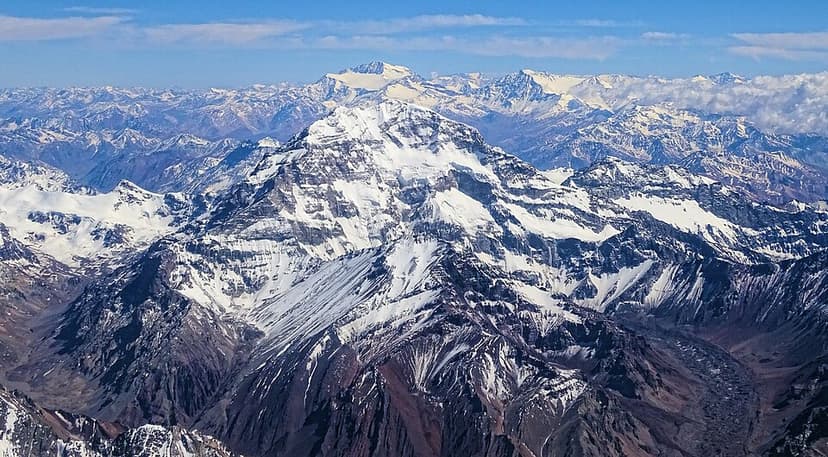
Aconcagua
Aconcagua is the highest mountain in the Americas, located in Mendoza Province, Argentina. It is also the highest peak outside of Asia and the second-most topographically prominent peak globally. Formed by tectonic activity, it was once an active stratovolcano and is now a significant challenge for mountaineers due to its extreme altitude, despite its technically straightforward normal route.

Machu Picchu
Machu Picchu is a 15th-century Inca citadel situated on a mountain ridge in southern Peru, standing as a significant symbol of the Inca civilization. Believed to have been an estate for Emperor Pachacuti, the site was likely abandoned around the time of the Spanish conquest, with modern dating placing its occupation between the early 15th and early 16th centuries. It is renowned for its classical Inca architecture, including finely crafted dry-stone walls and notable structures like the Temple of the Sun.

Mount Roraima
Mount Roraima is the highest tepui in the Pacaraima mountain chain, straddling the borders of Brazil, Guyana, and Venezuela. Known for its dramatic sheer cliffs and flat summit, it is a unique geological formation that has fostered a high degree of endemic flora and fauna due to its isolation. The mountain's name originates from the Pemon people, meaning "blue-green great," reflecting its natural beauty.