
Aconcagua
Argentina·South America
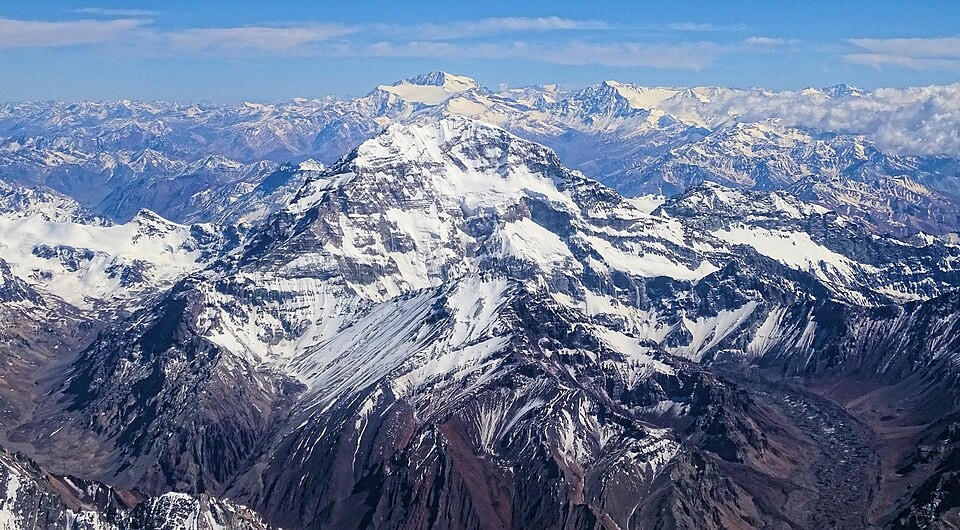
Aconcagua is the highest mountain in the Americas, located in Mendoza Province, Argentina. It is also the highest peak outside of Asia and the second-most topographically prominent peak globally. Formed by tectonic activity, it was once an active stratovolcano and is now a significant challenge for mountaineers due to its extreme altitude, despite its technically straightforward normal route.
Key Facts
- ›Highest mountain in the Americas and the highest outside Asia.
- ›Formed by the subduction of the Nazca Plate beneath the South American Plate.
- ›Once an active stratovolcano, volcanic activity ceased in the Miocene epoch.
- ›The normal route is considered technically straightforward, making it the highest non-technical mountain in the world.
- ›Extreme altitude presents significant risks, including altitude sickness and hypothermia, leading to its nickname 'Mountain of Death'.
- ›Inca civilization considered it a sacred mountain, performing sacrifices at its summit.
Aconca-Hue, Ackon Cahuak, Anco Cahuac, Janq'U Q'Awa
- Considered A Sacred Mountain By the Incas.
- Site of Ancient Inca Worship and Sacrifices, Including Human Sacrifices.
- the Aconcagua Mummy, Remains of A Child From the Highest Social Class, Found At A High-Altitude Worship Site.
- Subject of Mountaineering Records and Challenges.
- Ascent Via Various Routes For Mountaineering and Personal Challenge
- Visiting Historical Inca Worship Sites
Matthias Zurbriggen, Edward Fitzgerald, Paul GüSsfeldt, Konstanty Narkiewicz-Jodko, René Ferlet, Tyler Armstrong, Kaamya Karthikeyan, Scott Lewis, Miguel Doura, Kilian Jornet, Karl Egloff, Tyler Andrews, Fernanda Maciel, Daniela Sandoval, Cholita Climbers
- Permits Generally Required For Climbing.
- Waste Disposal Regulations Are Strictly Enforced.
- Climbers May Be Screened By Medical Teams At Base Camp.
About Aconcagua
Aconcagua is a colossal mountain situated in the Principal Cordillera of the Andes, within Argentina's Mendoza Province. It holds the distinction of being the highest peak in the Americas, the highest mountain outside of Asia, and the loftiest summit in both the Western and Southern Hemispheres. Its summit elevation reaches 6,967.15 meters (22,858.1 feet), and it is recognized as the second-most topographically prominent peak in the world. Aconcagua is also counted among the Seven Summits, the highest mountains on each of the seven continents.
Geological Formation and History
The mountain's formation is attributed to the subduction of the Nazca Plate beneath the South American Plate. Aconcagua was once an active stratovolcano, with volcanic activity present from the Late Cretaceous or Early Paleocene through the Miocene epoch. However, tectonic shifts during the Miocene, approximately 8 to 10 million years ago, led to a decrease in the subduction angle. This resulted in a halt to melting and increased horizontal stresses, causing thrust faults that uplifted the mountain from its volcanic base. Volcanic activity ceased long ago, and the rocks on its flanks are primarily volcanic in origin, including lavas, breccias, and pyroclastics.
Mountaineering Significance
For mountaineers, Aconcagua presents a significant challenge, primarily due to its extreme altitude. The atmospheric pressure at the summit is roughly 40% of that at sea level, leading to severe altitude sickness for most climbers. Despite this, the standard route from the north is considered technically straightforward, often described as the highest non-technical mountain in the world, not requiring ropes or specialized climbing equipment. Nevertheless, the severe environmental conditions contribute to its reputation, with approximately three deaths per year, earning it the somber nickname 'Mountain of Death.' Summit success rates are estimated between 30% and 40%.
Historical and Cultural Context
Historically, Aconcagua held significant spiritual importance for the Inca civilization. It was revered as a sacred mountain, with places of worship and sites for sacrifices, including human sacrifices, established at its high altitudes. Archaeological discoveries have uncovered remains of children, adorned in the attire of the highest social class, along with offerings of figures and coca leaves, indicating its role in Inca ritual practices. The first European attempt to summit was made in 1883 by Paul Güssfeldt, and the first recorded ascent was achieved in 1897 by Matthias Zurbriggen, a guide for a British expedition led by Edward FitzGerald.
Climbing Routes and Camps
Beyond the standard Normal Route from the north, climbers can opt for more demanding ascents. The Polish Glacier Traverse route, also known as the 'Falso de los Polacos,' involves crossing the Vacas Valley and ascending the Polish Glacier. More challenging still is the ascent via the Southwest Ridge or the famously difficult South Face. Established camps along the Normal Route include Puente del Inca, Confluencia, Plaza de Mulas (base camp), Camp Canadá, Nido de Cóndores, Camp Berlín, and Camp Colera, with summit attempts typically launched from high camps at Berlín or Colera.
Modern Records and Recognition
In recent times, Aconcagua has been the site of speed climbing records. Notable achievements include rapid ascents and descents by athletes like Kilian Jornet and Karl Egloff, with current records held by Tyler Andrews for men and Daniela Sandoval for women. In 2019, the 'Cholita climbers,' a group of Indigenous Aymara women, made history by ascending the mountain in traditional attire, documented in a film. Furthermore, in 2019, a twin-engine helicopter successfully landed on the summit, a first for a helicopter at such an extreme altitude.
Source: Wikipedia ↗
Frequently Asked Questions
What is the elevation of Aconcagua?
Aconcagua has a summit elevation of 6,967.15 meters (22,858.1 feet) above sea level. This makes it the highest peak in both the Western and Southern Hemispheres.
Is Aconcagua a volcano?
Aconcagua was once an active stratovolcano, formed by tectonic activity. However, volcanic activity ceased millions of years ago during the Miocene epoch, and it is now primarily known for its geological and mountaineering significance.
What are the main climbing routes on Aconcagua?
The most common route is the 'normal route' from the north, which is technically straightforward. Other more demanding routes include the Polish Glacier Traverse and the famously difficult South Face climb.
What are the risks associated with climbing Aconcagua?
The primary risks are extreme altitude, leading to altitude sickness and hypothermia, despite the technical ease of the normal route. The mountain records approximately three deaths per year, earning it the nickname 'Mountain of Death'.
Who first climbed Aconcagua?
The first recorded ascent of Aconcagua was on January 14, 1897, by Swiss guide Matthias Zurbriggen, as part of a British expedition led by Edward FitzGerald. Other expedition members reached the summit later that year.
What is the etymology of the name Aconcagua?
The origin of the name 'Aconcagua' is uncertain, with several proposed etymologies. These include interpretations from Mapudungun meaning 'comes from the other side,' and from Quechua or Aymara meaning 'Sentinel of Stone,' 'White Sentinel,' or 'White Ravine.'
Related Sacred Mountains

Machu Picchu
Machu Picchu is a 15th-century Inca citadel situated on a mountain ridge in southern Peru, standing as a significant symbol of the Inca civilization. Believed to have been an estate for Emperor Pachacuti, the site was likely abandoned around the time of the Spanish conquest, with modern dating placing its occupation between the early 15th and early 16th centuries. It is renowned for its classical Inca architecture, including finely crafted dry-stone walls and notable structures like the Temple of the Sun.

Mount Roraima
Mount Roraima is the highest tepui in the Pacaraima mountain chain, straddling the borders of Brazil, Guyana, and Venezuela. Known for its dramatic sheer cliffs and flat summit, it is a unique geological formation that has fostered a high degree of endemic flora and fauna due to its isolation. The mountain's name originates from the Pemon people, meaning "blue-green great," reflecting its natural beauty.
Nevado Ojos del Salado
Nevado Ojos del Salado is a dormant complex volcano located in the Andes on the border of Argentina and Chile. It holds the distinction of being the highest volcano on Earth and the highest peak in Chile. The mountain is significant for its extremely dry conditions, which limit ice cover, yet it hosts the world's highest lake within its summit crater. Its volcanic activity dates back to the Pleistocene and Holocene, with the last eruption occurring around 750 CE.