
Gyeryongsan
Gyeryongsan is a sacred mountain in South Korea, standing at 845 meters, known for its abundant spiritual energy. Its name translates to "chicken dragon mountain," and it holds significant religious and cultural importance, featuring ancient Buddhist temples and numerous peaks. The mountain is a popular destination, drawing about 1.4 million visitors annually to its national park.
Key Facts
- ›Gyeryongsan is an 845-meter mountain located in South Chungcheong Province, South Korea.
- ›Its name, Gyeryongsan, translates to "chicken dragon mountain."
- ›The mountain is traditionally considered the most spiritually charged in South Korea.
- ›It is situated at the intersection of Gongju, Gyeryong, Nonsan, and Daejeon cities.
- ›Gyeryongsan National Park covers an area of 64.6 km² and hosts diverse flora and fauna.
- ›Famous Buddhist temples, including Donghaksa, Gapsa, and Sinwonsa, are found within the mountain.

- Traditionally Regarded As A Sacred Mountain With Abundant Spiritual Energy .
- Features Ancient Buddhist Temples and Numerous Peaks.
- Contains 42 Cultural Resources, Including National Treasures and Treasures.
- Portions of the Mountain Are Included In A South Korean Military Reserve.
About Gyeryongsan
Gyeryongsan is a revered mountain in South Korea, standing at 845 meters (2,772 feet) in South Chungcheong Province. Traditionally considered a sacred site, it is believed to possess the most potent spiritual energy, or 'qi,' of any mountain in the country. Its evocative name, Gyeryongsan, translates to "chicken dragon mountain," hinting at its mythical and spiritual resonance.
Geography and Environment
The mountain spans the boundaries of several cities, including Gongju, Gyeryong, Nonsan, and Daejeon. A significant portion of Gyeryongsan is preserved as Gyeryongsan National Park, covering an area of 64.6 km². This park is a biodiversity hotspot, home to a rich array of flora and fauna, with 1,160 documented kinds of plants and animals, including roe deer, hedgehogs, and wild boar. The park's natural beauty is complemented by its cultural heritage, boasting 42 designated cultural resources, among which are national treasures and treasures.
Spiritual and Cultural Importance
Gyeryongsan is renowned for its numerous peaks, with the highest being Cheonhwangbong, and seven other peaks exceeding 500 meters. The mountain is dotted with significant Buddhist temples, most notably Donghaksa, Gapsa, and Sinwonsa. Gapsa and Sinwonsa are ancient, with histories stretching back over a thousand years, underscoring the mountain's long-standing spiritual significance. Its status as a sacred mountain draws approximately 1.4 million visitors annually, who access the park via buses from surrounding areas and can utilize camping facilities.
Access and Recreation
While large parts of Gyeryongsan are accessible to the public, particularly through the national park, certain areas are designated as South Korean military reserves, implying restricted access. The mountain is a popular destination for hikers and nature enthusiasts, and its campgrounds cater to visitors seeking overnight stays. The combination of natural splendor, spiritual depth, and historical sites makes Gyeryongsan a vital cultural and natural landmark in South Korea.
Source: Wikipedia ↗
Frequently Asked Questions
What is the elevation of Gyeryongsan?
Gyeryongsan stands at an elevation of 845 meters (2,772 feet) above sea level.
What does the name Gyeryongsan mean?
The name Gyeryongsan translates from Korean to 'chicken dragon mountain'.
Which cities surround Gyeryongsan?
Gyeryongsan is located at the meeting point of the boundaries of Gongju, Gyeryong, Nonsan, and Daejeon.
Are there any significant religious sites on Gyeryongsan?
Yes, Gyeryongsan is home to several famous Buddhist temples, including Donghaksa, Gapsa, and Sinwonsa, with Gapsa and Sinwonsa being over a thousand years old.
How many visitors does Gyeryongsan National Park attract annually?
Approximately 1.4 million visitors come to Gyeryongsan National Park each year.
What kind of wildlife can be found in Gyeryongsan National Park?
The park's fauna includes insects, birds, small fish, snakes, hedgehogs, deer, striped squirrels, and wild boar.
Related Sacred Mountains

Jirisan
Jirisan is the tallest mountain on mainland South Korea and the second-tallest overall, located within Jirisan National Park which spans three provinces. It holds significant religious importance, particularly for Buddhism, with several major temples situated on its slopes, and is also associated with Korean foundation myths. The mountain is a popular destination for hikers and pilgrims, renowned for its natural beauty and ten scenic views.
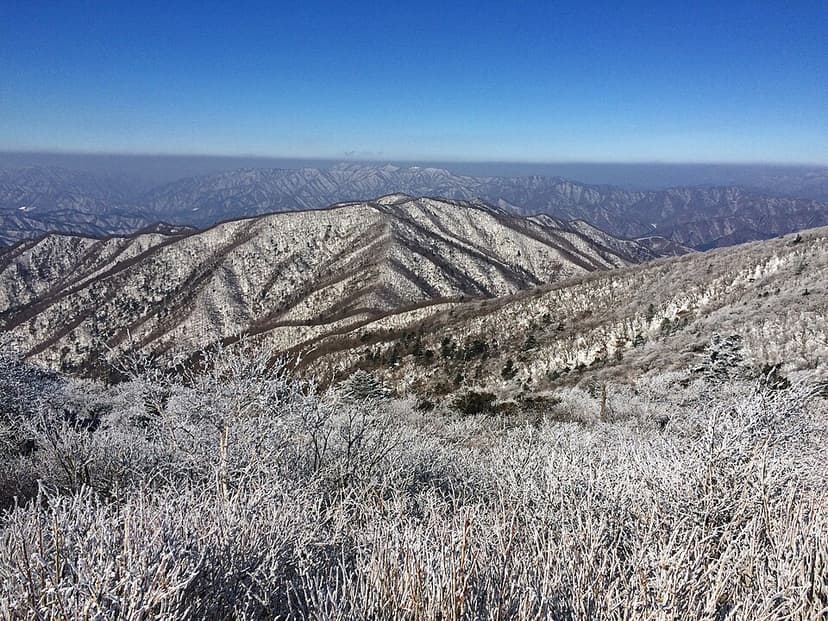
Odaesan
Odaesan is a significant mountain cluster and national park in eastern South Korea, renowned for its connection to Korean Buddhism and its stunning natural landscapes. Named "Five Platforms Mountains" due to its five main peaks, it is considered a sacred site where the five most important cosmic Buddhas of Mahayana Buddhism are believed to teach.

Taebaeksan
Taebaeksan is a significant South Korean mountain located in the Taebaek mountain range, notable for its role in the Baekdu-daegan mountain range where it turns westward. Designated as South Korea's 22nd national park, it holds deep spiritual and cultural importance, featuring ancient Shamanist altars and the historic Manggyeongsa Temple.