
Ynys Lannog
Christian·Wales·Ruins/Nature Reserve·6th century
Ynys Lannog, also known as Puffin Island, is an uninhabited island off Anglesey, Wales. It was historically a site of religious significance, with a hermitage established around the 6th century and the remains of a 12th-century monastery. Today, it is recognized as a Special Protection Area for its abundant wildlife, particularly its large cormorant colony and historically significant puffin population.
Key Facts
- ›A hermitage was established on the island around the 6th century.
- ›Remains of a 12th-century monastery, including a listed church, are present.
- ›The island is a Special Protection Area (SPA) for its significant bird colonies.
- ›It hosts one of the largest great cormorant colonies in the British Isles.
- ›Historically, it was a breeding ground for up to 2000 pairs of Atlantic puffins.

Ecclesiastical
Remains of A 12th-Century Church, Central Tower and Nave Foundations, Special Protection Area For Wildlife, Large Great Cormorant Colony, Disused Telegraph Station
Puffin Island, Priestholm, Ynys Seiriol, Ynys Glannog
Saint Seiriol, Owain Ddantgwyn, Saint Einion Frenin, King Cadwallon Ap Cadfan, Gerald of Wales, Llywelyn the Great
Establishment of A Hermitage, Shelter For King Cadwallon Ap Cadfan, Mentioned By Gerald of Wales, Confirming Charters By Llywelyn the Great, Shipwreck of the Pioneer, Rat Poisoning Program Initiated
About Ynys Lannog
Ynys Lannog, more commonly known in modern English as Puffin Island, is a small, uninhabited island situated off the eastern extremity of Anglesey, Wales. Historically, it bore the English name Priestholm and Welsh names such as Ynys Glannog, with its current Welsh designation being Ynys Seiriol, referring to Saint Seiriol. The island holds a significant place in early Welsh religious history, marked by the establishment of a hermitage around the 6th century, attributed to Saint Seiriol himself. Later, the island became the site of a monastery, with remains of a 12th-century church still visible today.
Geography and Natural History
Geographically, Ynys Lannog is the ninth-largest island off the Welsh coast and marks the northeastern boundary of the Menai Strait. Its highest point reaches 192 feet (59 meters) above sea level, characterized by steep cliffs on all sides. The island spans an area of approximately 69 acres (0.28 km2) and is privately owned by the Baron Hill estate. In contemporary times, Ynys Lannog is recognized as a Special Protection Area (SPA) due to its rich and diverse wildlife. It is particularly noted for its large colony of great cormorants, representing over 10% of the national population, making it one of the most significant colonies in the British Isles. The island also provides nesting grounds for guillemot, razorbill, shag, and kittiwake. Historically, it was a major breeding site for Atlantic puffins, although their numbers were severely impacted by the introduction of brown rats. A conservation program initiated in the late 1990s appears to have successfully eradicated the rats, leading to a resurgence in the puffin population. The surrounding strong currents support abundant marine life, attracting grey seals and regular visits from bottlenose dolphins and harbour porpoises.
Historical and Ecclesiastical Significance
The island's religious heritage is deeply connected to Saint Seiriol, son of the 5th-century ruler Owain Ddantgwyn. Saint Seiriol, after governing an ecclesiastical settlement at Penmon, chose to establish a hermitage on Ynys Lannog in his later years, and his remains are believed to be interred there. The island also served as a refuge; King Cadwallon ap Cadfan of Gwynedd is recorded as having sought shelter there around 630 AD during an invasion. By the late 12th century, a monastery was active on the island, famously described by Gerald of Wales, who recounted a tale of a plague of mice devouring the monks' food during times of internal strife. The monastery's importance is further evidenced by two charters issued by Llywelyn the Great in 1221 and 1237, which confirmed the rights of the Canons Regular to the island along with the church and manor of Penmon on the mainland. The ecclesiastical ruins on the island include the remains of a 12th-century church, which has been granted a Grade I heritage listing. While the central tower and nave foundations are visible, sections of the chancel and south transept are now obscured by a 19th-century cottage. Much later, a disused telegraph station was constructed on the island's northeastern tip, and a shipwreck, the steamship The Pioneer, is identified as having run aground offshore in 1878.
Source: Wikipedia ↗
Frequently Asked Questions
What is Ynys Lannog known by in English?
Ynys Lannog is also known as Puffin Island in modern English. It was formerly referred to as Priestholm.
Who founded the hermitage on Ynys Lannog?
The hermitage was established by Saint Seiriol, who was the son of Owain Ddantgwyn, a 5th-century ruler of Gwynedd. Saint Seiriol abandoned his responsibilities at Penmon to establish this hermitage.
What historical figures are associated with Ynys Lannog?
Saint Seiriol, a 5th or 6th-century figure, founded a hermitage there. King Cadwallon ap Cadfan of Gwynedd is said to have sheltered on the island around 630.
What is the historical significance of the monastery on Ynys Lannog?
A monastery existed on the island in the late 12th century and was documented by Gerald of Wales. Charters from Llywelyn the Great in the 1220s and 1230s confirmed the Canons Regular's possession of the island and associated mainland properties.
What is the current status of the island?
The island is uninhabited and privately owned by the Baron Hill estate. It is now primarily recognized as a Special Protection Area for its wildlife and has disused remains of a later telegraph station.
What wildlife can be found on Ynys Lannog?
The island is a Special Protection Area, notable for its large great cormorant colony, guillemot, razorbill, shag, and kittiwake. It also supports grey seals and is visited by bottlenose dolphins and harbour porpoises.
Related Monasteries

Bangor Monastery
Bangor Cathedral, dedicated to its founder Saint Deiniol, stands on a site of Christian worship since the sixth century. Originally established as St Deiniol's Monastery, it has a long and tumultuous history marked by destruction and rebuilding, evolving from its Norman origins to its current Gothic Revival appearance. The cathedral is a significant religious and historical landmark in Gwynedd, Wales, known for its architectural evolution and notable features.
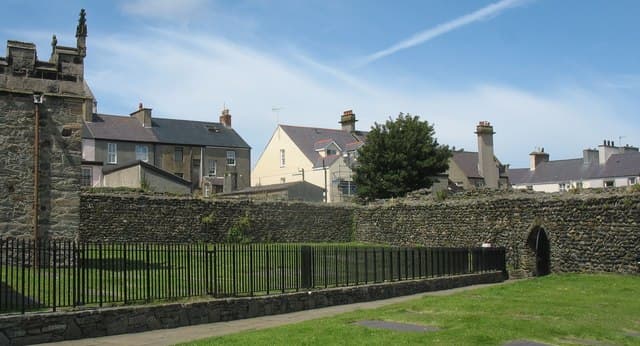
Caergybi Monastery
Caergybi Monastery, also known as the Church of St Cybi, is a historical religious site in Holyhead, Wales, with origins tracing back to a Roman fortlet. It was refounded as a monastery in the 6th century by Saint Cybi, and the church on the site today preserves elements of its long history, including its Roman foundations and a chapel reputedly over the saint's grave.

Llancarfan Monastery
Llancarfan Monastery was a significant 6th-century clas, a center of learning in the Vale of Glamorgan, Wales, founded by Saint Cadoc. It was renowned for its educational offerings, attracting many holy men who studied and taught there. Although the original monastic structures are not extant, the site is marked by its parish church, which still contains medieval wall paintings.