
Caergybi Monastery
Christian·Wales·Active religious site with historical elements·6th century
Caergybi Monastery, also known as the Church of St Cybi, is a historical religious site in Holyhead, Wales, with origins tracing back to a Roman fortlet. It was refounded as a monastery in the 6th century by Saint Cybi, and the church on the site today preserves elements of its long history, including its Roman foundations and a chapel reputedly over the saint's grave.
Key Facts
- ›Originally a 3rd or 4th-century Roman fortlet and naval base.
- ›Refounded as a monastery in the 6th century by Saint Cybi.
- ›The Church of St Cybi, dating from this period, still stands on the site.
- ›Features a chapel, Eglwys y Bedd, believed to be over Saint Cybi's grave.
- ›The Roman fort had three defensive walls with circular watch towers.

Roman, Medieval
Church of St Cybi, Eglwys Y Bedd, Remnants of Roman Fort Walls, Remnants of Roman Watch Towers
Church of St Cybi
Saint Cybi, King Maelgwn Gwynedd
- Roman Fortlet Construction
- Possible Abandonment Around 393 Ad
- Refounding As A Monastery By Saint Cybi In the 6th Century
About Caergybi Monastery
Caergybi Monastery, often identified with the Church of St Cybi, is a historically significant religious site located in the heart of Holyhead on the Isle of Anglesey, Wales. Its origins are deeply rooted in Roman history, as it was initially established as a small fortlet and naval base by the Romans between the late 3rd and early 4th centuries. This Roman structure served as an outpost likely intended to defend the coast against Irish sea-raiders.
History and Refounding
The Roman fortlet, characterized by its substantial defensive walls and watch towers, is believed to have been abandoned around 393 AD. However, the site's religious significance began to flourish in the 6th century when King Maelgwn Gwynedd granted the old fort to Saint Cybi. Saint Cybi subsequently founded a monastery here, transforming the military outpost into a center of Christian worship and learning.
Architectural Legacy and Features
Today, the Church of St Cybi stands on the original site, preserving elements of its layered history. The architectural remnants of the Roman fort include sections of its thick, herringbone-patterned walls and the bases of its circular watch towers. A notable feature within the monastery complex is the small detached chapel known as Eglwys y Bedd, which is traditionally said to stand directly over the burial place of Saint Cybi himself, underscoring the site's enduring spiritual importance.
Source: Wikipedia ↗
Frequently Asked Questions
When was Caergybi Monastery founded?
The Roman fortlet that predates the monastery is believed to have been built between the late 3rd or early 4th century. The monastery itself was founded in the 6th century by Saint Cybi.
What is the historical significance of Caergybi Monastery?
Caergybi Monastery is significant as a site that transitioned from a Roman military base to a monastic foundation. It is intrinsically linked to Saint Cybi, a prominent figure in early Welsh Christianity.
What remains of the original Roman fort at the site?
Remnants of the Roman fort's defensive walls, which are 4 meters high and 1.5 meters thick, are still visible. Sections of the corner watch towers, particularly the north-east tower, can also be seen.
Is there a specific chapel associated with Saint Cybi?
Yes, the Church of St Cybi includes a small detached chapel called Eglwys y Bedd. This chapel is reputedly built over the grave of Saint Cybi himself.
Related Monasteries

Bangor Monastery
Bangor Cathedral, dedicated to its founder Saint Deiniol, stands on a site of Christian worship since the sixth century. Originally established as St Deiniol's Monastery, it has a long and tumultuous history marked by destruction and rebuilding, evolving from its Norman origins to its current Gothic Revival appearance. The cathedral is a significant religious and historical landmark in Gwynedd, Wales, known for its architectural evolution and notable features.

Llancarfan Monastery
Llancarfan Monastery was a significant 6th-century clas, a center of learning in the Vale of Glamorgan, Wales, founded by Saint Cadoc. It was renowned for its educational offerings, attracting many holy men who studied and taught there. Although the original monastic structures are not extant, the site is marked by its parish church, which still contains medieval wall paintings.
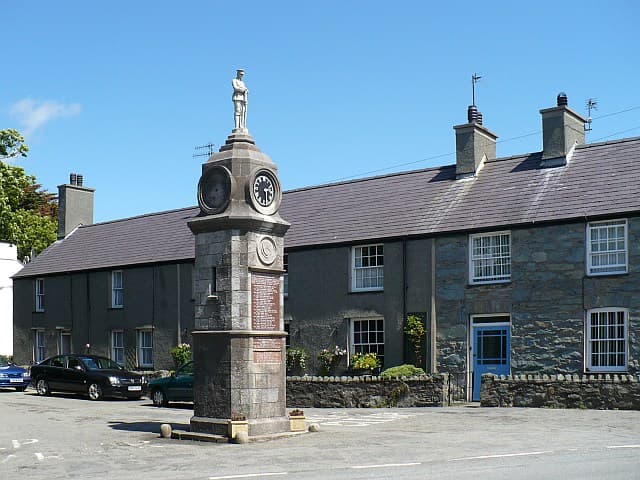
Llanfechell Clas
Llanfechell Clas was a monastic foundation attributed to Saint Mechell, a 6th-century missionary, in what is now Anglesey, Wales. Historical accounts suggest the monastery's land was demarcated by the flight of a hare, a detail found in a 17th-century manuscript. While the monastic community itself is no longer active, the village of Llanfechell retains its name and has a significant historical presence, including St. Mechell's Church with 12th-century elements.