
Yarchen Gar
Tibetan Buddhism·China·Partially demolished, community significantly impacted
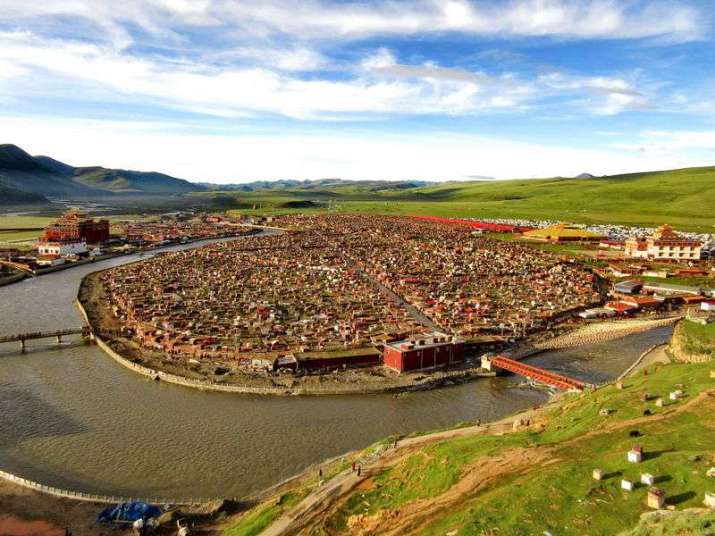
Yarchen Gar, officially "Yaqên Orgyän Temple", is a significant Tibetan Buddhist monastery of the Nyingma school located in western Sichuan, China. It was renowned for its large community, particularly its nuns, earning it the nickname "City of Nuns", and served as a center for preserving Tibetan Buddhist culture. However, the monastery has faced extensive demolitions and forced evictions by Chinese authorities, impacting its residential capacity and the lives of its practitioners.
Key Facts
- ›Established as a Nyingma school Tibetan Buddhist monastery.
- ›Located in an isolated valley of Pelyul County, Garzê Tibetan Autonomous Prefecture, Sichuan, China.
- ›At its peak, it housed an estimated 10,000 nuns, monks, and lay practitioners.
- ›Known for its large population of nuns, referred to as the 'City of Nuns'.
- ›Practitioners are known for the Tummo practice during winter retreats.
- ›Experienced significant demolitions and forced evictions by Chinese authorities starting in 2001.
Residential Community of Nuns, Tummo Practice In Winter, Preservation of Tibetan Buddhist Culture
YaqêN OrgyäN Temple, YaqêN OrgyäN Samden Ling, 亚青寺
- Demolitions and Forced Evictions By Chinese Authorities Beginning In 2001
- Significant Demolitions and Evictions In August 2017
- Closure To Foreigners In April 2019
- Forced Removals of 7,000 Residents and Demolition of 3,000 Nuns' Residences In May-July 2019
- Condemnation of Demolitions By Un Human Rights Experts In 2017
- U.S. Department of State Concern Expressed In 2018
About Yarchen Gar
Yarchen Gar, officially designated "Yaqên Orgyän Temple" (Tibetan: ཡ་ཆེན་ཨོ་རྒྱན་བསམ་གདན་གླིང་།, THL: Yachen Orgyen Samden Ling), is a Tibetan Buddhist monastery belonging to the Nyingma school, situated in an isolated valley in Pelyul County, western Sichuan, China. At its zenith, it was considered the largest monastic concentration globally, with an estimated 10,000 nuns, monks, and lay practitioners. The monastery was established with the aim of preserving Tibetan Buddhist culture, particularly in the wake of the Cultural Revolution. It gained particular recognition for its substantial nun community, leading to its common appellation as the "City of Nuns," and for the practitioners' dedication to the rigorous Tummo practice during winter retreats held in individual cabins on the hillsides.
History and Demolitions
The monastery's growth and the expanding influence of Tibetan Buddhism led to it being perceived as a threat by Chinese authorities seeking to "sinicize religions." Consequently, Yarchen Gar has been subjected to extensive demolitions and forced evictions. These actions began as early as 2001 with the demolition of residences. A significant escalation occurred in August 2017, when approximately 2,000 residences were torn down, leading to the eviction of a similar number of monks and nuns. The monastery has also faced periodic closures to foreigners. In May 2019, forced removals affected around 7,000 residents, and by July of that year, at least 3,000 nuns' residences were demolished. It is believed that these cleared areas were intended for tourist infrastructure. The evicted residents were often detained in political re-education centers, subjected to patriotic exercises, and there have been disturbing reports of sexual violence against nuns and torture of both sexes.
International Response
The actions taken against Yarchen Gar and similar monastic institutions, such as Larung Gar, have drawn international criticism. In 2017, six United Nations human rights experts jointly condemned China's demolitions and evictions. The U.S. Department of State also voiced its concern regarding the ongoing destruction at Yarchen Gar and Larung Gar in 2018.
Source: Wikipedia ↗
Frequently Asked Questions
Where is Yarchen Gar located?
Yarchen Gar is situated in an isolated valley of Pelyul County, within the Garzê Tibetan Autonomous Prefecture in western Sichuan, China. It lies approximately 400 kilometers west of Chengdu.
What is Yarchen Gar known for?
Yarchen Gar is known for its large Tibetan Buddhist community, particularly its significant population of nuns, which led to it being called the 'City of Nuns'. It was also a major center for preserving Tibetan Buddhist culture and practicing traditions like Tummo.
What is the current status of Yarchen Gar?
The monastery has faced extensive demolitions and forced evictions by Chinese authorities. By the end of 2019, more than half of its residences had been demolished, and many practitioners were forcibly removed and subjected to re-education programs.
When did the demolitions at Yarchen Gar begin?
Evictions and demolitions at Yarchen Gar began in 2001 due to concerns over the expanding influence of Tibetan Buddhism. Further significant demolitions occurred in August 2017 and again in 2019, impacting thousands of residences.
What happened to the residents after they were evicted?
Evicted monks and nuns were reportedly detained in political re-education centers. There have been reports of forced participation in patriotic exercises, sexual violence against nuns, and torture of practitioners.
Related Monasteries

Badekar Monastery
Badekar Monastery, also known as Udin Ju or Wudang Zhao, is a significant Tibetan Buddhist monastery of the Gelug sect and the largest of its kind in Inner Mongolia. Constructed in line with Tashi Lhunpo Monastery's design, it features no Han-style architecture and is built horizontally along the mountain. Designated a Major Historical and Cultural Site Protected at the National Level in 1996, it has also been developed as a major tourist destination and was part of a national park declared in 2001.

Dorje Drak
Dorje Drak, also known as Indestructible Rock Vihara, is a significant Tibetan Buddhist monastery of the Nyingma school, recognized as one of its 'Six Mother Monasteries' in Tibet. Originally founded as Ewam Chogar Gompa, it was enlarged and renamed Dorje Drak following the discovery of auspicious natural signs. The monastery has a history marked by destruction and rebuilding, most notably its relocation in 1632 and subsequent destruction during the 1960s, leading to a new foundation in India.

Drongtse Monastery
Drongtse Monastery was a significant Gelug Tibetan Buddhist monastery located in Tsang, Tibet, historically situated northwest of Gyantse. Though severely damaged during the Cultural Revolution, it has seen partial restoration, with its Assembly Hall rebuilt in the 1980s, although many main structures remain in ruins. The monastery was notable for its congregation hall containing old gilt images and historical depictions, and it was associated with prominent figures in Tibetan Buddhism.