
Ukraine
Ukraine is a country in Eastern Europe with a rich and complex history, marked by periods of statehood, foreign domination, and conflict. It emerged as a key center of East Slavic culture under Kievan Rus' in the 9th century, later experiencing fragmentation and rule by various powers. The modern Ukrainian nation developed through movements like the Cossack Hetmanate and faced significant challenges in the 20th century, including Soviet rule and the Holodomor, before regaining independence in 1991. Currently, Ukraine is engaged in a war with Russia, which began with the annexation of Crimea in 2014 and escalated with a full-scale invasion in 2022.
Key Facts
- ›Ukraine is the second-largest country in Europe by area.
- ›It was the site of early Slavic expansion and the powerful state of Kievan Rus' in the Middle Ages.
- ›The country gained independence in 1991 after the dissolution of the Soviet Union.
- ›Ukraine is a major exporter of grain, though production has been impacted by the ongoing war.
- ›It is a founding member of the United Nations and is in the process of joining the European Union.
- ›The name 'Ukraine' is often interpreted as 'borderland'.

Extensive Fertile Land, Significant Grain Exporter, Large Military Force, Diverse Drone Fleets
the Ukraine
Oleg, Vladimir the Great, Yaroslav the Wise, Vladimir Ii Monomakh, Mstislav, Daniel of Galicia, Haci I Giray, Bohdan Khmelnytsky, Ivan Mazepa, Catherine the Great, Taras Shevchenko, Mykhailo Drahomanov, Mykhailo Hrushevsky, Pavlo Skoropadskyi, JóZef PiłSudski, Mykola Skrypnyk, Vladimir Lenin, Joseph Stalin
- Emergence of Kievan Rus'
- Mongol Invasions
- Union of Lublin
- Cossack Uprisings
- Pereiaslav Agreement
- the Ruin
- Treaty of Perpetual Peace
- Great Northern War
- Abolition of the Cossack Hetmanate
- Annexation of Crimea By Russia
- Rise of Ukrainian Nationalism
- World War I and Ukrainian War of Independence
- Formation of Ukrainian People's Republic
- Establishment of Ukrainian Soviet Socialist Republic
- Holodomor
- World War Ii Occupation
- Independence From the Soviet Union
- Orange Revolution
- Euromaidan Revolution
- War In Donbas
- 2022 Russian Invasion of Ukraine
About Ukraine
Ukraine is a sovereign state located in Eastern Europe, distinguished by its significant historical depth, cultural resilience, and strategic geographical position. It is the second-largest country on the continent by area, sharing borders with Russia, Belarus, Poland, Slovakia, Hungary, Romania, and Moldova, and is bordered by the Black Sea and the Sea of Azov.
Early History and Kievan Rus'
Human habitation in the territory of modern Ukraine dates back at least to 32,000 BC, with evidence of early cultures such as the Cucuteni–Trypillia culture flourishing by 4,500 BC. During the Middle Ages, Ukraine became a crucial center for East Slavic expansion and culture under the state of Kievan Rus', which emerged in the 9th century. Kievan Rus' reached its zenith in the 10th and 11th centuries, becoming a dominant power in Europe, before gradually disintegrating under internal pressures and external invasions, notably by the Mongols in the 13th century.
Periods of Foreign Rule and National Awakening
For the subsequent six centuries, the lands of Ukraine were a contested territory, ruled by a succession of external powers including the Grand Duchy of Lithuania, the Kingdom of Poland, the Polish–Lithuanian Commonwealth, the Austrian Empire, the Ottoman Empire, and the Tsardom of Russia. In the 17th century, the Cossack Hetmanate emerged as a quasi-state, carving out a degree of autonomy. However, internal conflicts and external pressures, particularly from Russia and Poland, led to its eventual absorption into the Russian Empire by the 18th century. The 19th century witnessed the rise of Ukrainian nationalism, fueled by intellectuals and cultural figures like Taras Shevchenko, despite significant restrictions imposed by the Russian Empire.
20th Century Turmoil and Independence
Ukraine experienced immense upheaval in the 20th century. Following the Russian Revolution of 1917, a short-lived Ukrainian People's Republic was established, but control was consolidated by the Bolsheviks, leading to the formation of the Ukrainian Soviet Socialist Republic, which became part of the Soviet Union in 1922. This period was marked by immense suffering, including the man-made famine known as the Holodomor in the early 1930s, and devastation during World War II. Ukraine finally regained its independence in 1991 with the dissolution of the Soviet Union. The post-independence era has been characterized by political reforms, challenges with corruption, and, more recently, an ongoing war initiated by Russia, beginning with the annexation of Crimea in 2014 and escalating into a full-scale invasion in 2022.
Modern Ukraine
As a unitary state with a semi-presidential republic system, Ukraine is navigating a transition economy and plays a vital role in global food security as a major grain exporter. The country is actively pursuing integration with Western institutions, being a founding member of the United Nations and in the process of joining the European Union. Its military is a significant force, and it is a member of various international organizations, including the Council of Europe and the World Trade Organisation.
Source: Wikipedia ↗
Frequently Asked Questions
What is the origin of the name 'Ukraine'?
The name 'Ukraine' is frequently interpreted as deriving from the old Slavic term 'borderland,' similar to the word 'krajina.' Another interpretation suggests that 'Ukraine' means 'region' or 'country.' Historically, in the English-speaking world, it was often referred to as 'the Ukraine,' but this usage has become politicized and is now generally avoided.
When did Ukraine become an independent country?
Ukraine gained its independence in 1991, following the collapse of the Soviet Union. This marked a significant turning point after centuries of foreign rule and a period as a Soviet Socialist Republic.
What was Kievan Rus'?
Kievan Rus' was a powerful state that emerged in the 9th century, encompassing much of present-day Ukraine, Belarus, and western European Russia. It became the largest and most powerful realm in Europe during the 10th and 11th centuries, representing a golden age of East Slavic culture.
What major historical events shaped modern Ukraine?
Key events include the rise and fall of Kievan Rus', periods of foreign domination by powers like Poland and Russia, the formation of the Cossack Hetmanate, the devastating Holodomor in the 1930s, occupation during World War II, and the struggle for independence leading to the events of 2014 and the ongoing war since 2022.
What is Ukraine's current geopolitical situation?
Ukraine is currently engaged in a war following the 2022 Russian invasion, which escalated from the annexation of Crimea in 2014 and the conflict in Donbas. The country is seeking closer ties with the West and is in the process of joining the European Union.
Related Monasteries
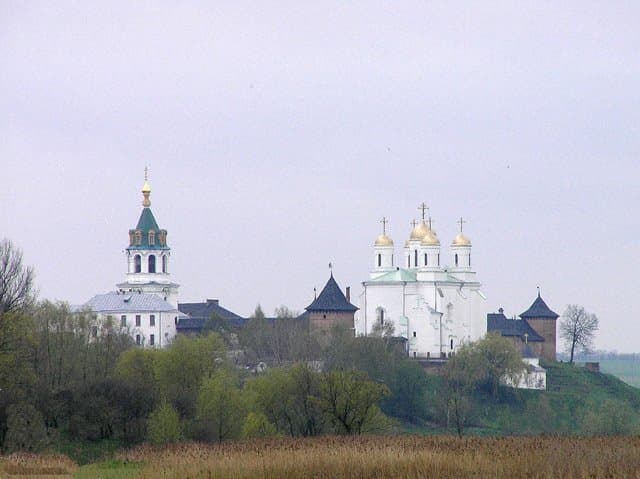
Assumption Cave Monastery
The Assumption Cave Monastery, also known as Sviatohirskyi Uspenskyi Zymnenskyi monastyr, is a significant Ukrainian Orthodox cave monastery located near the village of Zymne. Its origins are attributed to monastic legend, with some accounts suggesting a connection to Vladimir the Great. The monastery has a long and complex history, marked by periods of control by different religious authorities, dissolution, and re-establishment, eventually regaining its status as a stauropegial institution in 1996.

Bakhchysarai Cave Monastery
The Bakhchysarai Cave Monastery, also known as the Dormition Monastery of the Caves, is a significant Eastern Orthodox monastic site carved into cliffs near Bakhchysarai, Crimea. While local tradition suggests an 8th-century founding, the current monastic establishment dates to the 15th century, refounded by monks from Kyiv-Pechersk Lavra. It served as a vital center for Orthodox Christians, particularly those seeking refuge, before periods of decline and closure under Soviet rule, eventually reopening in 1993.
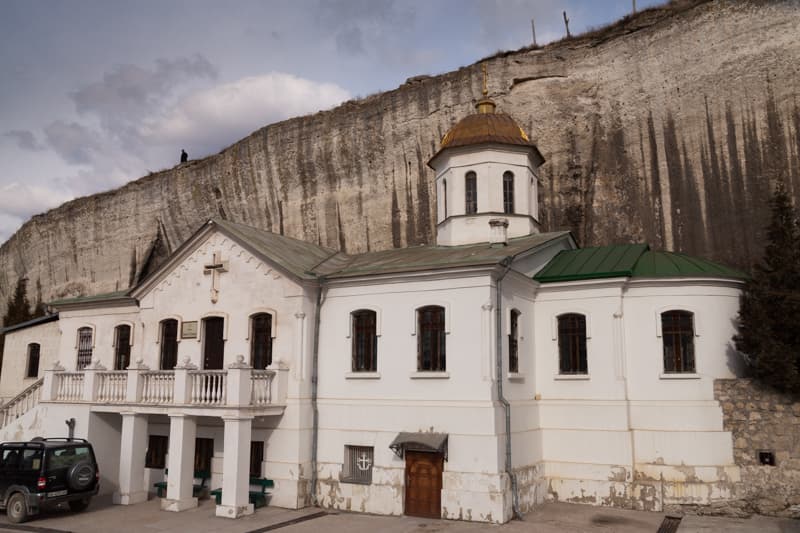
Inkerman Cave Monastery
The Inkerman Monastery of St. Clement is a cave monastery situated in a cliff near the Black River in Inkerman, Crimea. Founded in 1850, it stands on the site of a medieval Byzantine monastery believed to have housed the relics of St. Clement. The monastery has a complex history, including periods of damage, closure, and recent resumption of services.