
Inkerman Cave Monastery
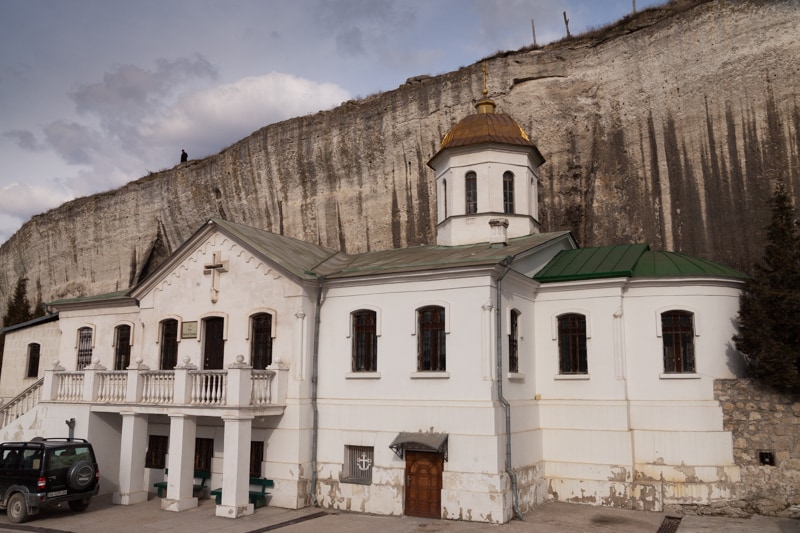
The Inkerman Monastery of St. Clement is a cave monastery situated in a cliff near the Black River in Inkerman, Crimea. Founded in 1850, it stands on the site of a medieval Byzantine monastery believed to have housed the relics of St. Clement. The monastery has a complex history, including periods of damage, closure, and recent resumption of services.
Key Facts
- ›Founded in 1850 on the site of a medieval Byzantine monastery.
- ›Believed to have been a repository for the relics of St. Clement before their removal.
- ›The medieval monastery may have been founded in the 8th century by icon-venerators.
- ›Suffered damage from the 1927 Crimean earthquakes and was closed from 1931 to 1991.
- ›Weekly services resumed in 2019 in the Church of Clement of Rome.
- ›The caves previously housed Soviet army officers during World War II.
Cave Architecture, Byzantine
Cave Dwellings and Chapels, Site of Presumed Relics of St. Clement
- Inkerman Monastery of St. Clement
- Inkermanskiy Svyato-Klimentovskiy Peshchernyy Monastyr'
- Inkermanskyi Pechernyi Monastyr
St. Clement, Saints Cyril and Methodius, William Rubruck, Peter Simon Pallas, Archimandrite Kallinik
- Removal of St. Clement's Relics
- British Looting In the 1850s
- Commemoration of the Borki Incident
- Commemoration of the Crimean War
- 1927 Crimean Earthquakes
- Closure Between 1931 and 1991
- Housing Soviet Army Officers During World War Ii
About Inkerman Cave Monastery
Inkerman Monastery of St. Clement
The Inkerman Monastery of St. Clement is a significant cave monastery located in Inkerman, Crimea, near the mouth of the Black River. The current monastery was founded in 1850, but it occupies the site of a much older medieval Byzantine monastery. This ancient site is traditionally believed to have once housed the relics of Saint Clement of Rome before their removal by Saints Cyril and Methodius. The early Christian community is thought to have kept these relics in a grotto accessible only on the anniversary of the saint's death.
History and Significance
The Byzantine monastery, believed to have been established in the 8th century, served as a sanctuary for icon-venerators fleeing persecution. Historical accounts suggest it comprised multiple storeys with eight chapels and an adjacent inn, all accessed by a stairway. The Inkerman caves were surveyed by Peter Simon Pallas in 1793, but the site also suffered looting by the British in the 1850s. The Russians later added two churches to commemorate the Borki Incident and the Crimean War.
The monastery endured further hardship in the 20th century, sustaining damage from the 1927 Crimean earthquakes. It was subsequently closed between 1931 and 1991. During World War II, the extensive cave system provided shelter for officers of the Soviet army defending Sevastopol, and several churches were dismantled by Soviet authorities. In recent times, the monastery has seen a revival, with weekly services resuming in the Church of Clement of Rome in 2019 under the auspices of the Russian Orthodox Church.
Source: Wikipedia ↗
Frequently Asked Questions
When was the Inkerman Monastery of St. Clement founded?
The current monastery was founded in 1850. However, it was established on the site of an older medieval Byzantine monastery.
What is the historical significance of the Inkerman Monastery?
It is significant as it is believed to be built on the location where the relics of St. Clement were once kept. The older Byzantine monastery was likely a refuge for icon-venerators fleeing persecution.
What happened to the monastery during the 20th century?
The monastery was damaged by earthquakes in 1927 and subsequently closed between 1931 and 1991. During World War II, its caves were used by officers of the defending Soviet army.
Is the Inkerman Monastery still operational?
Yes, weekly services were resumed in the Church of Clement of Rome in 2019, indicating a revival of its religious activities.
What is the origin of the medieval monastery at Inkerman?
The medieval Byzantine monastery was likely founded in the 8th century. It is thought to have been established by icon-venerators who were seeking refuge from persecution in their homeland.
Related Monasteries

Nativity of the Most Holy Mother of God Glinskaya Pustyn stauropegial Monastery
The Nativity of the Most Holy Mother of God Glinskaya Pustyn stauropegial Monastery, also known as the Glinsk Hermitage, was a significant spiritual center of the Russian Orthodox Church in the 19th and early 20th centuries. Founded in the 17th century near Putivl, it experienced periods of prosperity and severe suppression by the Soviet government before being reestablished in 1994. Many of its spiritual leaders have been canonized as saints, and it continues to operate under the Ukrainian Orthodox Church (Moscow Patriarchate).
Assumption Cave Monastery
The Assumption Cave Monastery, also known as Sviatohirskyi Uspenskyi Zymnenskyi monastyr, is a significant Ukrainian Orthodox cave monastery located near the village of Zymne. Its origins are attributed to monastic legend, with some accounts suggesting a connection to Vladimir the Great. The monastery has a long and complex history, marked by periods of control by different religious authorities, dissolution, and re-establishment, eventually regaining its status as a stauropegial institution in 1996.

Bakhchysarai Cave Monastery
The Bakhchysarai Cave Monastery, also known as the Dormition Monastery of the Caves, is a significant Eastern Orthodox monastic site carved into cliffs near Bakhchysarai, Crimea. While local tradition suggests an 8th-century founding, the current monastic establishment dates to the 15th century, refounded by monks from Kyiv-Pechersk Lavra. It served as a vital center for Orthodox Christians, particularly those seeking refuge, before periods of decline and closure under Soviet rule, eventually reopening in 1993.