
Assumption Cave Monastery
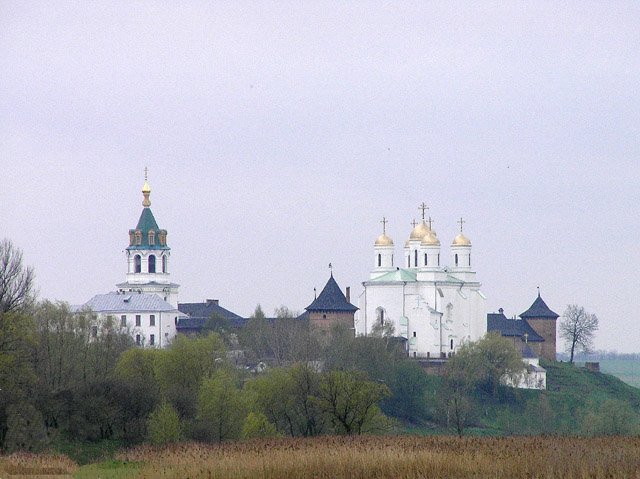
The Assumption Cave Monastery, also known as Sviatohirskyi Uspenskyi Zymnenskyi monastyr, is a significant Ukrainian Orthodox cave monastery located near the village of Zymne. Its origins are attributed to monastic legend, with some accounts suggesting a connection to Vladimir the Great. The monastery has a long and complex history, marked by periods of control by different religious authorities, dissolution, and re-establishment, eventually regaining its status as a stauropegial institution in 1996.
Key Facts
- ›Located on the Holy Mountain rising above the Luha River near Zymne, Ukraine.
- ›First mentioned in documents in 1458, with historical ties to the Greek Orthodox Church and later the Uniate Church.
- ›Features defensive walls and towers constructed in the 15th and 16th centuries.
- ›The Assumption Katholikon, completed in 1495, shows Gothic influence and has undergone numerous renovations.
- ›Includes the miniature Trinity Church, built between 1465–75, and a 16th-century refectory with a church dedicated to Saint Juliana.
- ›Contains a cave complex with a church consecrated to Saint Barlaam, representing the earliest monastic habitations.
Gothic, Russian Revival, Neo-Muscovite
- Defensive Walls and Towers
- Assumption Katholikon
- Trinity Church
- 16th-Century Refectory With Saint Juliana's Church
- Cave Complex With Saint Barlaam's Church
- Donated Bells, One On Exhibit
Sviatohirskyi Uspenskyi Zymnenskyi Monastyr
Vladimir the Great, Prince Fyodor Chartoryisky
- First Mentioned In Documents
- Joined the Uniate Church
- Revived As A Ukrainian Orthodox Parish Church
- Re-Established As A Ukrainian Orthodox Nunnery
- Dissolved By Soviets
- Revived During German Occupation
- Reduced To Parish Church
- Reopened
- Given Stauropegic Status
- Damaged During World War I
- Repaired
- Roofing Destroyed During World War Ii
About Assumption Cave Monastery
The Assumption Cave Monastery, officially known as the Sviatohirskyi Uspenskyi Zymnenskyi monastyr, is a significant stauropegial Ukrainian Orthodox cave monastery situated atop the Holy Mountain overlooking the Luha River near the village of Zymne, in Ukraine's Volyn Oblast. Its historical roots are partially shrouded in legend, with oral traditions suggesting its foundation by Vladimir the Great and potential links to early figures of Kievan Rus'. The monastery's documented history begins in 1458, and it has experienced a complex evolution, shifting between Orthodox and Uniate affiliations and undergoing periods of dissolution and revival.
History and Development
Initially under the control of the Greek Orthodox Church, the monastery joined the Uniate Church in 1698, though its community later ceased to exist. The site was revived in 1857 as a Ukrainian Orthodox parish church and formally re-established as a Ukrainian Orthodox nunnery in 1893. The monastery's existence was disrupted by Soviet annexation in 1939, but it was revived during the German occupation. Following World War II, it was again reduced to a parish church until its full reopening in 1990 after the dissolution of the Soviet Union. In 1996, it was granted stauropegial status, signifying its direct subordination to the Patriarch.
Architecture and Features
The monastery complex is characterized by defensive walls and towers constructed in the 15th and 16th centuries, with later additions and modifications. The central Assumption Katholikon, completed in 1495, displays Gothic architectural influences from the period and has been subject to numerous renovations, adapting to prevailing styles and ideologies across centuries. Notable structures also include the miniature Trinity Church (1465–75), a stone replica of traditional wooden churches, and a 16th-century refectory housing a church dedicated to Saint Juliana, reputedly the oldest refectory church in the country. A significant feature is the cave system, believed to be the dwelling place of the earliest monks, which includes a cave church consecrated to Saint Barlaam.
Source: Wikipedia ↗
Frequently Asked Questions
What is the origin of the Assumption Cave Monastery?
The precise origin of the monastery is uncertain. However, monastic legend attributes its foundation to Vladimir the Great, who is said to have built churches and his winter palace there. Another claim suggests the first hegumen of the Kiev Pechersk Lavra died at the site in the 11th century.
When was the Assumption Cave Monastery first documented?
The monastery was first mentioned in written documents in the year 1458. This marks the earliest verifiable historical reference to its existence.
What architectural styles are present at the monastery?
The monastery's defensive walls and towers were built in the 15th and 16th centuries. The Assumption Katholikon, completed in 1495, exhibits Gothic influence, though it has been modernized and renovated in various styles throughout its history, including Russian Revival. The Trinity Church is a stone copy of traditional wooden churches of Volynia.
What significant historical events have affected the monastery?
The monastery was controlled by the Greek Orthodox Church until 1698, then joined the Uniate Church. It was dissolved and later revived multiple times, notably as a parish church in 1857, a nunnery in 1893, and reopened in 1990 after Soviet dissolution. It suffered damage during World War I and World War II.
Are there any notable cave structures at the monastery?
Yes, the monastery features a cave complex which is believed to have housed the earliest monks. These caves consist of two parallel corridors joined in the middle, with a cave church consecrated to Saint Barlaam.
Related Monasteries

Bakhchysarai Cave Monastery
The Bakhchysarai Cave Monastery, also known as the Dormition Monastery of the Caves, is a significant Eastern Orthodox monastic site carved into cliffs near Bakhchysarai, Crimea. While local tradition suggests an 8th-century founding, the current monastic establishment dates to the 15th century, refounded by monks from Kyiv-Pechersk Lavra. It served as a vital center for Orthodox Christians, particularly those seeking refuge, before periods of decline and closure under Soviet rule, eventually reopening in 1993.

Kyiv Pechersk Lavra
The Kyiv Pechersk Lavra, also known as the Kyiv Monastery of the Caves, is a historic Eastern Orthodox monastery that has served as a preeminent center of Eastern Christianity in Eastern Europe since its foundation in 1051. Renowned for its extensive cave systems and numerous architectural monuments, it has been a significant spiritual and cultural hub, facing periods of destruction and reconstruction throughout its history. Today, it is a UNESCO World Heritage Site and an active monastic community.

Nativity of the Most Holy Mother of God Glinskaya Pustyn stauropegial Monastery
The Nativity of the Most Holy Mother of God Glinskaya Pustyn stauropegial Monastery, also known as the Glinsk Hermitage, was a significant spiritual center of the Russian Orthodox Church in the 19th and early 20th centuries. Founded in the 17th century near Putivl, it experienced periods of prosperity and severe suppression by the Soviet government before being reestablished in 1994. Many of its spiritual leaders have been canonized as saints, and it continues to operate under the Ukrainian Orthodox Church (Moscow Patriarchate).