
Tintern Abbey (Tintern Parva)
Tintern Abbey was a Cistercian monastic establishment founded around 1200 on the Hook Peninsula in County Wexford, Ireland. It was established by William Marshal, Earl of Pembroke, following a vow made during a perilous sea voyage. The abbey was initially populated by monks from its Welsh namesake and played a role in religious life until its dissolution, after which its ownership changed hands multiple times. Today, Tintern Abbey exists primarily in ruins, with some sections undergoing restoration and conservation efforts.
Key Facts
- ›Founded around 1200 by William Marshal, Earl of Pembroke.
- ›Established as a result of a vow made by William Marshal during a storm at sea.
- ›Colonized by monks from Tintern Abbey in Monmouthshire, Wales.
- ›Once known as Tintern de Voto (Tintern of the vow) to distinguish it from its mother house.
- ›Became property of the Colclough family after the Dissolution of the Monasteries.
- ›Underwent significant conservation and heritage development work by the Irish state from the late 20th century onwards.

- Restored Sections of Ruins
- Site of Conservation Efforts For Local Bat Colonies
Tintern De Voto
William Marshal, Earl of Pembroke, Anthony Colclough, Lucey Marie Biddulph Colclough
Dissolution of the Monasteries
About Tintern Abbey (Tintern Parva)
Tintern Abbey, also known historically as Tintern de Voto, was a significant Cistercian monastic institution situated on the Hook Peninsula in County Wexford, Ireland. Its establishment in approximately 1200 is attributed to William Marshal, Earl of Pembroke, who vowed to found the abbey after experiencing a severe storm at sea nearby. This foundation was further solidified by the arrival of monks from the mother house in Wales, Tintern Abbey, of which Marshal was also a patron.
Following the Dissolution of the Monasteries, the abbey's ownership transitioned, eventually coming into the possession of the Colclough family. The descendants of Anthony Colclough, who acquired the property in 1575, were the last to reside at Tintern. After the departure of Lucey Marie Biddulph Colclough in 1959, the Irish state initiated crucial conservation and consolidation works on the site.
Modern efforts have focused on preserving the abbey's remains, which are today primarily in ruins but feature restored sections. Between 1982 and 2007, extensive excavation and heritage development were undertaken, including specific measures for the protection of local bat colonies. Further restoration activities have occurred, notably after a fire in 2012 that affected outbuildings on the grounds. Tintern Abbey remains an important archaeological and historical site, offering insights into monastic life and the subsequent history of the estate.
Source: Wikipedia ↗
Frequently Asked Questions
When was Tintern Abbey founded?
Tintern Abbey was founded around the year 1200. Church historian J. H. Bernard suggested a specific foundation date of December 3, 1200, based on an analysis in 1917.
Who founded Tintern Abbey?
The abbey was founded by William Marshal, Earl of Pembroke. His founding was the result of a vow he made when his boat was caught in a storm.
What religious order was Tintern Abbey part of?
Tintern Abbey was a Cistercian abbey. It was colonized by monks from the Cistercian abbey at Tintern in Monmouthshire, Wales.
What is the current state of Tintern Abbey?
Today, Tintern Abbey is largely in ruins, though some sections have been restored. Conservation and heritage development efforts have been undertaken by the Irish state.
What happened to Tintern Abbey after its dissolution?
Following the Dissolution of the Monasteries, the abbey and its grounds were granted to Sir James Croft and later to Anthony Colclough. The Colclough family descendants resided there until 1959, after which the Irish state began conservation works.
Related Monasteries
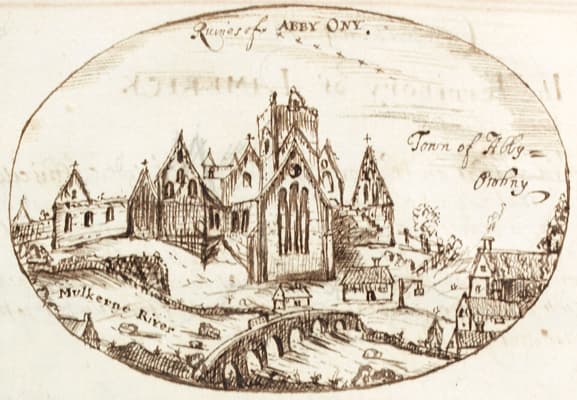
Abington Abbey
Abington Abbey, also known as the Cistercian Abbey of Woney, was founded in 1205 by Theobald Walter in County Limerick, Ireland. Situated on the banks of the Mulkear River, the abbey's charter granted extensive lands and judicial rights, establishing it as a significant religious and economic entity. Although the original buildings are now largely gone, traces of its architecture and layout can still be observed in the graveyard at Abington.
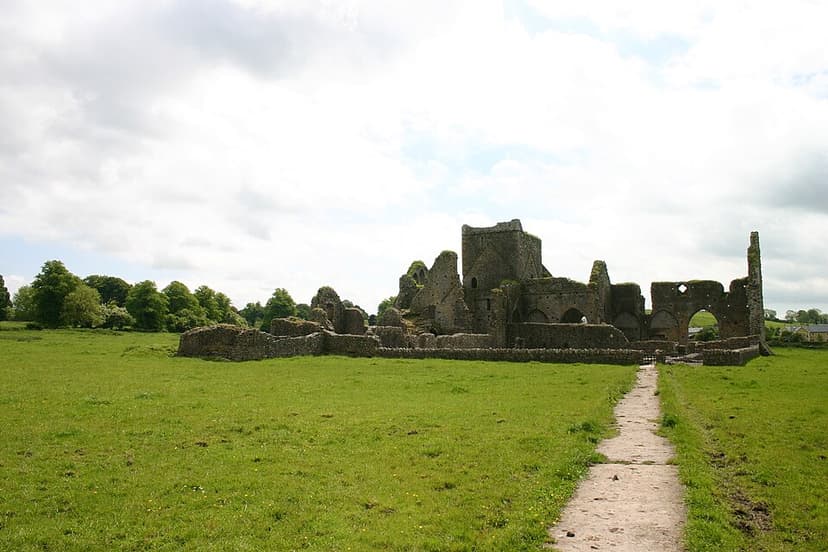
Hore Abbey
Hore Abbey, also known as St Mary's, is a ruined Cistercian monastery situated near the Rock of Cashel in County Tipperary, Ireland. Established in 1270 from Mellifont Abbey, it was the last Cistercian foundation in Ireland before the Dissolution of the Monasteries. Archbishop David Mac Cerbaill played a pivotal role in its founding, transferring it from Benedictine to Cistercian hands and later joining the order himself.

Abbey of Lerha
The Abbey of Lerha was a significant Cistercian monastery founded in 1205 by Risteárd de Tiúit. Although dissolved in 1539, its ruins remain visible and give the nearby village of Abbeylara its name. The monastery's historical presence is a defining characteristic of the region.